How OEM Hand Tool Manufacturers Ensure Product Quality and Consistency
- Why Quality Consistency Matters in OEM Hand Tool Manufacturing
- The 7 Quality Control Stages Used by OEM Hand Tool Manufacturers
- International Standards That Support Manufacturing Quality
- How Indian OEM Hand Tool Manufacturers Maintain Consistency Across Large Orders
- Questions Buyers Should Ask Before Selecting an OEM Hand Tool Manufacturer
- Conclusion
- FAQs
When sourcing hand tools for industrial, automotive, construction, or distribution businesses, product quality is only one part of the equation; consistency is equally important. A single batch that differs in hardness, dimensions, or finish can lead to customer complaints, production delays, and increased warranty costs.
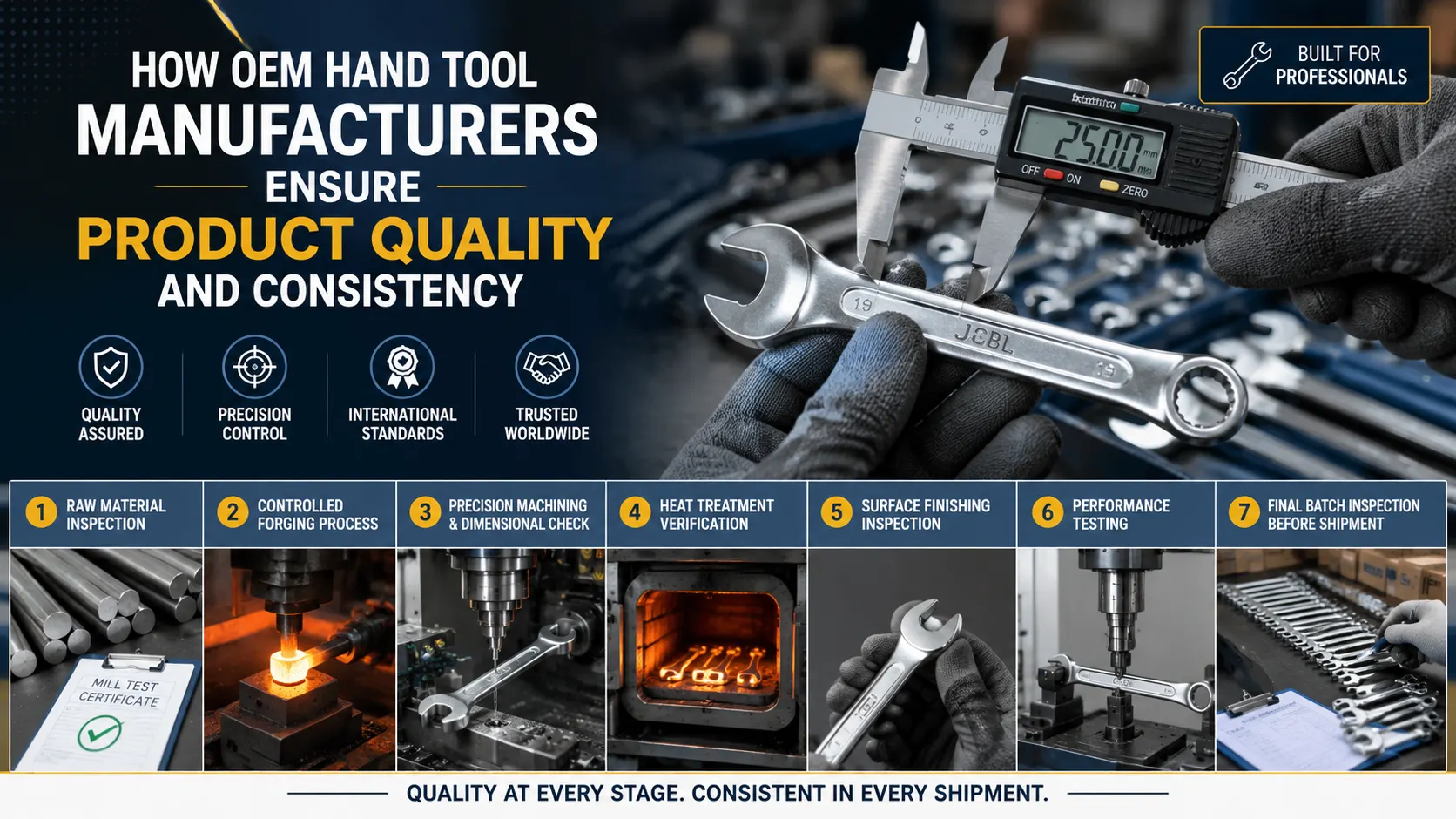
OEM hand tool manufacturers ensure product quality and consistency by implementing strict quality controls at every production stage. From raw material inspection and precision forging to heat treatment, dimensional testing, surface finishing, and final batch verification, each process is monitored to produce tools that meet customer specifications and international quality standards.
Why Quality Consistency Matters in OEM Hand Tool Manufacturing
For OEM buyers, consistency means every tool in every shipment performs the same way. Whether ordering 5,000 or 500,000 pieces, businesses expect identical dimensions, hardness, finish, and performance across production batches.
Reliable quality control helps manufacturers:
- Deliver uniform products across large production runs
- Reduce product returns and warranty claims
- Meet buyer specifications and export requirements
- Build long-term supplier relationships
- Support repeat orders with predictable manufacturing outcomes
This is particularly important for businesses importing hand tools from India, where global buyers expect consistent quality across recurring OEM orders.
The 7 Quality Control Stages Used by OEM Hand Tool Manufacturers
1. Raw Material Inspection
Quality begins before manufacturing starts. Reputable OEM manufacturers inspect incoming raw materials to verify they match the specifications required for each tool.
Typical inspections include the following:
- Verification of steel grade, such as Chrome Vanadium (Cr-V) or carbon steel
- Review of Mill Test Certificates (MTCs)
- Chemical composition verification where required
- Visual inspection for defects or contamination
Using verified raw materials helps ensure the finished tool achieves the required strength, durability, and service life.
2. Controlled Forging Process
Forging determines the structural integrity of many hand tools. During this stage, manufacturers carefully control forging temperature, pressure, and die quality to produce consistent tool shapes.
Quality checks typically focus on:
- Proper metal flow during forging
- Uniform tool dimensions
- Surface defect identification
- Die wear monitoring for dimensional accuracy
Controlled forging helps create stronger tools with improved mechanical properties while reducing production variation.
3. Precision Machining and Dimensional Inspection
After forging, tools undergo machining to achieve precise dimensions and functional accuracy.
Manufacturers use calibrated measuring equipment to inspect:
- Overall dimensions
- Jaw openings and profiles
- Hole diameters and thread specifications (where applicable)
- Critical tolerances
For products such as spanners and wrenches, dimensions are often verified against customer drawings or applicable standards such as DIN or ANSI, depending on buyer requirements.
4. Heat Treatment Verification
Heat treatment plays a critical role in determining a hand tool’s hardness, toughness, and durability.
To maintain consistency, manufacturers monitor the following:
- Hardening and tempering cycles
- Furnace temperature control
- Cooling processes
- Hardness testing using recognized testing methods
Proper heat treatment helps ensure tools are hard enough to withstand heavy use while retaining sufficient toughness to reduce the risk of cracking or premature failure.
5. Surface Finishing Inspection
Surface finishing protects tools against corrosion while improving their appearance.
Depending on product specifications, manufacturers may apply finishes such as the following:
- Nickel chrome plating
- Satin finish
- Mirror polish
- Phosphate coating
- Black oxide finish
Quality inspections verify the following:
- Uniform coating coverage
- Finish consistency
- Surface cleanliness
- Cosmetic appearance
Consistent finishing also supports brand presentation, especially for private-label OEM products.
6. Performance and Functional Testing
Before production is approved, manufacturers conduct performance tests to verify that tools function as intended.
Common quality tests include:
| Tool Type | Typical Quality Test |
| Spanners & Wrenches | Torque and load testing |
| Pliers | Cutting performance and grip testing |
| Adjustable Wrenches | Jaw alignment and adjustment testing |
| Sockets | Proof torque testing |
Testing procedures may vary depending on customer specifications, product application, and applicable manufacturing standards.
7. Final Batch Inspection Before Shipment
The final inspection confirms that finished products meet agreed specifications before packaging and dispatch.
This stage generally includes:
- Random batch sampling
- Visual inspection
- Dimensional verification
- Packaging and labeling checks
- Quantity verification
- Documentation review
Many export-focused OEM manufacturers also maintain batch traceability, allowing production records to be linked to specific shipments if future verification is required.
International Standards That Support Manufacturing Quality
OEM hand tool manufacturers often produce tools according to internationally recognized standards specified by their customers.
| Standard | Purpose |
| DIN | Defines dimensional and performance requirements for many hand tools |
| ISO | Supports quality management systems and standardized manufacturing processes |
| ANSI / ASME | Provides specifications commonly required in North American markets |
Not every tool is manufactured to every standard. Instead, OEM manufacturers typically produce according to the standards requested by the buyer and the intended export market.
How Indian OEM Hand Tool Manufacturers Maintain Consistency Across Large Orders
India has established itself as a major manufacturing hub for OEM hand tools, supplying distributors, retailers, and industrial buyers across Europe, North America, the Middle East, Africa, and Asia.
Leading OEM hand tool manufacturers in India maintain consistency through:
- Standardized production processes
- Calibrated inspection equipment
- Controlled manufacturing documentation
- Batch-wise production records
- Skilled production teams
- Continuous process monitoring
Manufacturing clusters such as Ludhiana, Punjab, are well known for producing a wide range of forged hand tools for domestic and international markets. Many manufacturers serving export customers also adapt production to meet buyer-specific technical drawings, branding requirements, packaging specifications, and quality documentation.
Questions Buyers Should Ask Before Selecting an OEM Hand Tool Manufacturer
Evaluating a manufacturer’s quality system is just as important as comparing prices. Consider asking:
- What raw material certifications are available?
- Which international standards can you manufacture according to?
- How is hardness verified after heat treatment?
- What inspection reports are provided with shipments?
- Is batch traceability maintained?
- What quality checks are performed before dispatch?
- Can you manufacture according to custom drawings or OEM specifications?
These questions provide a clearer picture of a supplier’s manufacturing capabilities and commitment to consistent quality.
Conclusion
Product quality and consistency are the result of disciplined manufacturing—not a single inspection at the end of production. Reliable OEM hand tool manufacturers build quality into every stage, from raw material verification and controlled forging to precision machining, heat treatment, performance testing, surface finishing, and final batch inspection.
For businesses sourcing OEM hand tools from India, selecting a manufacturer with documented quality processes, international manufacturing capabilities, and consistent production controls can help support dependable product performance, smoother procurement, and long-term supply reliability.
FAQs
OEM hand tool manufacturers ensure product quality through raw material inspection, controlled forging, precision machining, heat treatment, dimensional checks, performance testing, surface finishing inspection, and final batch verification before shipment.
Common quality tests include hardness testing, torque testing, dimensional inspection, load testing, coating inspection, jaw alignment checks, and visual inspections to verify that tools meet the required specifications.
Depending on customer requirements, OEM manufacturers commonly produce hand tools according to standards such as DIN, ISO, ANSI, and ASME to ensure dimensional accuracy, performance, and manufacturing consistency.
Consistency ensures every tool performs the same across production batches, helping businesses reduce warranty claims, maintain product reliability, meet buyer specifications, and support long-term supply agreements.
Buyers should review the manufacturer’s material certifications, manufacturing standards, testing procedures, inspection reports, batch traceability system, and quality assurance processes before placing an order.