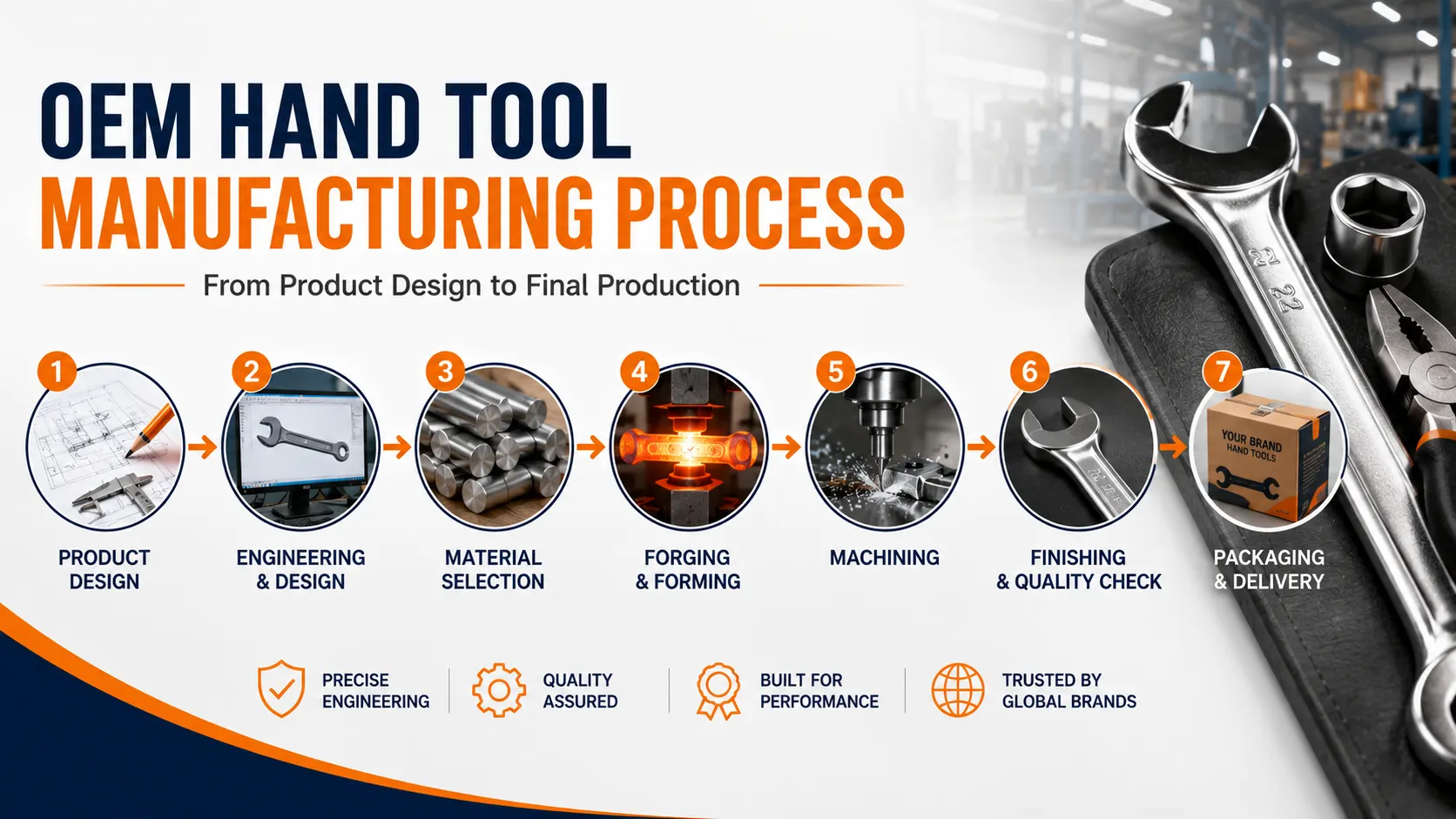
OEM Hand Tool Manufacturing Process: From Product Design to Final Production
- What Is OEM Hand Tool Manufacturing?
- Step-by-Step OEM Hand Tool Manufacturing Process
- Manufacturing Stages in OEM Hand Tool Production
- Quality Control Throughout Production
- Packaging and Final Production
- How to Choose the Right OEM Hand Tool Manufacturer
- Why Businesses Choose OEM Hand Tool Manufacturing
- Conclusion
- FAQs
As industries continue to demand reliable, application-specific hand tools, many brands choose OEM (Original Equipment Manufacturer) hand tool manufacturing to bring their products to market. Rather than investing in in-house production, businesses collaborate with experienced manufacturers who can transform product concepts into finished tools while meeting technical, quality, and branding requirements.
Whether the goal is to develop custom spanners, pliers, screwdrivers, wrenches, or other industrial hand tools, the manufacturing journey follows a structured process, from engineering design to final production. This guide explains each stage and what businesses should look for when choosing an OEM hand tool manufacturer in India or other global manufacturing hubs.
What Is OEM Hand Tool Manufacturing?
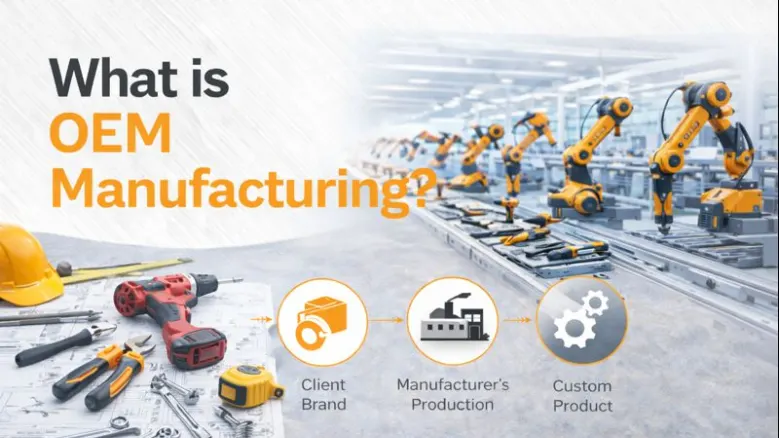
OEM hand tool manufacturing refers to producing tools based on a customer’s design, technical specifications, or branding requirements. The manufacturer is responsible for engineering support, production, quality assurance, and delivery, while the brand markets the finished products under its own name.
Unlike standard off-the-shelf production, OEM manufacturing allows businesses to customize factors such as:
- Tool dimensions and design
- Material selection
- Surface finish
- Branding and logo engraving
- Packaging and labeling
- Product specifications for target markets
This approach is widely used by distributors, industrial brands, automotive suppliers, and international importers seeking consistent manufacturing quality.
Step-by-Step OEM Hand Tool Manufacturing Process
1. Product Requirement Analysis and Concept Development
Every OEM project begins with understanding the customer’s requirements. Manufacturers evaluate how the tool will be used, the expected operating conditions, target industries, and applicable technical standards.
Key considerations include the following:
- Intended application
- Functional requirements
- Ergonomic design expectations
- Dimensional specifications
- Production feasibility
- Market-specific compliance requirements
This planning stage helps ensure the product design aligns with both manufacturing capabilities and customer expectations before production begins.
2. Product Design and Engineering
Once the requirements are finalized, engineers create detailed technical designs that guide manufacturing.
This stage typically includes:
- CAD (Computer-Aided Design) models
- Technical drawings
- Dimensional tolerances
- Material specifications
- Prototype planning
- Manufacturing process validation
Engineers also review factors such as grip comfort, tool balance, accessibility in confined spaces, and compatibility with production methods. Early engineering validation helps identify potential design improvements before manufacturing progresses.
3. Material Selection
Material selection directly influences manufacturing processes and the intended application of the finished tool.
Common materials include:
- Chrome Vanadium (Cr-V) Steel for many professional-grade hand tools
- Carbon Steel for selected applications
- Alloy Steel where specific mechanical properties are required
Manufacturers also consider factors such as heat treatment compatibility, machinability, corrosion protection requirements, and customer specifications when selecting raw materials.
4. Prototype Development
Before large-scale production begins, manufacturers often develop prototype samples.
Prototype evaluation may include:
- Dimensional verification
- Functional assessment
- Fit and finish inspection
- Customer feedback
- Design refinements
This stage allows manufacturers and customers to validate the design before committing to production tooling and larger manufacturing volumes.
Manufacturing Stages in OEM Hand Tool Production
1. Forging and Forming
Many hand tools begin with forging, where heated steel is shaped using controlled pressure and precision dies.
Depending on the product, manufacturers may use processes such as drop forging to produce the basic tool profile before further machining.
Proper forging helps establish the tool’s geometry while preparing it for subsequent manufacturing operations.
2. Precision Machining
Following forging, the components undergo machining to achieve required dimensions and functional features.
Common operations include:
- Milling
- Grinding
- Drilling
- Cutting
- Surface finishing
- Threading (where applicable)
Precision machining ensures consistency across production batches while meeting specified tolerances.
3. Heat Treatment
Heat treatment is an important stage in hand tool manufacturing.
Depending on product requirements, manufacturers may perform processes such as the following:
- Hardening
- Tempering
- Stress relieving
These controlled treatments help achieve the mechanical characteristics specified during product development while preparing components for their intended applications.
4. Surface Finishing
Surface finishing improves the appearance of the tool while supporting customer specifications and intended use.
Common finishes include:
- Chrome plating
- Satin finish
- Mirror polish
- Matte finish
- Protective coatings
The selected finish depends on the product category, customer requirements, and desired appearance.
Quality Control Throughout Production
Quality assurance is integrated throughout the OEM manufacturing process rather than being limited to the final inspection.
Typical quality checks include the following:
- Incoming Material Inspection: Raw materials are verified against specified grades and manufacturing requirements before entering production.
- In-Process Inspection: Critical dimensions, machining accuracy, and manufacturing consistency are monitored at various production stages.
- Final Product Inspection: Finished tools are evaluated for:
- Visual appearance
- Dimensional accuracy
- Functional performance
- Surface finish
- Packaging and labeling
Many manufacturers also maintain documented inspection procedures to support consistency across production batches.
Packaging and Final Production
Once products pass inspection, they move to packaging and shipment preparation.
Depending on customer requirements, OEM manufacturers may offer the following:
- Private label packaging
- Brand logo engraving
- Product labeling
- Barcode application
- Export-ready packaging
- Bulk or retail packaging options
Proper production planning and packaging coordination help streamline delivery to domestic and international markets.
How to Choose the Right OEM Hand Tool Manufacturer
Selecting an OEM manufacturing partner involves evaluating more than production capacity alone.
Consider the following factors:
- Engineering expertise to support product development and customization.
- Manufacturing capabilities including forging, machining, finishing, and assembly.
- Quality management systems with documented inspection procedures.
- Customization options for branding, packaging, and product specifications.
- Production scalability to accommodate both small and large order volumes.
- Export experience for businesses serving international markets.
For companies sourcing from India, choosing an established OEM hand tool manufacturer with integrated production capabilities can simplify communication, quality management, and supply chain coordination.
Why Businesses Choose OEM Hand Tool Manufacturing
OEM manufacturing enables brands to develop products tailored to their market without establishing their own production facilities.
Working with an experienced manufacturer can provide the following:
- Access to engineering and manufacturing expertise
- Support for custom product development
- Flexible branding and packaging options
- Consistent production processes
- Scalable manufacturing for growing product lines
This collaborative approach helps businesses focus on product development, distribution, and customer relationships while relying on specialized manufacturing capabilities.
Conclusion
The OEM hand tool manufacturing process combines engineering expertise, precision manufacturing, and structured quality control to transform product concepts into finished tools. From design validation and material selection to forging, machining, finishing, inspection, and packaging, every stage contributes to delivering products that align with customer specifications.
For businesses seeking an OEM hand tool manufacturer in India, partnering with an experienced manufacturer that offers integrated design support, advanced production capabilities, and consistent quality processes can help streamline product development and support long-term growth in competitive global markets.
FAQs
OEM hand tool manufacturing is the process of producing hand tools according to a customer’s design, specifications, or branding requirements. It includes engineering, manufacturing, quality inspection, packaging, and final delivery.
Common materials include chrome-vanadium steel, carbon steel, and various alloy steels. Material selection depends on the tool’s application, manufacturing process, and customer specifications.
Production timelines vary depending on product complexity, prototype approval, manufacturing processes, order quantity, and customization requirements.
Yes. Many OEM manufacturers offer customization options such as product dimensions, finishes, branding, logo engraving, packaging, and labeling based on customer requirements.
India has developed a strong manufacturing ecosystem for forged and precision-engineered hand tools, supported by skilled engineering talent, established production infrastructure, and experience serving domestic and international markets.