Essential Certifications to Look for in an OEM Hand Tool Manufacturer
- What certifications should an OEM hand tool manufacturer have?
- Why Certifications Matter When Choosing an OEM Hand Tool Manufacturer
- Essential Certifications to Look For in an OEM Hand Tool Manufacturer
- Certification Checklist for OEM Hand Tool Buyers
- Questions to Ask Before Accepting a Manufacturer’s Certifications
- Certifications vs. Product Compliance: What’s the Difference?
- Conclusion
- FAQs
When sourcing from an OEM hand tool manufacturer, certifications are one of the first indicators buyers review during supplier evaluation. They provide documented evidence that a manufacturer follows recognized standards for quality management, workplace safety, environmental practices, or product compliance where applicable.
For importers, distributors, wholesalers, and industrial brands, understanding which certifications matter can simplify supplier selection and support procurement decisions. However, the certifications required may vary depending on the product type, destination market, and customer requirements.
What certifications should an OEM hand tool manufacturer have?
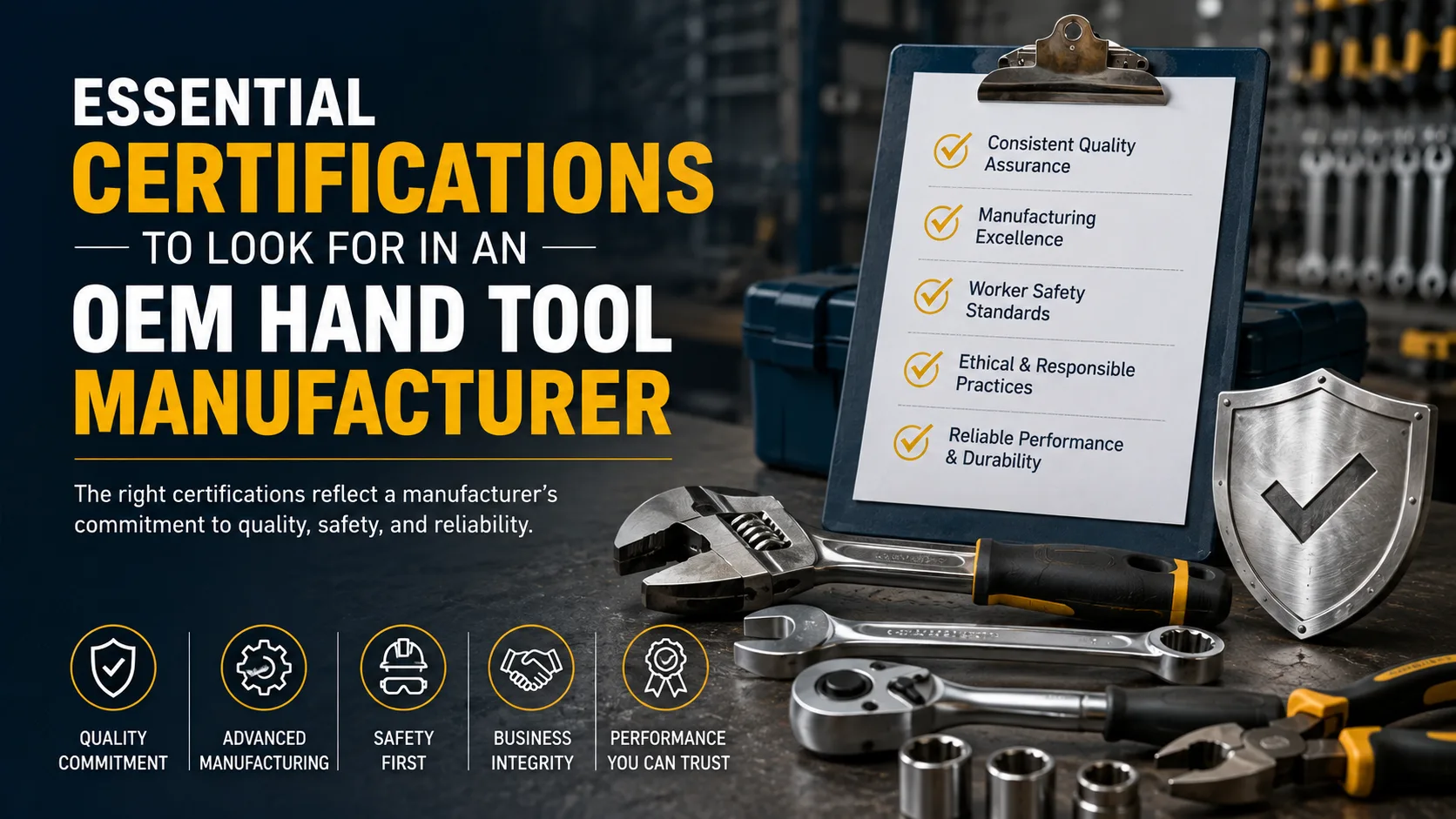
An OEM hand tool manufacturer should ideally hold certifications related to quality management, environmental management, occupational health and safety, and, where applicable, product compliance. Commonly requested certifications include ISO 9001, ISO 14001, ISO 45001, CE (where applicable), GS certification, and social compliance audits such as BSCI. Buyers may also request product-specific testing and material compliance reports based on their target market.
Why Certifications Matter When Choosing an OEM Hand Tool Manufacturer
Certifications help buyers assess whether a manufacturer has implemented recognized management systems and follows documented processes. While certifications do not guarantee product performance, they can provide greater transparency during supplier evaluation.
They may help buyers:
- Evaluate manufacturing and quality management systems
- Understand environmental and workplace safety practices
- Meet customer or importer sourcing requirements
- Support supplier qualification during procurement
- Review compliance documentation for specific export markets
For international sourcing, certifications are often one part of a broader supplier assessment that may also include factory audits, product testing, and production capability reviews.
Essential Certifications to Look For in an OEM Hand Tool Manufacturer
1. ISO 9001 – Quality Management System
ISO 9001 is the globally recognized standard for quality management systems. It indicates that a manufacturer follows documented processes for production, quality control, and continuous improvement. For buyers, it reflects a structured approach to maintaining product quality and manufacturing consistency.
2. ISO 14001 – Environmental Management System
ISO 14001 demonstrates that a manufacturer has established processes to manage its environmental impact, including waste reduction, resource efficiency, and regulatory compliance. It is often valued by buyers with sustainability or environmental sourcing requirements.
3. ISO 45001 – Occupational Health and Safety Management
ISO 45001 focuses on workplace health and safety by helping manufacturers identify risks and improve employee safety practices. It indicates that the facility follows a recognized occupational health and safety management system.
4. CE Marking (Where Applicable)
CE marking indicates that applicable products meet relevant European Union health, safety, and environmental requirements. Not all hand tools require CE marking, so buyers should confirm whether it applies to their specific product and target market.
5. GS Certification
The GS (Geprüfte Sicherheit) mark is a voluntary German safety certification based on independent product testing. Although not mandatory, it is widely recognized across Europe and may enhance buyer confidence for certain products.
6. BSCI Social Compliance Audit
BSCI is a social compliance audit that assesses manufacturing facilities for responsible labor practices, workplace conditions, and ethical business conduct. Many global retailers and sourcing companies consider BSCI during supplier evaluation.
7. Product Testing and Material Compliance Reports
In addition to certifications, buyers may request product-specific documents such as Material Test Reports (MTR), hardness and salt spray test reports, REACH or RoHS compliance documents (where applicable), and third-party laboratory reports. The required documentation depends on the product and destination market.
Certification Checklist for OEM Hand Tool Buyers
| Certification | Purpose | Commonly Requested By |
| ISO 9001 | Quality management system | Importers, distributors, global brands |
| ISO 14001 | Environmental management | Sustainability-focused buyers |
| ISO 45001 | Occupational health and safety | International procurement teams |
| CE (where applicable) | EU regulatory conformity | European importers |
| GS Certification | Independent product safety verification | German and European buyers |
| BSCI Audit | Social compliance assessment | Retailers and sourcing companies |
| Product Test Reports | Product-specific verification | OEM buyers and distributors |
Questions to Ask Before Accepting a Manufacturer’s Certifications
Before finalizing an OEM partnership, buyers should verify that certification documents are current and applicable to the manufacturing facility producing their order.
Consider asking:
- Is the certification currently valid?
- Which accredited certification body issued it?
- Does it cover the production facility manufacturing my products?
- Can recent certificates or audit reports be shared?
- Are product-specific testing reports available if required?
- Do the certifications align with my destination market?
Certifications vs. Product Compliance: What’s the Difference?
These terms are often confused but serve different purposes.
| Manufacturer Certifications | Product Compliance |
| Apply to factory management systems | Apply to individual products |
| Focus on manufacturing processes | Focus on product requirements |
| Include ISO 9001, ISO 14001, ISO 45001 | May include CE, REACH, RoHS, or other market-specific requirements where applicable |
| Evaluate operational systems | Verify compliance for specific products |
Understanding this distinction helps buyers request the correct documentation during supplier evaluation.
Conclusion
Choosing an OEM hand tool manufacturer involves more than comparing pricing or production capacity. Certifications provide buyers with documented information about a manufacturer’s management systems, environmental practices, workplace safety, and, where applicable, product conformity.
Because certification requirements differ by product category and destination market, buyers should verify that all certificates are current, issued by recognized certification bodies, and relevant to the products being sourced. Reviewing certifications alongside factory audits, product testing, and technical documentation can support a more informed supplier selection process.
FAQs
Common certifications include ISO 9001 for quality management, ISO 14001 for environmental management, ISO 45001 for occupational health and safety, and, where applicable, CE, GS, BSCI audits, and product-specific testing reports.
ISO 9001 is widely recognized because it demonstrates that a manufacturer has implemented a documented quality management system with standardized production and quality control processes.
No. CE marking only applies to products covered by specific European Union legislation. Whether it is required depends on the product category and applicable regulations.
ISO certifications evaluate a manufacturer’s management systems, while product compliance relates to whether a specific product meets the regulatory requirements of a target market.
Buyers can request valid certification documents, confirm the issuing certification body, check expiration dates, ensure the certification covers the relevant manufacturing facility, and review product-specific test reports when required.