Spanner Manufacturing Process: How High-Quality Spanners Are Made Step by Step
- At a Glance: The Spanner Manufacturing Process
- How Are Spanners Made?
- Stage-by-Stage Manufacturing Summary
- Why Manufacturing Quality Matters
- Step 1: Selecting the Right Steel (Material Science)
- Step 2: Billet Cutting & Shearing
- Step 3: Hot Drop Forging (The Core of Strength)
- Step 4: Trimming & Flash Removal
- Step 5: Precision Machining & Broaching
- Step 6: Heat Treatment (Hardening & Tempering)
- Step 7: Drop Forging vs. Cold Forging: A Quick Comparison
- Step 8: Surface Finishing (Shot Blasting & Polishing)
- Step 9: Protective Chrome Plating & Coating
- Step 10: Marking & Branding
- Step 11: Quality Control & Torque Testing
- Common Manufacturing Defects in Spanners (And How to Spot Them)
- How OEM Spanners Are Customized for Global Markets
- International Standards: DIN, ANSI & ISO
- B2B Sourcing Guide: How Importers Should Evaluate Suppliers
- Conclusion
- FAQs
When buying spanners in bulk, price is only one part of the decision. The real difference lies in how the tool is manufactured. A properly forged and heat-treated spanner can deliver years of reliable performance on a high-torque assembly line or inside an automotive workshop. A poorly manufactured tool, on the other hand, can snap under pressure, strip expensive fasteners, or rust sitting on a distributor’s warehouse shelf.
Understanding the spanner manufacturing process helps importers, procurement managers, and OEM buyers evaluate quality before placing a production order.
In this guide, we break down the complete spanner production process—from raw material testing to drop forging, heat treatment, precision machining, surface finishing, and quality control.
At a Glance: The Spanner Manufacturing Process
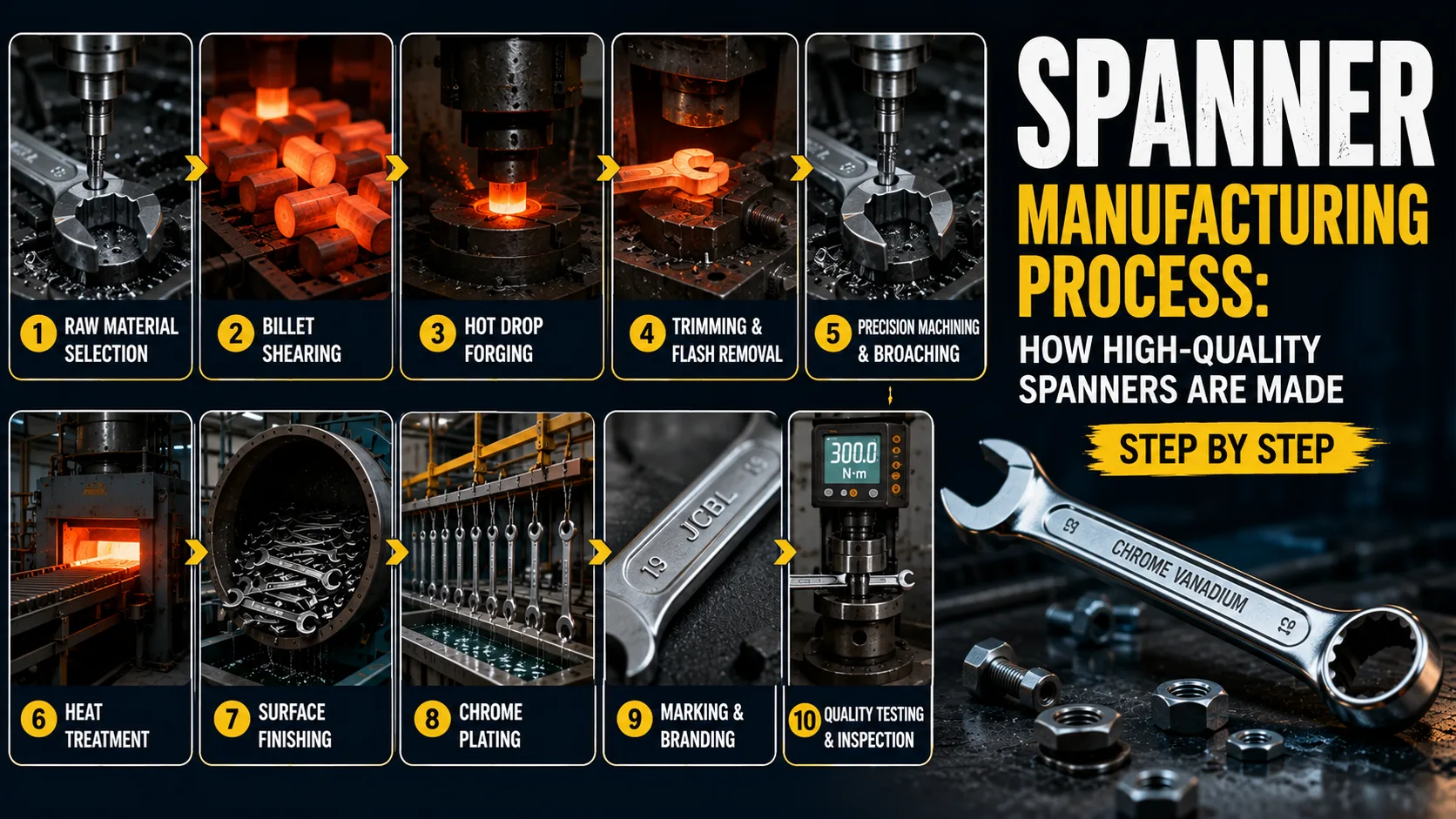
The production of industrial-grade spanners involves ten core engineering stages:
- Raw Material Selection: Chemical validation of Chrome Vanadium (Cr-V) or Carbon Steel.
- Billet Shearing: Cutting long steel rods into precise, weighed blanks.
- Hot Drop Forging: High-temperature compression inside closed dies for dense grain alignment.
- Trimming & Flash Removal: Clipping off excess squeezed-out metal.
- Precision Machining & Broaching: Milling open jaws and broaching 6-point or 12-point ring profiles.
- Heat Treatment: Two-stage hardening and tempering to achieve balanced Rockwell hardness.
- Surface Finishing: Shot blasting, vibratory deburring, and polish buffing.
- Protective Electroplating: Multi-layer nickel and chromium coating against rust.
- Marking & Branding: Permanent laser etching or cold stamping of sizes and brand logos.
- Quality Testing & Inspection: Proof torque testing, hardness audits, and salt-spray analysis.
How Are Spanners Made?
High-quality spanners are manufactured through hot drop forging. Chrome Vanadium or carbon steel billets are heated to around 1200°C and compressed under massive hammer pressure inside closed-die molds. The resulting forged blanks are trimmed, machined for precise jaw dimensions, and heat-treated (hardened and tempered) to achieve optimum toughness. Finally, they receive a protective chrome plating layer and undergo strict DIN and ANSI proof-torque testing.
Stage-by-Stage Manufacturing Summary
| Manufacturing Stage | Primary Engineering Purpose | Direct Impact on Tool Quality |
| Material Selection | Verifies chemical composition (Cr-V / Carbon) | Determines tensile strength and wear resistance |
| Hot Drop Forging | Compresses steel along continuous grain flow lines | Eliminates internal voids and maximizes torque load capacity |
| Precision Machining | CNC mills jaws and broaches ring eye geometries | Prevents tool slippage and fastener rounding |
| Heat Treatment | Controlled hardening followed by tempering | Gives high load resistance without making the steel brittle |
| Chrome Plating | Applies electro-deposited nickel and chrome layers | Delivers long-term corrosion protection in harsh environments |
| Torque & Hardness Testing | Audits finished lots against DIN and ANSI standards | Guarantees user safety and validates proof load capacity |
Why Manufacturing Quality Matters
A spanner works on mechanical leverage. When a worker applies heavy rotational force on a stubborn bolt, extreme stress concentrates on the jaw corners and the beam handle.
When cheap tools fail in the field, it usually stems from three manufacturing shortcuts:
- Jaw Spreading: Soft, untreated steel gives way under load, stripping fastener corners.
- Brittle Fractures: Incorrect quenching without proper tempering makes the tool snap under shock loads.
- Flaking Chrome & Rust: Poor surface cleaning causes plating to peel off, exposing raw iron to rapid moisture corrosion.
Step 1: Selecting the Right Steel (Material Science)
The lifetime performance of a spanner is determined long before it hits the forging line. Everything starts with the chemical composition of the raw steel bars. Quality-focused manufacturers typically verify incoming raw steel batches using spectrometer analysis to confirm key alloying elements.
Chrome Vanadium Steel (Cr-V / 31CrV3)
This is the universally accepted standard for high-performance professional tools. Chromium increases hardness, tensile strength, and wear resistance, while Vanadium acts as a grain-refining agent, preventing brittle grain growth during heat treatment and maximizing resistance to cyclic fatigue.
Medium Carbon Steel (C45 / EN8)
A cost-conscious alternative suitable for domestic DIY, light assembly, or promotional toolkits. While adequately strong for light torque, it lacks the high impact strength and fatigue life of Chrome Vanadium.
Chrome Molybdenum Steel (Cr-Mo)
Reserved for specialized industrial tools, heavy striking spanners, and pneumatic impact sockets that require high shock absorption under extreme torque.
Buyer Tip: Always request Mill Test Certificates (MTC) for bulk orders. Unscrupulous suppliers sometimes mix carbon steel with Cr-V batches to cut costs, resulting in inconsistent jaw hardness across the same shipment.
Why this step matters: Starting with verified Chrome Vanadium steel ensures the spanner can absorb heavy rotational torque without permanent jaw deformation or fatigue cracking over time.
Step 2: Billet Cutting & Shearing
Before forging begins, manufacturers cut long steel bars into accurately sized billets. These raw blanks are weighed and checked for dimensional accuracy.
Precision at this stage is critical. If a billet is cut even slightly undersized, the steel will fail to completely fill the forging die cavity, leaving structural voids in the handle or jaw. If it is cut too large, excessive metal forces its way out, causing rapid die wear and wasting raw material.
Why this step matters: Uniform billet sizing ensures every drop-forged blank achieves full density and balanced weight across the entire production lot.
Step 3: Hot Drop Forging (The Core of Strength)
Hot drop forging is the single most important phase in hand tool manufacturing. It gives spanners their structural integrity.
- Induction Heating: The cut billets pass through a continuous induction furnace, reaching controlled temperatures between 1100°C and 1250°C. At this red-hot stage, the steel becomes malleable without losing its solid structure.
- Die Compression: The glowing billet is placed onto a custom-machined lower forging die matching the profile of the spanner.
- High-Impact Forging: A heavy power hammer drops down with multiple tons of pressure, forcing the plastic steel to flow into every corner of the die cavity.
Why Forged Tools Outperform Casted or Cut Tools
Unlike casting (where liquid metal is poured into a mold, leaving random grain arrangements and potential air pockets) or cutting tools flat out of sheet metal, drop forging forces the natural internal grain structure of the steel to align continuously along the curved contours of the jaw and handle. This directional grain flow provides maximum resistance against snapping or twisting under heavy torque.
Practical Engineering Insight: In export manufacturing, even minor temperature drops during forging can create hidden internal micro-cracks. Reputable manufacturers carefully monitor billet temperatures before hammering to ensure consistent grain alignment across every single production run.
Why this step matters: Continuous grain alignment along the tool’s contours provides substantially higher strength and durability than cast or sheet-metal alternatives.
Step 4: Trimming & Flash Removal
During drop forging, a small portion of surplus steel squeezes out between the upper and lower die faces along the parting line. This thin surrounding metal border is known as flash.
While the newly forged spanners are still warm, they are immediately moved to a high-speed trimming press. A custom-shaped punch die clips away the surrounding flash in a single smooth strike, leaving behind a clean, recognizable tool profile. The trimmed flash is collected, sorted, and sent directly back to steel mills for recycling.
Why this step matters: Clean trimming creates smooth tool edges and prepares the forged blank for accurate positioning in downstream machining jigs.
Step 5: Precision Machining & Broaching
After trimming, the forged blank is strong, but its functional working ends—the open jaw opening and the box-end ring profile—require high-precision machining.
- Open-Jaw Milling: Heavy-duty CNC milling machines precision-cut the inner parallel faces of Double Open End Spanners. Dimensional tolerances are held within fractions of a millimeter to ensure a tight, anti-slip fit on hexagonal bolt heads.
- Box-End Ring Broaching: For Combination Spanners and Ring Spanners, a vertical multi-tooth cutting bar called a broach is drawn through the forged eye. The broaching teeth gradually cut clean, accurate 6-point or 12-point internal geometries that conform strictly to international standards like DIN 3113.
Did You Know? The 15-degree offset angle on combination spanner jaws isn’t just an aesthetic design choice. It allows mechanics to flip the spanner over in tight spaces, effectively doubling the available engagement angles on fasteners where swing space is severely limited.
Why this step matters: Precision machining guarantees exact dimensional clearance between the tool jaw and fastener, preventing slippage and head rounding under torque.
Step 6: Heat Treatment (Hardening & Tempering)
Freshly machined steel is still relatively soft and ductile. To handle real-world mechanical loads without bending or wearing down, the spanners undergo a continuous two-stage heat treatment process.
1. Hardening (Austenitizing & Quenching)
Spanners are carried on a mesh-belt conveyor through a controlled-atmosphere furnace heated to 850°C – 880°C. Once the steel’s internal lattice structure transforms into austenite, the tools are dropped directly into a temperature-monitored oil bath (quenching). This rapid cooling locks the steel into a dense martensitic structure, making it extremely hard.
2. Tempering (Stress Relief & Elasticity)
In its fully hardened state, the tool is so brittle it could shatter under a sudden blow. The spanners are immediately transferred to a tempering furnace heated to between 350°C and 500°C. This process relieves thermal stress and restores necessary toughness, allowing the tool to flex slightly under extreme load without breaking.
Common Mistake: Some low-cost factories shorten or entirely skip the tempering phase to speed up production cycles. This leaves the metal glass-brittle, causing the spanner jaws to shatter dangerously under sudden shock loads.
Why this step matters: Controlled heat treatment brings the tool core to a balanced hardness range of 42 HRC to 48 HRC, maximizing torque capacity while eliminating brittleness.
Step 7: Drop Forging vs. Cold Forging: A Quick Comparison
When evaluating hand tool manufacturing methods, buyers often encounter both drop forging and cold forging techniques:
| Parameter | Hot Drop Forging (Standard Industrial) | Cold Forging / Cold Heading |
| Working Temperature | 1100°C – 1250°C | Room temperature / Ambient |
| Material Grain Flow | Highly continuous along complex shapes | Good, but limited to simpler geometries |
| Tooling & Setup Cost | Moderate to High | High initial die costs |
| Best Application | Complex, high-strength spanners and wrenches | Sockets, fasteners, and simple uniform shapes |
| Structural Reliability | Excellent shock absorption and toughness | High surface hardness, lower impact resistance |
Step 8: Surface Finishing (Shot Blasting & Polishing)
Heat treatment leaves a dark iron oxide scale on the surface of the steel. Before electroplating can occur, the tools must undergo thorough surface preparation.
- Shot Blasting & Tumbling: The spanners are loaded into industrial shot-blasting machines where high-velocity steel shot strips away heat scale, deburs sharp edges, and leaves a smooth, uniform matte surface.
- Vibratory Polishing & Buffing: For high-end polished spanners, tools are placed in vibratory tubs containing ceramic abrasive media and polishing compounds. Automated buffing wheels polish the flat faces and handles to prepare them for a bright chrome finish.
Why this step matters: Thorough surface scaling and deburring ensure that electroplated chrome adheres permanently to the steel base without peeling or bubbling.
Step 9: Protective Chrome Plating & Coating
Uncoated steel reacts quickly with moisture, atmospheric oxygen, and chemical solvents. Multi-layer electroplating acts as a protective shield while giving the spanner its classic professional look.
- Chemical Cleaning: The tools pass through ultrasonic degreasing and acid pickling baths to remove all oils and oxide traces.
- Nickel Base Layer: A foundational layer of nickel is electro-deposited onto the steel. Nickel provides the primary defense against rust and moisture penetration.
- Chromium Top Layer: A thin top layer of chromium is plated over the nickel. This adds surface hardness, scratch resistance, and an attractive finish.
Popular Finishes
- Satin Finish (Matte Chrome): Highly favored in automotive and heavy equipment workshops because it reduces light glare and provides a secure, non-slip grip when hands are oily.
- Mirror Polished Chrome: Offers a smooth, high-luster appearance that is easy to wipe clean after dirty jobs.
- Black Phosphate / Industrial Finish: Applied to heavy industrial or oilfield spanners where non-reflective surfaces are required for safety.
Why this step matters: Multi-layer nickel-chrome plating creates a sealed barrier against oxidation, extending tool service life in high-humidity or marine environments.
Step 10: Marking & Branding
Once plated, the spanners move to the identification stage. Clear, legible size markings save mechanics time in fast-paced workshop environments.
While traditional manufacturers cold-stamp brand names into the forging die, modern facilities utilize high-precision fiber lasers. Laser etching creates clean size markings (e.g., 17mm, 5/8″), batch numbers, international standard stamps, and custom private-label logos directly onto the plated surface without degrading the protective chrome coating.
Why this step matters: Laser marking provides crisp, permanent size identification and traceability without breaking the surrounding protective plating shield.
Step 11: Quality Control & Torque Testing
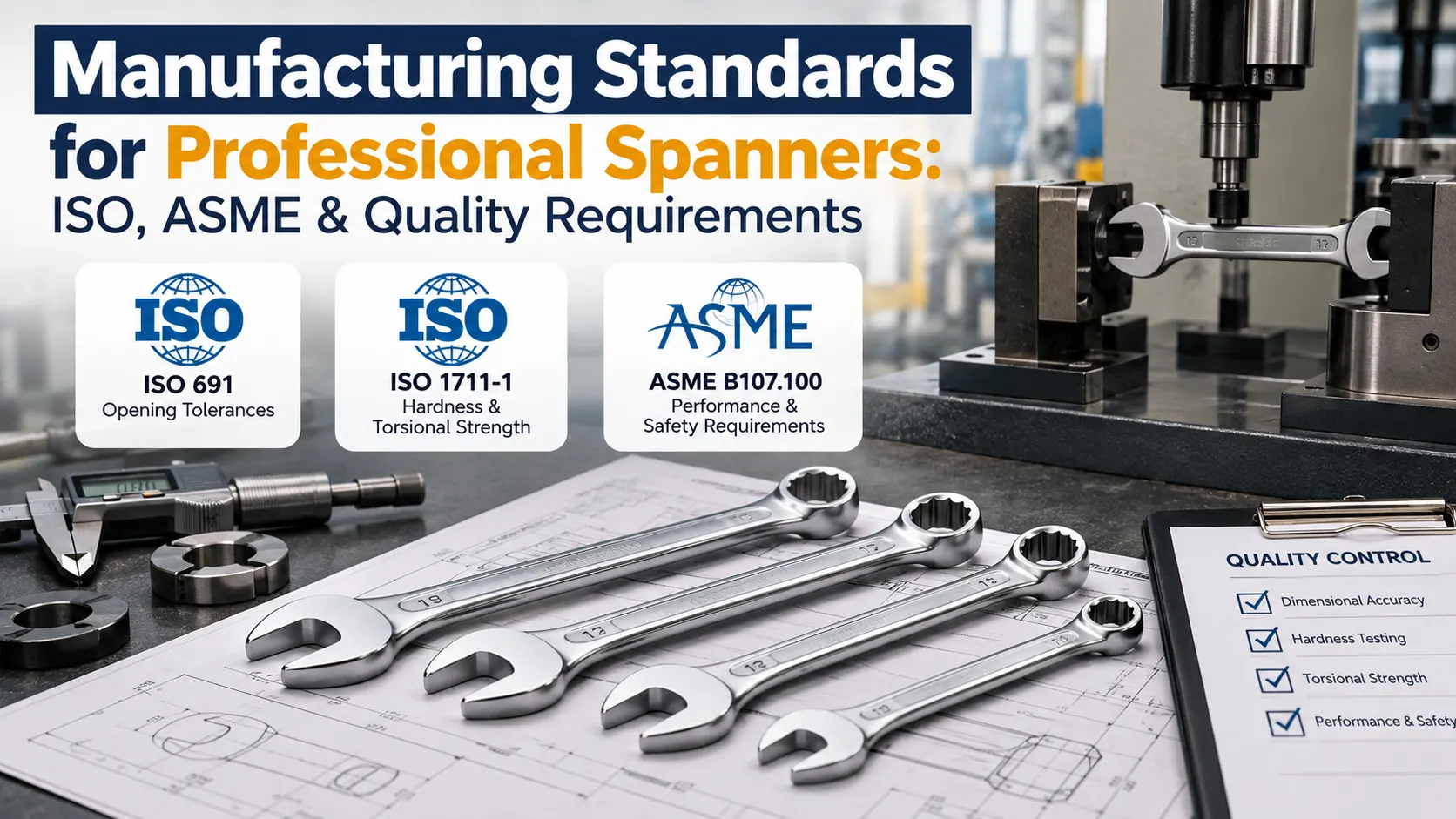
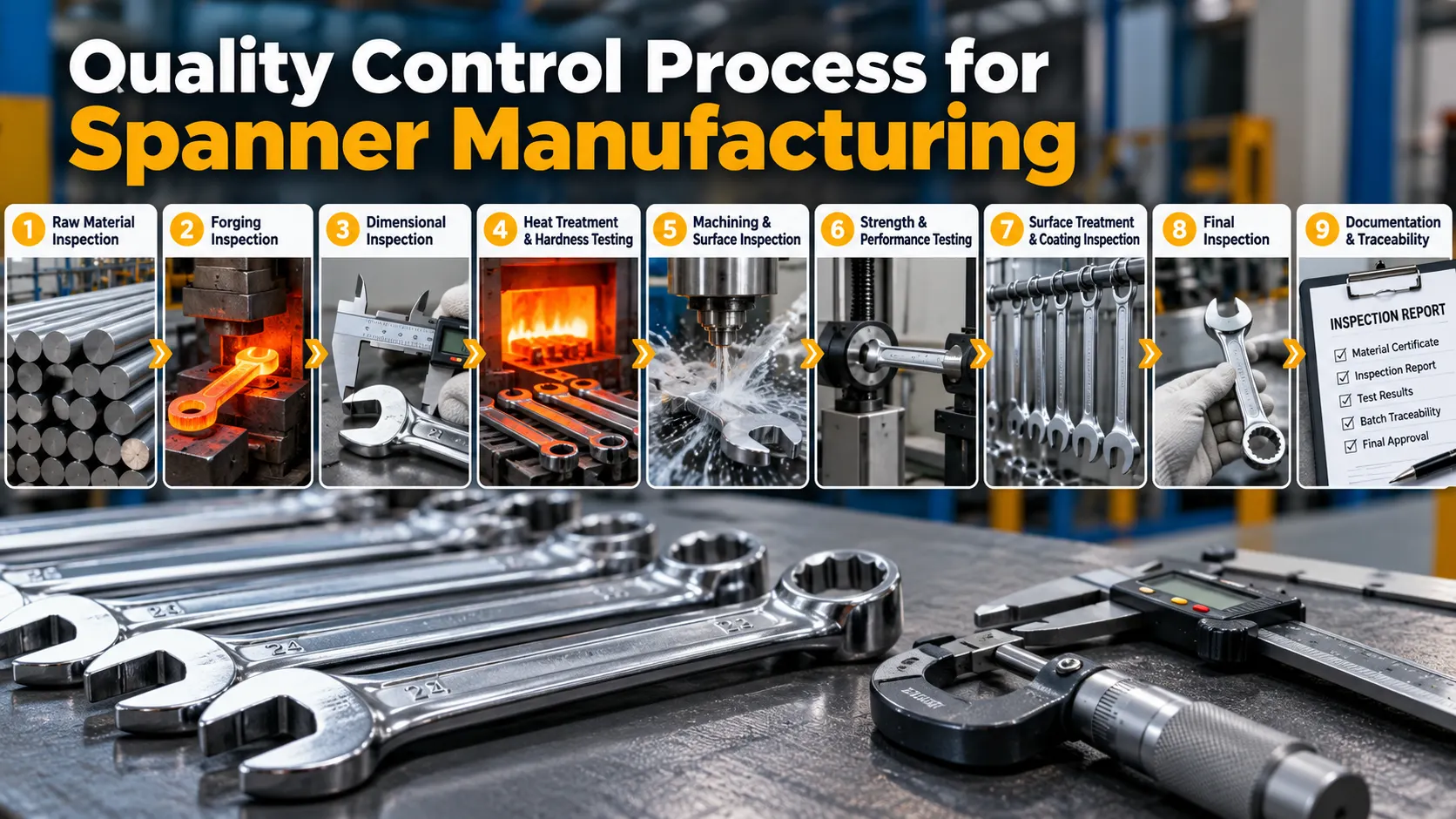
A reputable manufacturer audits every batch against international benchmarks like DIN 3110, DIN 3113, and ANSI B107.100 before authorizing export shipments.
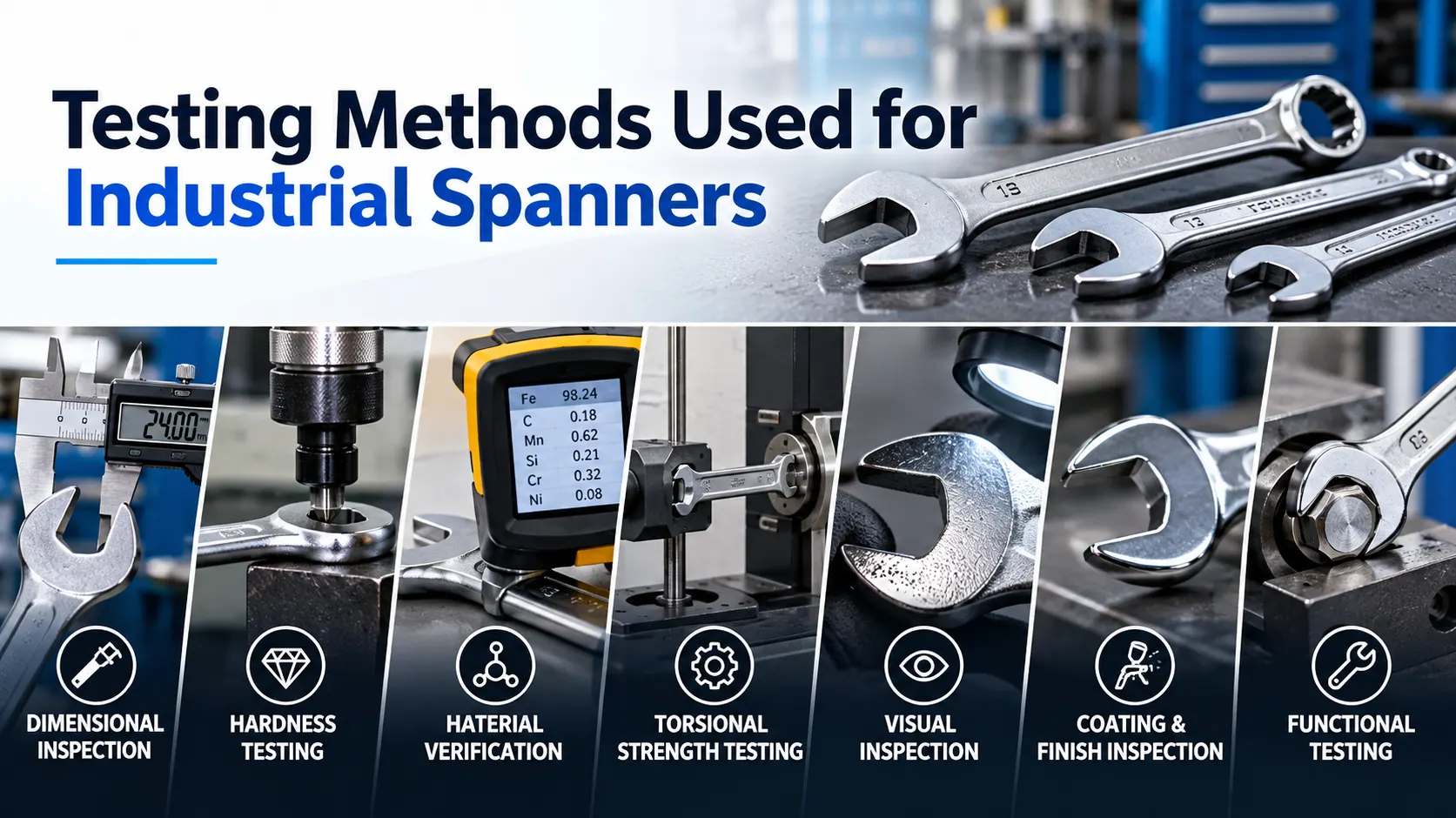
- Hardness Testing: Rockwell hardness testers confirm that the core hardness falls strictly within the 42–48 HRC window.
- Torque Load Testing: Spanners are mounted in hydraulic testing rigs that apply rotational torque to the jaws and ring ends until reaching the required proof load—or continuing until destruction to measure total safety margins.
- Dimensional Inspection: Digital calipers and optical profile projectors verify that open-jaw tolerances and ring geometries match strict international standards.
- Salt Spray Test (ASTM B117): Plated samples are placed in an accelerated salt-fog chamber for 24 to 96+ hours to ensure long-term rust prevention during ocean transport and humid storage conditions.
Practical Engineering Insight: Quality-focused manufacturers perform destructive torque testing on random sample units from every production lot. Knowing the exact point of metal failure allows engineers to verify that safety margins exceed standard DIN requirements by at least 20–30%.
Why this step matters: End-of-line testing verifies that every production lot meets global torque and corrosion safety standards before reaching customer hands.
Common Manufacturing Defects in Spanners (And How to Spot Them)
When sourcing hand tools in bulk, understanding common defect causes helps procurement teams audit incoming shipments:
- Cold Shuts / Forging Seams: Occur when metal folds over itself during forging without fusing properly. Under heavy load, these seams act as stress points where the handle can snap.
- Decarburization: Overheating the steel in non-controlled furnace atmospheres burns off carbon from the outer surface layer, leaving the jaw edges soft and prone to premature wear.
- Pitting & Pin-Hole Plating: Poor chemical cleaning before plating leaves microscopic bubbles in the nickel/chrome layers, causing tiny rust spots to emerge after storage.
- Out-of-Tolerance Jaws: Worn-out milling cutters or uncalibrated broaches produce oversized jaw openings, leading to tool slippage and rounded bolt heads.
How OEM Spanners Are Customized for Global Markets
For B2B importers, buying off-the-shelf tools isn’t always enough. Experienced suppliers offering specialized OEM Manufacturing services allow distributors to tailor products to their specific market preferences:
- Custom Forging Dies: In-house die shop design allows custom handle contours, raised panel bands, or ultra-thin slimline jaw profiles.
- Private Labeling: Custom laser etching, deep roll-stamping, or customized raised lettering directly on the tool beam.
- Specialized Finishes: Options ranging from satin matte and high-polish mirror chrome to black nickel or rubber-dipped insulated handles.
- Custom Packaging: Complete retail-ready solutions including blow-molded cases, plastic hanging racks, roll-up canvas pouches, color boxes, and barcode-labeled shipping cartons.
International Standards: DIN, ANSI & ISO
Global buyers rely on standard frameworks to ensure tool safety and interchangeability:
- DIN (Deutsches Institut für Normung): The standard across Europe and Asia. Key benchmarks include DIN 3110 (Double Open-End Spanners), DIN 3113 (Combination Spanners), and DIN 838 (Deep Offset Ring Spanners).
- ANSI (American National Standards Institute): The standard across North America, governing proof torque minimums, dimensional clearances, and handle strength (e.g., ANSI B107 series).
- ISO (International Organization for Standardization): Universal international frameworks such as ISO 6787 and ISO 10102 that standardize dimensions and testing methods globally.
B2B Sourcing Guide: How Importers Should Evaluate Suppliers
If you are sourcing spanners for wholesale distribution, retail chains, or OEM supply, use this checklist during supplier evaluations:
- Verify Raw Material Certificates: Request Mill Test Certificates (MTC) proving genuine Chrome Vanadium (Cr-V) chemical content rather than low-grade carbon steel equivalents.
- Audit In-House Testing Setup: Ensure the manufacturer operates their own laboratory equipped with digital torque testers, Rockwell hardness machines, and salt-spray testing chambers. Review their formal Quality Assurance procedures to confirm continuous batch testing.
- Order Pre-Production Samples: Conduct independent destructive torque and dimensional checks on sample units before authorizing full production runs.
- Confirm Anti-Rust Export Packaging: Long ocean transport exposes shipments to high humidity. Ensure tools are protected with anti-rust oil coatings and wrapped in VCI (Vapor Corrosion Inhibitor) paper inside heavy-duty cartons.
Conclusion
By understanding each stage of the manufacturing process, buyers can evaluate spanner quality beyond price alone. Whether you are sourcing tools for industrial use, retail distribution, or OEM supply, choosing a manufacturer with proven quality control, international standards, and consistent production practices makes a significant difference over the product’s lifetime.
If you’re evaluating suppliers for OEM or bulk hand tool sourcing, reviewing a manufacturer’s quality systems, production capabilities, and international standards can help you make a more informed decision. To learn more about manufacturing capabilities and OEM services, learn more about JCBL Hand Tools‘ manufacturing capabilities on our About Us page or get in touch for detailed technical inquiries.
FAQs
Cheap spanners are often made from low-grade carbon steel, skip proper heat treatment, or use worn-out milling cutters. This results in soft jaws that deform under load or brittle metal that snaps without warning under heavy torque.
Buyers should request Mill Test Certificates (MTC) from the supplier and conduct independent laboratory spectrometer analysis. Genuine Cr-V steel shows distinct chemical traces of Chromium (~0.80–1.10%) and Vanadium (~0.10–0.25%).
Yes. Hot drop forging aligns the internal grain structure of the steel along the contours of the tool, giving it far superior torque capacity, fatigue resistance, and durability compared to cast or sheet-metal stamped spanners.
Importers should request ISO 9001 quality management certificates, material test reports, and compliance documentation confirming that tools meet or exceed specific DIN (e.g., DIN 3113) or ANSI torque standards.
A 15-degree offset allows the user to flip the spanner over in tight working spaces, effectively doubling the available engagement angles on a hexagonal fastener where swing space is limited.
Production time depends on order size, tooling requirements, heat treatment cycles, finishing processes, and quality inspections. Standard production batches may take several days, while custom OEM orders typically require additional lead time for tooling and approvals.