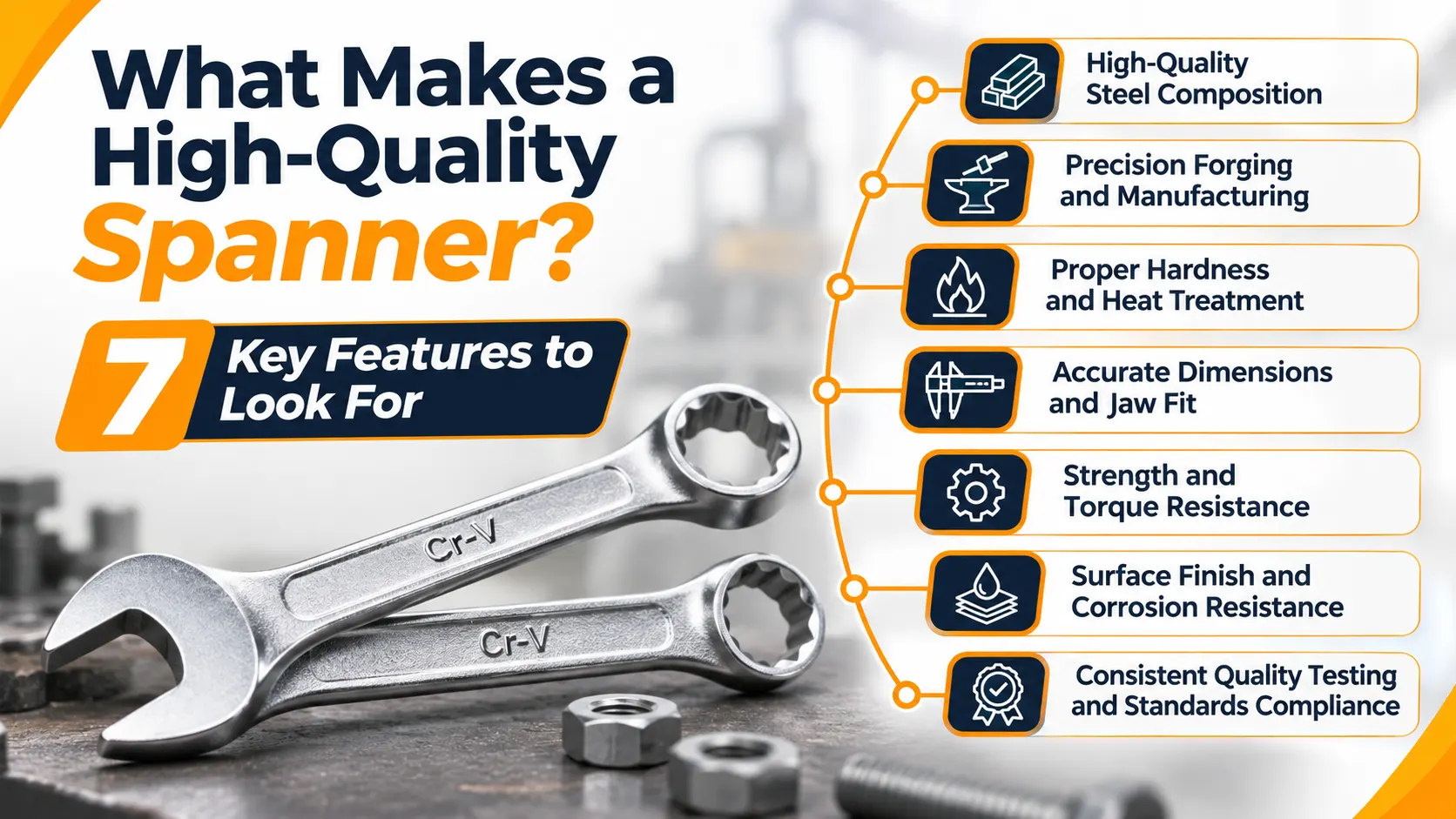
What Makes a High-Quality Spanner? 7 Key Features to Look For
A high-quality spanner is made from suitable alloy steel, precision-manufactured, properly heat-treated, and dimensionally accurate. It should provide a secure fit, adequate torque resistance, corrosion protection, and consistent performance under its specified working conditions. For industrial buyers, distributors, and procurement teams, evaluating these characteristics is essential when sourcing reliable hand tools for mechanical, automotive, and industrial applications.
Understanding these quality parameters helps businesses compare spanner manufacturers, verify product specifications, and make informed bulk purchasing decisions.
What Makes a Spanner High-Quality?
A high-quality spanner combines suitable material composition, controlled manufacturing processes, accurate dimensions, and verified mechanical properties. Its quality depends on how well the steel, forging, heat treatment, jaw geometry, and surface finish work together to deliver reliable fastener engagement.
The following table highlights the key parameters buyers should evaluate.
| Quality Parameter | What to Look For |
|---|---|
| Material | Verified steel grade and consistent composition |
| Manufacturing | Controlled forging and defect-free construction |
| Heat treatment | Appropriate hardness and toughness |
| Dimensions | Accurate jaw openings and tolerances |
| Strength | Verified torsional and mechanical performance |
| Surface finish | Uniform coating and corrosion protection |
| Quality control | Documented testing and batch consistency |
7 Key Features of a High-Quality Spanner
1. High-Quality Steel Composition
The steel grade determines a spanner’s strength, toughness, hardness, and wear resistance. Chrome vanadium (Cr-V) steel is commonly used in hand-tool manufacturing for its strength and hardenability.
Buyers should verify the steel grade, material composition, batch consistency, and material test reports to ensure the material meets application requirements.
2. Precision Forging and Manufacturing
Precision forging helps produce a strong, uniformly shaped spanner with consistent geometry. However, quality also depends on controlled temperatures, accurate die design, and proper finishing.
A well-manufactured spanner should have uniform construction, accurately formed jaws, and no visible cracks, burrs, or forging defects. Consistent manufacturing processes are especially important for bulk production.
3. Proper Hardness and Heat Treatment
Controlled heat treatment develops the required hardness, strength and toughness of the steel. An appropriate balance is essential: insufficient hardness can cause premature wear, while excessive hardness without adequate toughness can increase the risk of breakage.
Rockwell hardness testing and other relevant mechanical tests help verify whether the finished spanner meets its specified requirements.
4. Accurate Dimensions and Jaw Fit
A spanner must have accurately sized jaw openings to ensure a secure fit on nuts and bolts. Incorrect dimensions or excessive clearance can cause slipping and damage fastener edges.
Key checks include jaw opening, alignment, head dimensions, and dimensional tolerances. ISO 691 specifies tolerances for wrench and socket openings, while IS 2028 and IS 2029 cover specific open-jaw and ring wrench categories in India.
5. Strength and Torque Resistance
A high-quality spanner should withstand the forces associated with its intended application without excessive bending, deformation, or failure. Its performance depends on material composition, heat treatment, and overall design.
ISO 1711-1:2019 specifies hardness and torsional strength requirements for covered hand-operated wrenches and sockets. Buyers should also ensure the tool is rated for its intended use, particularly when distinguishing standard hand spanners from impact-rated tools.
6. Surface Finish and Corrosion Resistance
A consistent surface finish protects the steel and helps improve corrosion resistance. Chrome plating and other protective coatings are commonly used depending on product specifications.
A quality finish should be uniform, free from peeling or flaking, and suitable for the tool’s intended working environment.
7. Consistent Quality Testing and Standards Compliance
Quality testing verifies whether a spanner meets its specified material, dimensional, and mechanical requirements. Manufacturers should conduct relevant material, hardness, dimensional, torsional strength, and surface-finish inspections.
Compliance with applicable standards, including ISO 1711-1, ISO 691, and relevant BIS specifications, helps establish measurable quality requirements. For bulk procurement, buyers should also review inspection reports, material traceability, and batch consistency. Quality control is essential for maintaining these requirements across production batches.
How to Identify a Poor-Quality Spanner
A poor-quality spanner may show visible manufacturing defects or fail to meet its specified mechanical and dimensional requirements.
Watch for these warning signs:
- Incorrect jaw dimensions: The opening does not fit the specified fastener accurately.
- Visible manufacturing defects: Cracks, uneven construction, or significant forging imperfections.
- Poor surface finish: Rough edges, peeling coatings, or uneven plating.
- Inadequate mechanical performance: Excessive deformation under specified test conditions.
- Unclear product markings: Missing size identification or material specifications.
- Lack of quality documentation: No relevant inspection records or test reports.
Visual inspection can identify obvious defects, but material verification and mechanical testing are necessary for a more complete quality assessment.
How to Choose the Right Spanner for Industrial Requirements
Selecting a spanner for industrial use requires matching its specifications to the intended application.
Before placing an order, procurement teams should:
- Identify application requirements: Determine the fastener sizes, tool type, and operating conditions.
- Verify material specifications: Check the steel grade and its suitability for the application.
- Review manufacturing processes: Understand the forging, heat treatment, and finishing methods.
- Check dimensional accuracy: Verify jaw openings, tolerances, and relevant product specifications.
- Evaluate mechanical performance: Review hardness and torsional strength test results where applicable.
- Request quality documentation: Check inspection reports, material records, and batch traceability.
- Assess supplier capabilities: Confirm production capacity, quality consistency, and ability to meet bulk order specifications.
These checks help industrial buyers and distributors compare suppliers based on verifiable product quality rather than price alone.
Why Manufacturing Quality Matters in Bulk Spanner Procurement
For hardware wholesalers, tool distributors, and industrial procurement teams, consistency across production batches is as important as the quality of an individual spanner.
Variations in steel composition, jaw dimensions, heat treatment, or surface finishing can lead to product rejection, customer complaints, and replacement costs.
A dependable spanner manufacturer should maintain documented material specifications, controlled production processes, and repeatable quality inspections. Manufacturers supplying the Indian and international markets should also understand the applicable product standards and customer-specific requirements.
Evaluating these capabilities helps businesses establish reliable supply relationships and maintain consistent product specifications across bulk orders.
Conclusion
A high-quality spanner is the result of suitable steel selection, precision manufacturing, controlled heat treatment, accurate dimensions, and verified mechanical performance. Its surface finish and quality inspection processes further contribute to reliable operation and service life.
For industrial buyers, distributors, and wholesalers, evaluating these parameters provides a practical basis for comparing spanner manufacturers in India and sourcing tools that meet defined quality and application requirements.
Frequently Asked Questions (FAQs)
1. Which material is best for manufacturing high-quality spanners?
Chrome vanadium steel is widely used for manufacturing hand spanners because of its strength, toughness, and hardenability. Other alloy steels may also be suitable depending on the required mechanical properties, product design, and intended application.
2. Why is chrome vanadium steel used in spanners?
Chrome vanadium steel contains chromium and vanadium alloying elements that contribute to strength, hardenability, and toughness. These properties make it suitable for hand tools exposed to repeated mechanical loads.
3. How can you check the quality of a spanner?
Check its steel grade, jaw dimensions, surface finish, hardness, and mechanical performance. For industrial procurement, request material records, relevant test reports, and batch inspection documentation.
4. Why is heat treatment important in spanner manufacturing?
Heat treatment helps achieve the required hardness and strength of the steel while maintaining adequate toughness. Controlled heating and cooling improve the mechanical properties needed for the tool’s intended application.
5. Which standards are relevant to spanner manufacturing in India?
Relevant Indian Standards include IS 2028 for open-jaw wrenches and IS 2029 for ring wrenches. Internationally, ISO 1711-1 covers specified hardness and torsional strength requirements, while ISO 691 addresses opening tolerances.
6. What causes a spanner to slip or damage a nut?
Incorrect jaw dimensions, excessive clearance, worn edges, and improper tool selection can cause slipping. Using the correct spanner size and ensuring accurate jaw geometry helps achieve secure fastener engagement.
7. What should buyers check before purchasing spanners in bulk?
Buyers should verify steel grade, manufacturing specifications, dimensional accuracy, mechanical test results, surface finish, batch consistency, and supplier production capabilities. Quality documentation helps establish whether a manufacturer can meet recurring procurement requirements.