Why Importers Prefer Indian Spanner Manufacturers
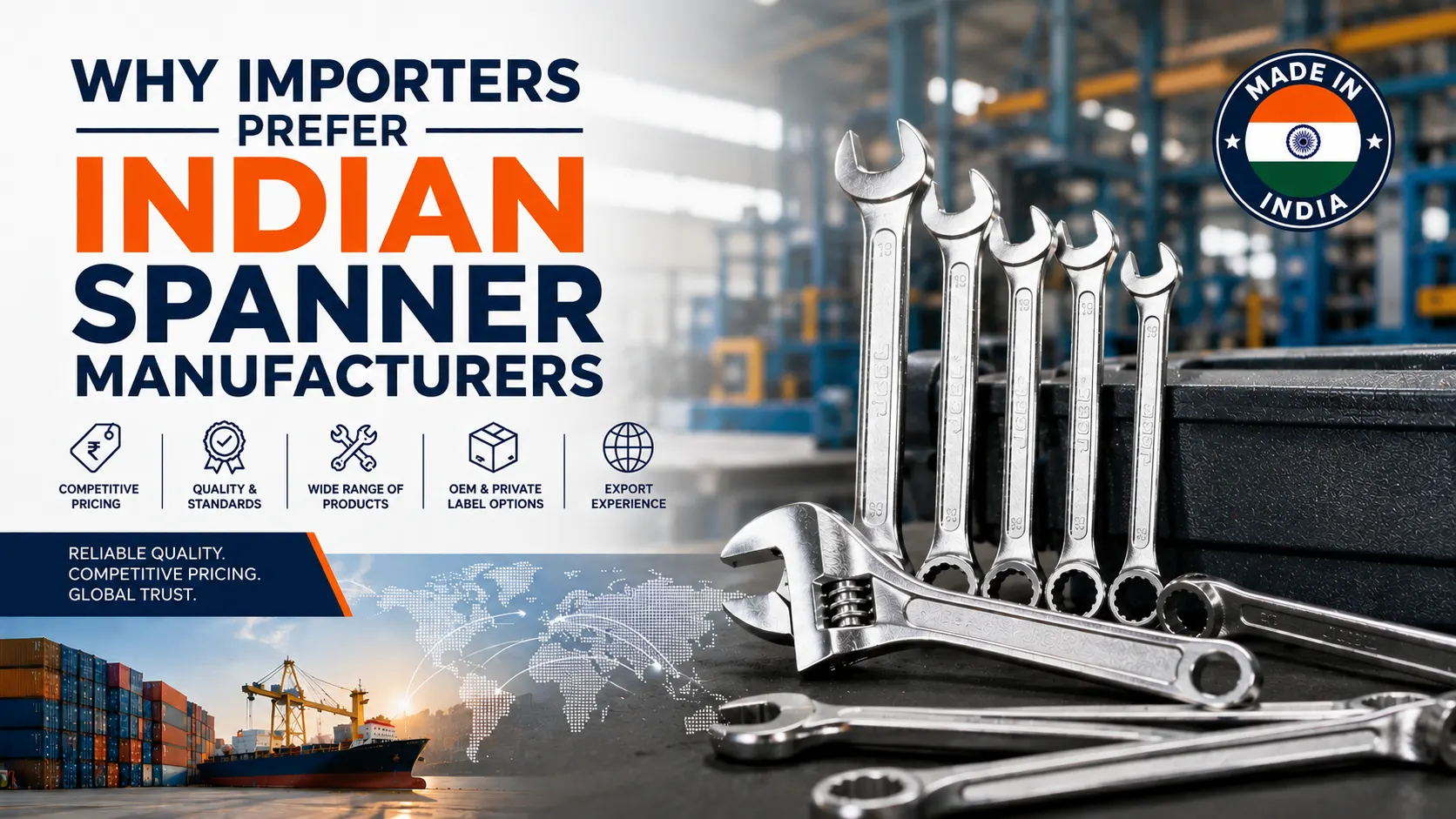
Indian spanner manufacturers are attractive to importers because they combine established hand-tool manufacturing expertise, competitive sourcing, product variety, customization capabilities, and export experience. India also has established hand-tool manufacturing clusters, particularly in Punjab, along with Indian Standards covering several types of spanners and wrenches. For importers, this combination can make India a practical sourcing market for standard, customized, and private-label spanners.
Why Do Importers Choose Indian Spanner Manufacturers?
Importers choose Indian spanner manufacturers for their combination of competitive pricing, established hand-tool manufacturing expertise, product variety, OEM capabilities, quality standards and export experience. India’s established manufacturing clusters, particularly in Punjab, further support sourcing for standard, customized and private-label spanners.
1. Competitive Manufacturing Costs
Indian spanner manufacturers can offer competitive pricing because they operate within an established engineering and metalworking ecosystem with access to skilled labor, supporting industries and manufacturing infrastructure.
For importers, the advantage is not simply a lower price. The focus is on achieving the right balance of cost, quality, consistency, lead time and supplier reliability.
2. Established Hand-Tool Manufacturing Expertise
India has an established hand-tool manufacturing base with capabilities covering key processes such as forging, machining, heat treatment, finishing and dimensional inspection.
NITI Aayog identifies Jalandhar and Ludhiana in Punjab among India’s major hand-tool manufacturing clusters, with additional manufacturing activity in states such as Maharashtra and Rajasthan. These clusters provide access to skilled workers, supporting suppliers and related engineering capabilities.
3. Wide Range of Spanner Products
Indian manufacturers can supply different types of spanners and related hand tools, depending on their production capabilities, including:
- Open-end spanners
- Ring spanners
- Combination spanners
- Double-ended spanners
- Adjustable wrenches
- Slugging spanners
- Spanner sets
India also has established BIS standards for several wrench and spanner categories, including IS 2028 for open-jaw wrenches, IS 2029 for ring wrenches, IS 4508 for open-ended slugging wrenches and IS 4509 for ring slugging wrenches.
This gives buyers a recognized framework for defining and evaluating applicable product requirements.
4. OEM and Private-Label Capabilities
Indian OEM spanner manufacturers can support customized requirements for distributors, wholesalers, and international tool brands.
Depending on the supplier, customization may include the following:
- Product dimensions and specifications
- Brand or logo marking
- Surface finishes
- Customized spanner sets
- Private-label packaging
- Retail or bulk packaging
Importers should confirm MOQ, tooling requirements, production capacity and quality controls before placing a customized order.
5. Established Quality and Standards Framework
Quality is critical when importing spanners because material properties, dimensions and mechanical performance must meet the requirements of the intended application.
BIS has established standards for several spanner and wrench categories, while the Hand Tools (Quality Control) Order, 2025, covers specified hand tools, including certain open-jaw and ring wrenches.
However, a national standard does not mean every manufacturer automatically complies with it. Importers should verify the individual supplier’s
- Applicable BIS certification or license
- Material specifications
- Testing procedures
- Inspection records
- Product test reports
- Quality-control systems
6. Access to India’s Export Ecosystem
India’s hand-tool industry is part of its broader engineering export sector. EEPC India represents hand tools within India’s engineering-export ecosystem, supporting the sector’s connection with international markets.
Manufacturers with established export experience may be better equipped to handle:
- Export documentation
- International packaging
- Product labelling
- Shipment coordination
- Commercial documentation
- Overseas buyer specifications
For importers, the key consideration is therefore the manufacturer’s actual export experience, not simply its location in India.
7. Access to Established Manufacturing Clusters
India’s hand-tool manufacturing clusters can also support efficient sourcing. Jalandhar and Ludhiana in Punjab are particularly important centres, with established networks of manufacturers, skilled workers and supporting industries.
For importers, this can provide greater access to suppliers and related manufacturing capabilities. However, supplier capability should remain more important than location alone when selecting an Indian spanner manufacturer.
What Makes India Competitive for Spanner Imports?
India’s appeal is best understood as a combination of sourcing factors rather than one single advantage.
| Importer requirement | Why India can be attractive |
| Competitive pricing | Established engineering and manufacturing ecosystem |
| Product variety | Broad hand-tool manufacturing base |
| Custom products | OEM and private-label capabilities from suitable suppliers |
| Quality requirements | Established Indian Standards and quality frameworks |
| Bulk procurement | Export-oriented manufacturing capabilities |
| Supplier access | Established hand-tool clusters |
| International sourcing | Existing engineering export ecosystem |
This does not mean India is automatically the best sourcing destination for every importer. Buyers should compare suppliers based on product specifications, total landed cost, quality, capacity, and delivery requirements.
What Should Importers Check Before Choosing an Indian Spanner Manufacturer?
Choosing a supplier based only on catalog photos or quoted price can create quality and delivery risks.
Importers should assess five areas before placing a commercial order.
Product Specifications
Confirm:
- Material grade
- Dimensions and tolerances
- Hardness requirements
- Surface finish
- Mechanical requirements
- Applicable Indian or international standards
Manufacturing Capability
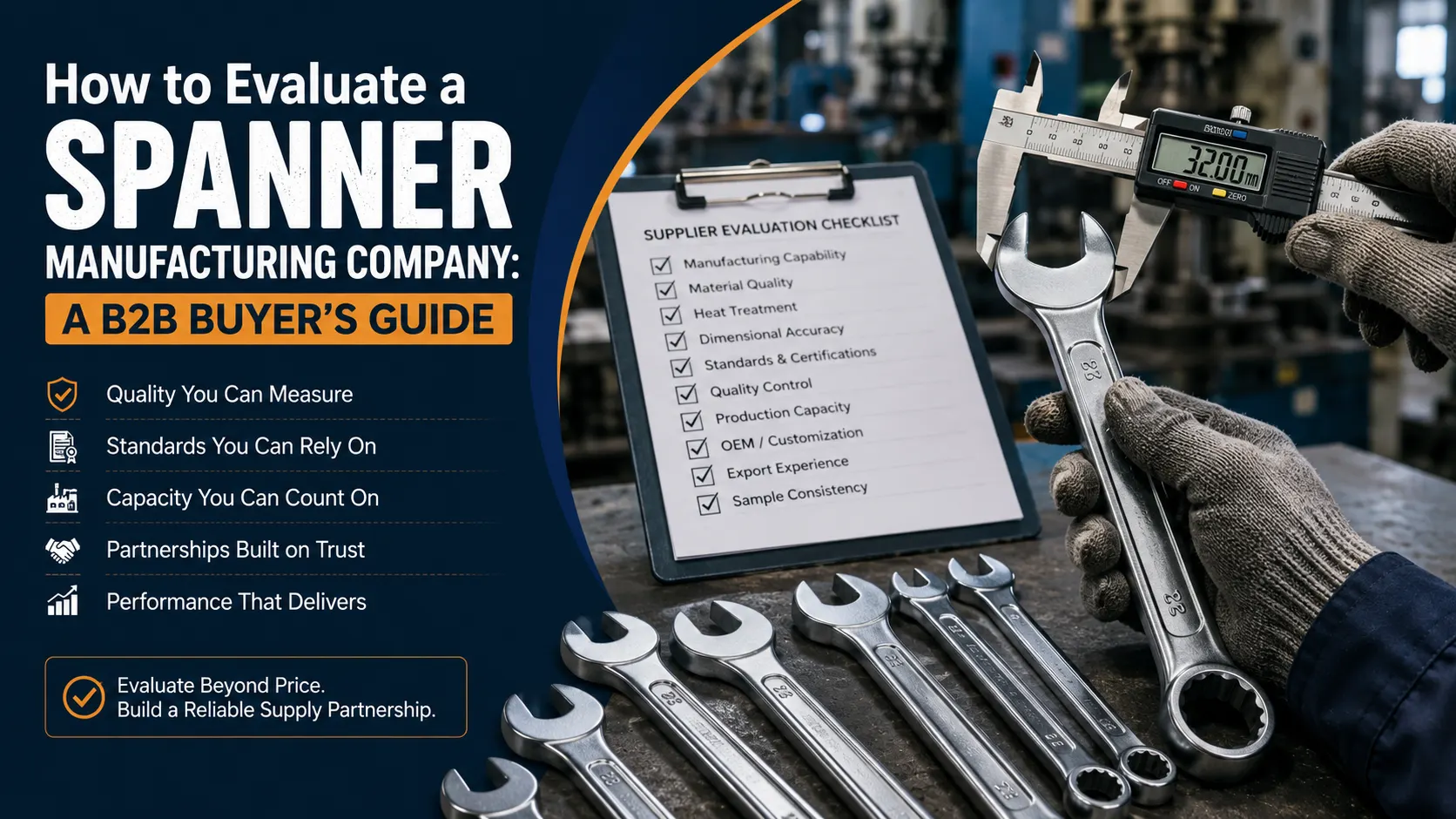
Ask whether the manufacturer has the required forging, machining, heat-treatment, finishing and inspection capabilities.
Quality Control
Review quality procedures, inspection methods, test reports, certifications and batch-control practices.
Export Experience
Check experience with international buyers, packaging requirements, documentation and shipping arrangements.
Commercial Terms
Compare:
- MOQ
- Unit pricing
- Tooling costs
- Payment terms
- Production lead time
- Packaging costs
- Replacement or warranty terms
A supplier that offers a lower unit price may not provide the lowest total sourcing cost once quality, freight, delays and rejection risks are considered.
How to Choose the Right Spanner Manufacturer
A structured sourcing process can reduce supplier-selection risks:
Define specifications → Shortlist manufacturers → Verify capabilities → Request samples → Inspect quality → Compare commercial terms → Place a trial order → Scale procurement
Samples are particularly important for importers ordering customized or private-label spanners. They allow buyers to evaluate the actual product before committing to larger production quantities.
Conclusion
Indian spanner manufacturers can offer importers a combination of manufacturing expertise, competitive sourcing, product flexibility and access to an established export ecosystem. India’s major hand-tool clusters and standards framework further support its position as a sourcing market.
However, country of origin should be only the starting point. The best sourcing decision comes from verifying the individual manufacturer’s quality, capabilities, certifications, capacity, commercial terms and ability to meet the importer’s exact requirements.
FAQs
Importers consider Indian manufacturers because of India’s established hand-tool manufacturing ecosystem, competitive sourcing potential, product variety, OEM capabilities and export infrastructure.
They can be, provided the manufacturer meets the buyer’s required specifications, applicable standards, quality requirements and destination-market regulations.
Yes. Manufacturers with suitable OEM capabilities may provide customized products, branding, packaging and product configurations. Requirements vary by supplier.
Jalandhar and Ludhiana in Punjab are major hand tool manufacturing centres. On the other hand, hand-tool activity is also present in parts of Maharashtra and Rajasthan.
Importers should verify material and product specifications, manufacturing capability, quality systems, applicable certifications, testing, MOQ, pricing, lead times and export experience.
Request product samples, technical specifications, quality documents, applicable certifications, factory information and references or evidence of export experience before placing a large order.
Related Readings: