India vs. China: Which Is Better for Sourcing Spanners?
- India vs. China for Spanner Sourcing: A Quick Comparison
- Manufacturing Cost and Total Landed Cost
- Spanner Quality, Materials, and Quality Control
- Manufacturing Capabilities and Customisation
- Minimum Order Quantities and Supplier Flexibility
- Lead Times, Shipping, and Supply Chain Reliability
- Why Consider Indian Spanner Manufacturers?
- How to Choose the Right Spanner Supplier
- Conclusion
- FAQs
Choosing between India and China for spanner sourcing requires more than comparing unit prices. Importers, wholesalers, distributors, and tool brands must evaluate manufacturing capabilities, product quality, minimum order quantities (MOQs), delivery timelines, and total landed costs before selecting a supplier.
India and China can both be viable sourcing destinations for spanners. The right choice depends on your product specifications, order volume, target market, and supplier performance. Comparing individual manufacturers against consistent technical and commercial criteria is the most reliable way to make an informed decision.
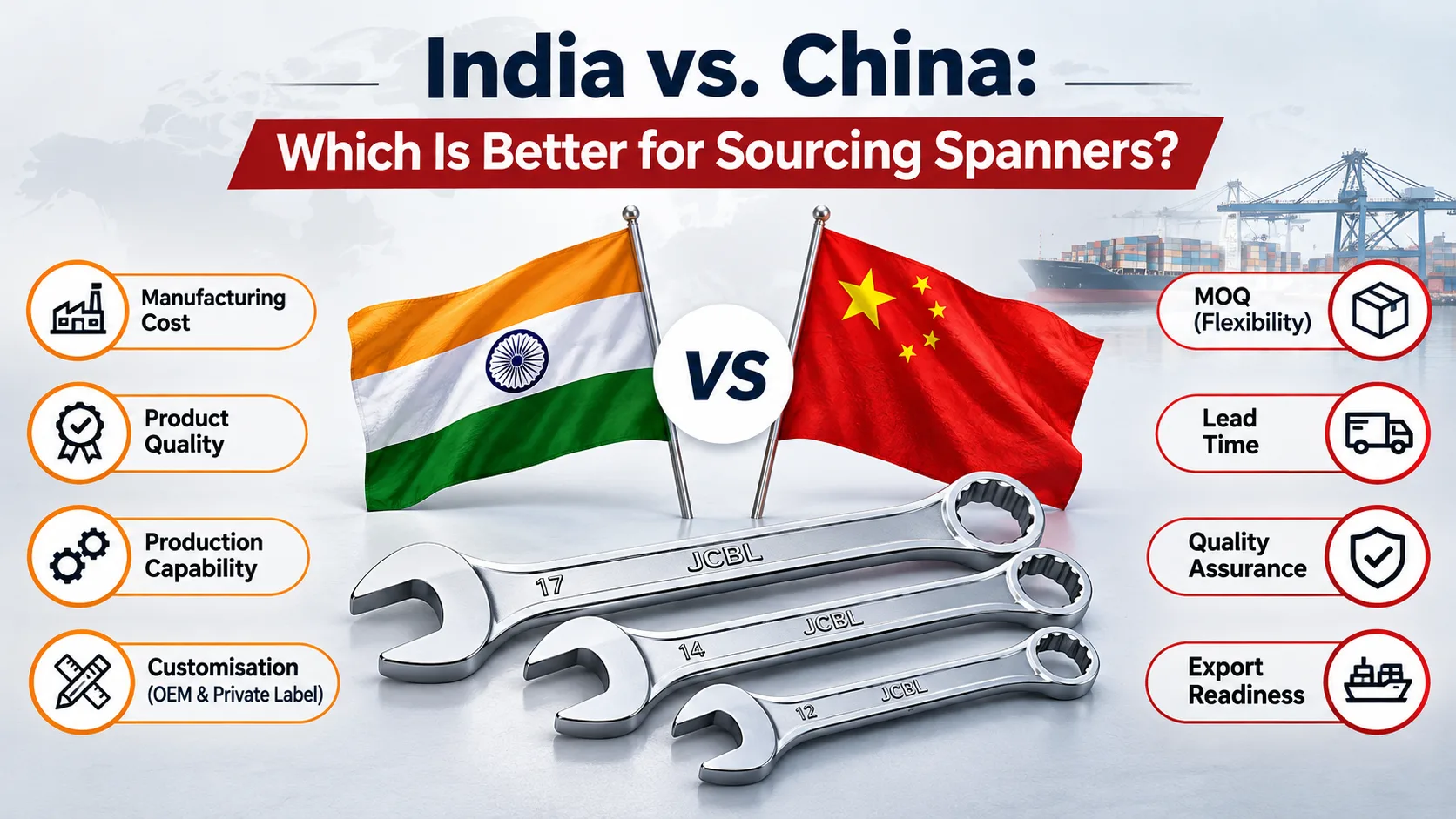
India vs. China for Spanner Sourcing: A Quick Comparison
| Factor | What buyers should evaluate |
| Manufacturing cost | Unit price, tooling, packaging, and total landed cost |
| Product quality | Material grade, hardness, dimensional accuracy, and finish |
| Production capacity | Manufacturing capabilities and ability to handle repeat orders |
| Customization | OEM manufacturing, private labelling, and custom specifications |
| MOQ | Supplier-specific minimum order quantities |
| Lead time | Production schedules, shipping, and customs clearance |
| Quality assurance | Inspection procedures, test reports, and traceability |
| Export readiness | Documentation and destination-market requirements |
Neither country is automatically better across all these factors. The decision should be based on verified supplier capabilities and the requirements of your business.
Manufacturing Cost and Total Landed Cost
Manufacturing cost is often a primary consideration when sourcing spanners in bulk. However, the lowest quoted price does not necessarily represent the most economical option.
When comparing Indian and Chinese spanner manufacturers, evaluate:
- Unit price: Compare quotations for identical spanner types, material specifications, sizes, and order quantities.
- Additional charges: Account for tooling, customisation, packaging, and inspection costs.
- Import expenses: Include freight, insurance, customs duties, and applicable import charges.
- Quality-related costs: Consider the financial impact of defective products, rework, returns, and delayed deliveries.
Request itemised quotations from suppliers in both countries. Calculate the total landed cost per saleable spanner to understand the actual cost of bringing products to your warehouse.
Spanner Quality, Materials, and Quality Control
Spanner quality directly affects product performance, durability, and customer satisfaction. Buyers should assess the manufacturer’s quality-control processes rather than assume that a particular country guarantees better products.
Key checks include:
- Material specifications: Verify the steel grade and material traceability against your requirements.
- Heat treatment and hardness: Request relevant test results to establish whether the spanner meets the specified mechanical requirements.
- Dimensional accuracy: Check jaw openings, ring dimensions, tolerances, and fit.
- Performance testing: Review applicable strength or torque-test results for the product type.
- Batch consistency: Ask how the manufacturer monitors production quality and handles non-conforming products.
For example, the Bureau of Indian Standards publishes specifications for different spanner types, including open-jaw and ring spanners. Buyers should identify the applicable standard and confirm its current edition and relevance to their product and target market.
Before placing a bulk order, evaluate samples and request documented evidence of quality checks. Apply the same acceptance criteria to Indian and Chinese suppliers.
Manufacturing Capabilities and Customisation
The right supplier must be able to manufacture the products your business needs consistently, whether you distribute standard tools or sell products under your own brand.
Evaluate manufacturers on their ability to produce the required spanner types, such as open-end, ring, combination, and adjustable spanners, where applicable.
Also assess their capabilities in:
- OEM manufacturing and private-label production.
- Custom designs, dimensions, and product specifications.
- Branding, labelling, and retail or bulk packaging.
- Tooling, production capacity, and repeat-order consistency.
India has an established hand-tool manufacturing base, particularly in clusters such as Jalandhar and Ludhiana in Punjab. A 2025 report by NITI Aayog and the Foundation for Economic Development identifies hand tools as an important opportunity for India’s manufacturing and export growth. However, industry-level potential does not establish the capabilities of any individual manufacturer.
For buyers considering India, the practical step is to shortlist manufacturers whose product range, technical capabilities, and production capacity match the order requirements.
Minimum Order Quantities and Supplier Flexibility
Minimum order quantity affects inventory investment, working capital, and the ability to test a new supplier.
Do not assume that Indian manufacturers always accept smaller orders or that Chinese suppliers require larger quantities. MOQs vary by manufacturer, product complexity, tooling requirements, and production arrangements.
Before finalizing a supplier, confirm:
- The MOQ for standard and customized spanners.
- Whether a trial order or sample batch is available.
- Additional costs for small production runs.
- Requirements for custom branding and packaging.
- Flexibility for repeat orders and changes in demand.
For distributors introducing a new product line, a manageable initial order can help assess quality and market demand before committing to larger volumes.
Lead Times, Shipping, and Supply Chain Reliability
A competitive quotation is useful only if the supplier can deliver the required products within your schedule.
Compare the complete order timeline, including manufacturing, quality inspection, dispatch, international transit, and customs clearance.
Ask prospective suppliers about production capacity, current order backlogs, shipping arrangements, export documentation, and their process for communicating delays.
The destination market also matters. Freight costs, transit times, customs procedures, and applicable duties vary by route and shipment. An Indian supplier may be commercially attractive for one buyer, while a Chinese supplier may offer a better overall arrangement for another.
Request realistic delivery schedules and review the supplier’s track record for on-time deliveries before committing to recurring orders.
Why Consider Indian Spanner Manufacturers?
India is worth considering for businesses seeking an alternative or additional source of hand tools. Its established manufacturing clusters, including those in Punjab, provide a starting point for identifying relevant manufacturers and export suppliers.
Potential advantages for a particular buyer may include access to manufacturers producing the required spanner categories, opportunities for OEM or private-label arrangements, and the ability to develop long-term supplier relationships.
However, these benefits must be verified at the company level. Buyers should confirm product availability, manufacturing processes, quality documentation, order capacity, pricing, and export experience rather than relying on broad claims about Indian manufacturing.
India should also be evaluated on its actual commercial competitiveness. NITI Aayog’s 2025 hand and power tools sector report discusses both India’s export opportunities and structural challenges affecting the industry’s global competitiveness. This makes supplier-level cost and capability assessments especially important.
How to Choose the Right Spanner Supplier
Whether sourcing from India or China, use a consistent evaluation process before placing a bulk order.
- Define product specifications: Document spanner types, sizes, materials, tolerances, finishes, and applicable standards.
- Request comparable quotations: Use identical specifications, quantities, packaging requirements, and delivery terms.
- Evaluate samples: Inspect dimensions, finish, fit, and relevant performance-test results.
- Verify the manufacturer: Check production capabilities, quality procedures, certifications where applicable, and export documentation.
- Compare total costs: Include tooling, freight, duties, insurance, inspection, and other relevant expenses.
- Assess delivery reliability: Confirm production schedules, lead times, communication, and repeat-order capacity.
- Agree on quality requirements: Establish acceptance criteria, inspection arrangements, and procedures for handling defective products.
This process helps buyers compare suppliers objectively and reduces the risk of choosing a manufacturer based solely on price.
Conclusion
The better sourcing destination is the one that meets your product requirements at a competitive total cost without compromising quality or delivery reliability.
India offers buyers an additional sourcing option through its hand-tool manufacturing base, while China remains an important destination for tool manufacturing. Rather than making a country-wide assumption, compare manufacturers on technical capabilities, quality assurance, customisation, order flexibility, and export performance.
For B2B buyers, the most effective sourcing decision comes from comparable quotations, evaluated samples, verified documentation, and a clear understanding of the supplier’s ability to fulfil both current and future orders.
FAQs
Both India and China can be suitable sourcing destinations. The better option depends on product specifications, order volumes, supplier capabilities, quality requirements, delivery schedules, and total landed cost. Buyers should compare individual manufacturers before making a decision.
Some Indian manufacturers serve export markets, but suitability depends on their production capacity, quality-control systems, documentation, and ability to meet destination-market requirements. Buyers should verify these factors before placing an order.
Request quotations for identical specifications and order quantities. Include tooling, packaging, freight, insurance, customs duties, and quality-related costs to calculate the total landed cost per saleable product.
Check material specifications, dimensional accuracy, relevant testing, sample quality, manufacturing capacity, MOQ, lead times, export experience, and quality documentation. Confirm applicable product standards and certification requirements for the destination market.
Some Indian manufacturers offer OEM production, custom specifications, branding, and packaging. Buyers should confirm these services, along with tooling costs, minimum order quantities, production timelines, and intellectual-property arrangements, directly with prospective suppliers.