Why Chrome Vanadium Is Used in Professional Spanners
- What Is Chrome Vanadium Steel?
- Why Is Chrome Vanadium Used in Professional Spanners?
- What Role Do Chromium and Vanadium Play in Cr-V Steel?
- How Does Heat Treatment Improve Chrome Vanadium Spanners?
- Chrome Vanadium vs Chrome Plating: What Is the Difference?
- Chrome Vanadium vs Chrome Molybdenum: Which Is Better?
- How to Evaluate the Quality of Chrome Vanadium Spanners
- Conclusion
- Frequently Asked Questions (FAQs)
Chrome Vanadium (Cr-V) steel is widely used in professional spanners because it offers a useful combination of strength, toughness, hardness and wear resistance when correctly manufactured and heat-treated. These properties help a spanner withstand repeated tightening and loosening operations while resisting excessive deformation and surface wear.
For mechanics, maintenance teams and industrial users, the material matters because a spanner must transfer torque to a fastener without losing its shape or damaging the nut or bolt. Chrome Vanadium steel is a popular choice because its alloying elements help manufacturers develop the mechanical properties required for demanding hand-tool applications. It is widely used across professional spanners and wrenches designed for automotive, industrial and mechanical applications.
What Is Chrome Vanadium Steel?
Chrome Vanadium steel is an alloy steel that contains chromium and vanadium alongside iron, carbon and other elements. Often identified by the abbreviation Cr-V, it is used in hand tools such as spanners, wrenches, screwdrivers and sockets.
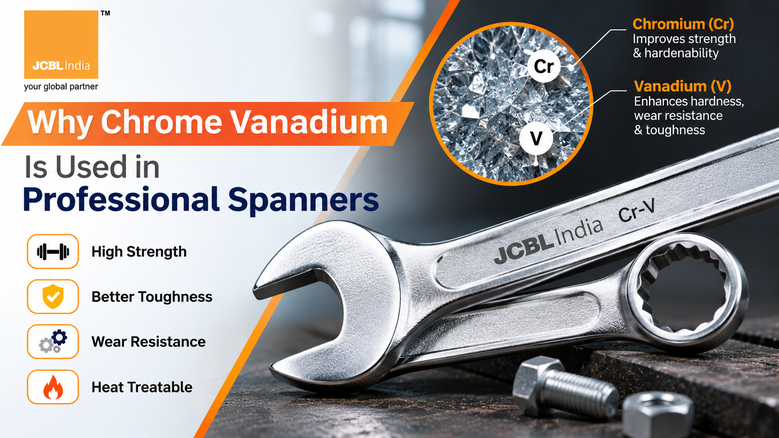
Chromium and vanadium contribute different properties to the steel. Chromium improves hardenability and supports strength and wear-related performance, while vanadium helps control grain growth and contributes to hardness, wear resistance and toughness.
The exact composition is not identical across every Chrome Vanadium steel grade. For example, 50BV30 is identified in an Indian government hand-tool manufacturing report as a commonly used Cr-V material for wrenches and other hand tools. The appropriate grade depends on the tool’s design, intended application and required mechanical properties.
Why Is Chrome Vanadium Used in Professional Spanners?
Professional spanners are exposed to repeated torque, contact pressure and friction. Their material must therefore provide more than basic hardness. It must also resist deformation, maintain the shape of its working surfaces and withstand the stresses associated with regular use.
Chrome Vanadium steel is suitable for these requirements because of several important material characteristics.
1. Strength to Withstand Applied Torque
When a spanner turns a nut or bolt, force is transmitted through its handle, head and working surfaces. If the steel lacks sufficient strength, the tool may bend or deform under load.
Chrome Vanadium alloying helps manufacturers achieve the strength required for demanding hand-tool applications through suitable material selection and heat treatment. A properly manufactured spanner can therefore maintain its shape more effectively during its intended use.
2. Hardness and Wear Resistance
The jaws and contact surfaces of a spanner repeatedly engage with nuts and bolts. Over time, friction and contact pressure can contribute to wear.
Chromium and vanadium support the development of hardness and wear resistance in alloy steel. Vanadium can also form hard vanadium carbide particles, which contribute to wear-related properties.
For a professional spanner, suitable surface hardness helps the working areas resist wear while maintaining the contact geometry needed for effective fastener engagement.
3. Toughness to Resist Fracture
Hardness alone does not make a spanner suitable for professional use. A material that is too brittle may crack or fracture when subjected to sudden or excessive loading.
Toughness describes a material’s ability to absorb energy before fracturing. Chrome Vanadium steel can provide a useful balance of hardness and toughness when its composition and heat treatment are properly controlled.
This balance is important for tools that experience repeated loading in automotive workshops, industrial maintenance and mechanical repair environments.
4. Hardenability for Consistent Heat Treatment
Hardenability refers to the ability of steel to develop hardness to a particular depth during heat treatment. It is different from the final hardness value itself.
Chromium and vanadium contribute to the hardenability of alloy steels. This helps manufacturers develop suitable mechanical properties through controlled heat treatment, depending on the steel grade and tool dimensions.
For spanners with different head and handle sections, achieving the required properties throughout the tool is an important part of manufacturing quality.
What Role Do Chromium and Vanadium Play in Cr-V Steel?
The two alloying elements work together, but their individual contributions are different.
| Alloying element | Main contribution | Importance in spanners |
| Chromium | Improves hardenability and contributes to strength and wear-related properties | Helps the steel develop suitable mechanical properties during heat treatment |
| Vanadium | Supports grain refinement and forms hard vanadium carbides | Contributes to hardness, wear resistance and resistance to deformation |
| Carbon | Contributes to the steel’s ability to harden | Helps develop the required hardness and strength |
| Iron | Forms the base of the alloy | Provides the main metallic structure |
The final performance of the steel depends on the complete chemical composition, manufacturing process and heat treatment. No single alloying element can guarantee the quality of a finished spanner.
How Does Heat Treatment Improve Chrome Vanadium Spanners?
The alloy composition is only one part of spanner performance. Manufacturing and heat treatment are equally important.
Heat treatment changes the internal structure of steel to develop the required hardness and mechanical properties. The heat treatment process for industrial spanners is controlled according to the selected grade, product dimensions and intended application.
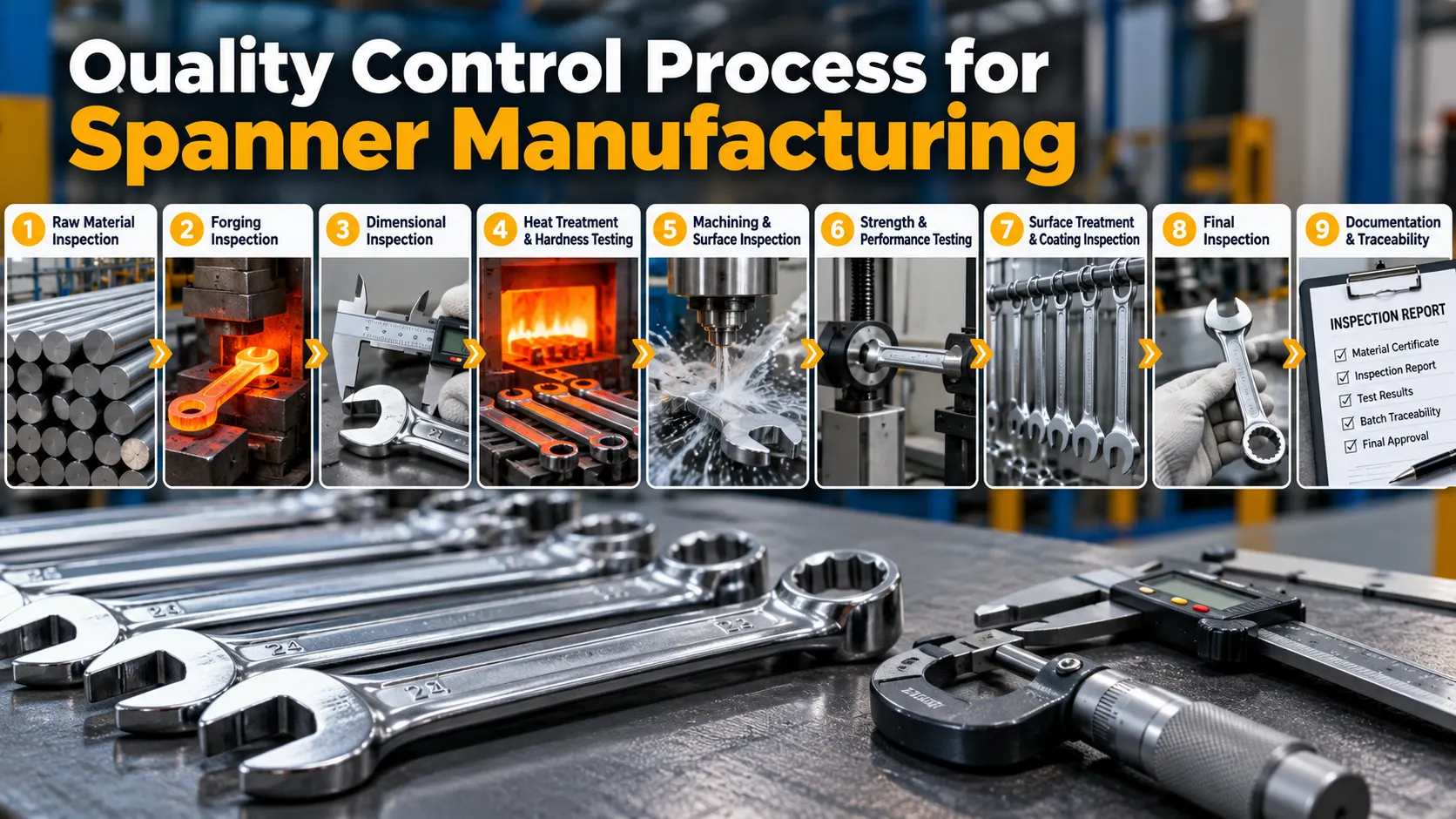
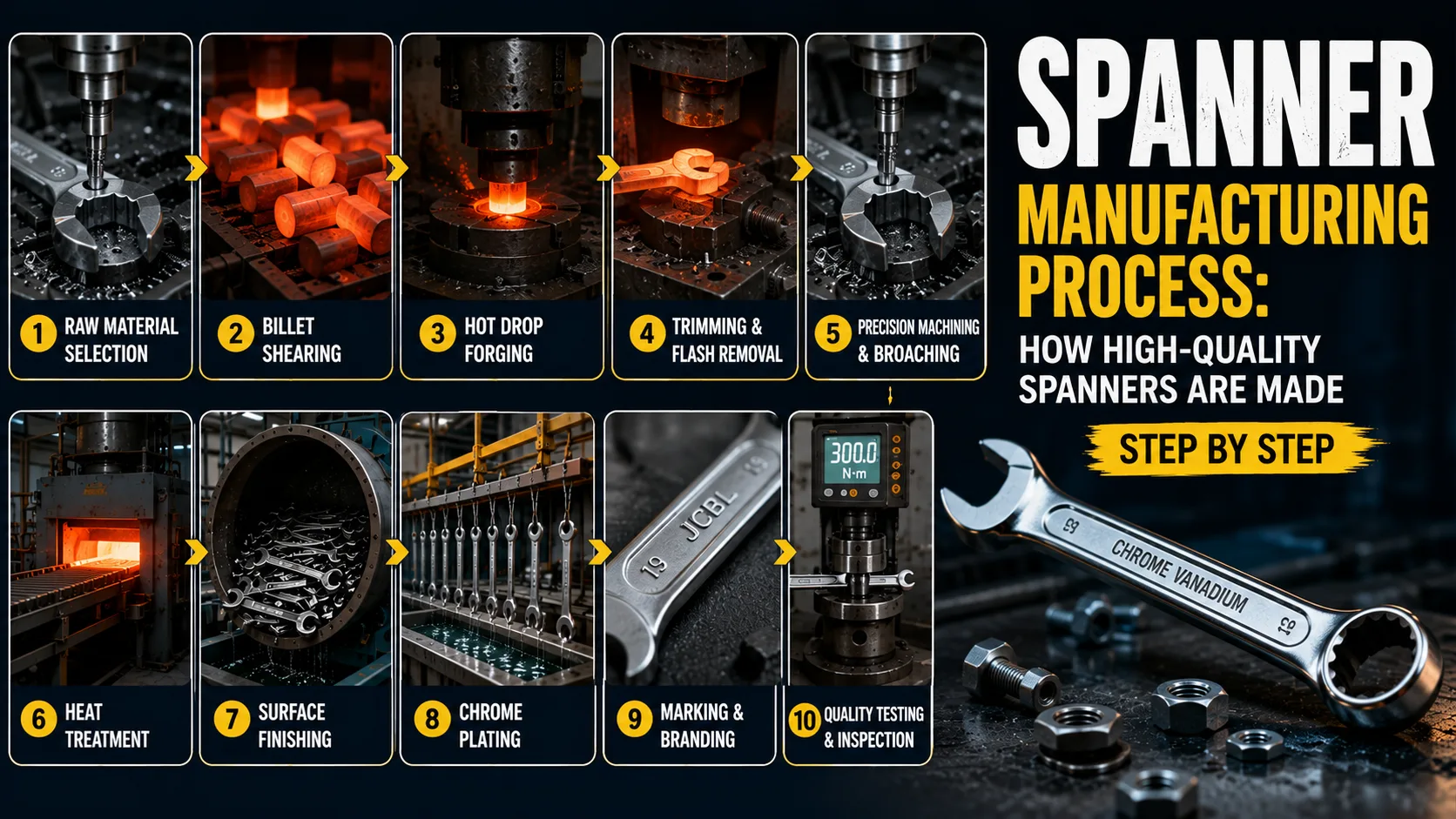
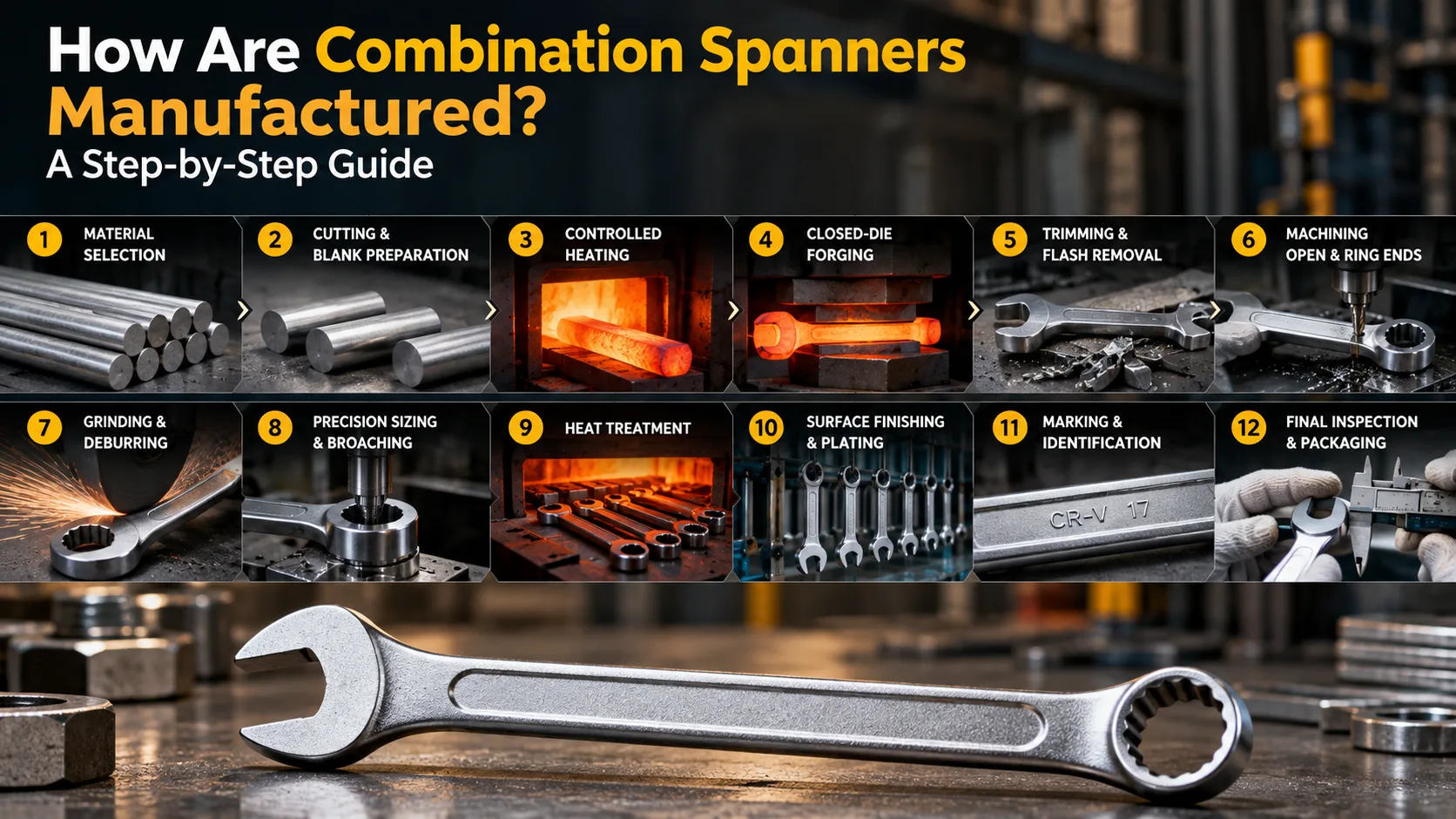
A typical hand-tool manufacturing process involves the following stages:
- Raw material selection: Steel is selected according to the required grade and product specifications.
- Heating and forging: The material is heated and shaped using suitable forging equipment and dies.
- Trimming and blank preparation: Excess material is removed to prepare the forged spanner profile.
- Heat treatment: The tool is treated under controlled conditions to develop the required strength and hardness.
- Machining and finishing: Working surfaces and dimensions are finished to meet product requirements.
- Surface treatment: A suitable protective coating or plating may be applied to improve the finish and provide corrosion protection.
- Inspection and testing: Finished tools are checked for dimensions, hardness, workmanship and relevant performance requirements.
The precise manufacturing sequence and heat-treatment parameters vary with the product and material specification. Consistency at each stage is essential for producing reliable professional tools. The complete Chrome Vanadium spanner manufacturing process involves material selection, forging, machining, heat treatment, finishing and inspection.
Chrome Vanadium vs Chrome Plating: What Is the Difference?
Chrome Vanadium steel and chrome plating are not the same thing.
Chrome Vanadium Steel
Chrome Vanadium refers to the base material, meaning the alloy steel from which the spanner is manufactured. Chromium and vanadium are incorporated into the steel’s composition.
Chrome Plating
Chrome plating is a surface-finishing process in which a chromium-containing coating is deposited onto the tool. It is commonly used to improve surface appearance and provide corrosion protection.
A spanner can therefore be manufactured from Chrome Vanadium steel and then receive a chrome-plated finish. The material and its surface treatment serve different purposes. The electroplating process used on spanners provides a protective surface layer, while the base steel and heat treatment determine much of the tool’s mechanical performance.
It is also important to note that Chrome Vanadium steel should not be confused with stainless steel. Its chromium content is generally much lower than that required for stainless-steel classification, so a Cr-V spanner is not automatically rust-proof.
For example, JCBL’s cold-stamped Chrome Vanadium combination spanner lists nickel-chrome plating and hardening and tempering as separate product features. This illustrates the difference between the base material, heat treatment and surface finish.
Chrome Vanadium vs Chrome Molybdenum: Which Is Better?
Chrome Vanadium (Cr-V) and Chrome Molybdenum (Cr-Mo) are different alloy-steel systems used in engineering and tool manufacturing.
Both can be developed to provide useful combinations of strength, toughness and hardenability. However, their performance depends on the specific grade, chemical composition, heat treatment, tool geometry and intended application.
| Feature | Chrome Vanadium (Cr-V) | Chrome Molybdenum (Cr-Mo) |
| Main alloying elements | Chromium and vanadium | Chromium and molybdenum |
| Common tool applications | Spanners, wrenches and other hand tools | Selected sockets, impact tools and engineering applications |
| Key material characteristics | Strength, hardenability, hardness and toughness | Strength, hardenability and toughness |
| Material selection | Depends on tool design and performance requirements | Depends on tool design and performance requirements |
Neither material should be considered universally superior based on its name alone. Buyers should compare the actual material specification and finished-tool performance for the intended application.
How to Evaluate the Quality of Chrome Vanadium Spanners
For importers, wholesalers, distributors and professional tool buyers, checking the material marking alone is not enough. A reliable assessment should consider the material, manufacturing quality and finished-product testing.
Important points include:
- Material grade and composition: Confirm the specified alloy grade and whether the supplier can provide supporting material documentation.
- Hardness: Check that the finished spanner meets the hardness requirements applicable to its type and size.
- Torque performance: Evaluate whether the tool meets the required torque-test specifications.
- Dimensional accuracy: Check jaw openings, dimensions and tolerances to ensure proper fastener engagement.
- Workmanship and finish: Inspect forging quality, surface condition and working edges.
- Protective coating: Confirm the type and quality of the surface finish or anti-corrosive coating.
- Quality consistency: Review inspection procedures, batch traceability and quality documentation.
These checks are part of broader industrial spanner testing methods, which may include material verification, hardness testing, dimensional inspection, torsional-strength testing, coating inspection and functional checks.
In India, the revised IS 2028:2026 standard covers open-jaw spanners, while IS 2029:2026 covers ring spanners. The BIS testing listings identify material composition, hardness, workmanship, coating or plating and torque testing as separate assessment areas. Buyers should check the applicable standard and requirements for the specific product.
Conclusion
Chrome Vanadium is used in professional spanners because it can provide the combination of strength, hardness, toughness and wear resistance required for demanding hand-tool applications. Chromium and vanadium contribute different metallurgical benefits, while controlled forging, heat treatment, machining and inspection help turn the alloy into a reliable finished tool.
For professional buyers, the most important consideration is not simply whether a spanner carries a Cr-V marking. Its actual material grade, heat treatment, dimensions, finish and tested performance all contribute to overall quality.
Frequently Asked Questions (FAQs)
1. Why is Chrome Vanadium steel preferred for spanners?
Chrome Vanadium steel is widely used because it can provide a useful combination of strength, hardness, toughness and wear resistance. These properties help professional spanners withstand repeated loading when they are correctly designed and manufactured.
2. Does Chrome Vanadium make a spanner stronger?
Chromium and vanadium contribute to the strength and hardenability of alloy steel. However, the finished spanner’s strength also depends on its exact steel grade, dimensions, heat treatment and manufacturing quality.
3. Are Chrome Vanadium spanners rust-proof?
No. Chrome Vanadium steel is not stainless steel and can corrode under unsuitable conditions. Protective finishes or coatings can help reduce corrosion, but proper storage and maintenance remain important.
4. Is Chrome Vanadium the same as chrome-plated steel?
No. Chrome Vanadium describes the alloy composition of the base steel, whereas chrome plating is a surface treatment. A Cr-V spanner may also have a chrome-plated finish.
5. What is the difference between Chrome Vanadium and Chrome Molybdenum tools?
Chrome Vanadium contains chromium and vanadium, while Chrome Molybdenum contains chromium and molybdenum. Both are used in engineering tools, but their suitability depends on the exact grade, heat treatment and application.
6. Does a Chrome Vanadium marking guarantee spanner quality?
No. The marking identifies the material family, but it does not independently confirm chemical composition, hardness, torque performance or manufacturing consistency. Buyers should evaluate the material specification and relevant finished-tool test results.
7. Why is heat treatment important in Chrome Vanadium spanners?
Heat treatment develops the steel’s required hardness and mechanical properties. Without suitable process control, even a correctly selected alloy may not deliver the intended performance in the finished spanner.