Difference Between Spanner and Wrench (Complete Guide)
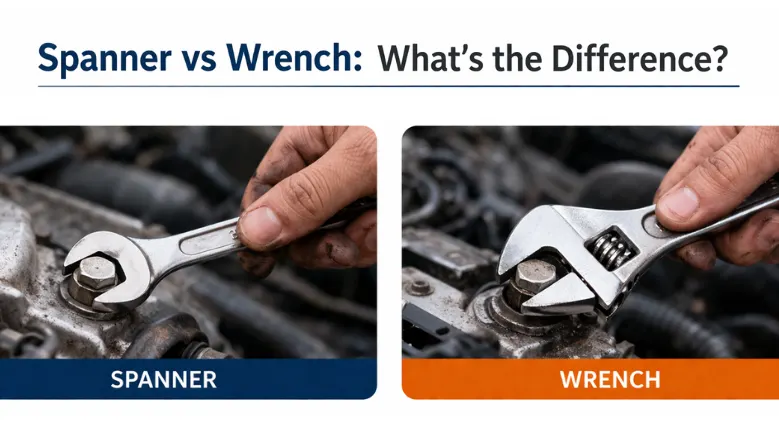
The main difference between a spanner and a wrench is that a spanner is a fixed-size tool designed for precise fits on specific bolts, whereas a wrench is a broader category that includes both fixed and adjustable tools. Additionally, “spanner” is the preferred term in the UK and India, while “wrench” is the standard term used in the USA.
A wrench and a spanner are essential hand tools used to tighten or loosen nuts and bolts. While these terms are often used interchangeably, their difference mainly depends on regional terminology, design, and practical applications.
In simple terms:
- Spanner: Usually refers to a tool with a fixed opening designed for a specific nut or bolt size.
- Wrench: A broader category that includes fixed, adjustable, or specialized gripping mechanisms.
Regional Terminology (The Biggest Difference)
The primary distinction between a spanner and a wrench is geographical rather than functional:
- UK, India, and Australia: Fixed-size fastening tools are commonly called Spanners (e.g., Open-ended spanner, Ring spanner).
- USA and Canada: Similar tools are universally referred to as Wrenches (e.g., Open-end wrench, Combination wrench). In these regions, the word “spanner” is reserved only for specialized tools like hook spanners.
What is a Spanner?
A spanner is a hand tool designed to grip and turn fasteners of a specific size. Because it has a fixed profile, it provides a tight, secure fit, making it ideal for precision work where preventing bolt damage is important.
Key Features:
- Fixed opening size (non-adjustable).
- High accuracy and precise grip.
- Lightweight and easy to handle in tight spaces.
Common Types & Applications:
- Types: Open-end, Ring, Combination, Socket, and Hook spanners.
- Best Used For: Automotive repair, machinery maintenance, and precise mechanical assembly.
Understanding the different types of spanners may help you choose the right tool for specific fastening applications.
What is a Wrench?
A wrench is a broader category of hand tools used to apply torque for turning fasteners. Depending on the type, a wrench may feature fixed jaws, adjustable jaws, or specialized mechanisms to handle multiple sizes or unique shapes.
Key Features:
- Available in fixed, adjustable, and specialized designs.
- Highly versatile (one tool can fit multiple sizes).
- Heavier build designed for high-torque applications.
Common Types & Applications:
- Types: Adjustable wrench (Shifter), Pipe wrench, Torque wrench, Monkey wrench, and Flare nut wrench.
- Best Used For: Plumbing, heavy-duty construction, and DIY tasks where the exact fastener size is unknown.
Head-to-Head Comparison
| Feature | Spanner | Wrench |
| Opening Type | Generally Fixed | Fixed, Adjustable, or Specialized |
| Grip Accuracy | Higher (Less risk of slipping) | Moderate to High (Higher risk if poorly adjusted) |
| Flexibility | Lower (One tool fits one size) | Higher (One tool can fit multiple sizes) |
| Measurement | Available in Metric (mm) & Imperial (inch) | Available in Metric (mm) & Imperial (inch) |
| Primary Region | UK, India, Europe, Australia | USA and Canada |
| Best For | Automotive & Precision Machinery | Plumbing, Construction & Heavy-duty tasks |
Understanding the Measurement Systems
There is a common misconception that spanners use the metric system (mm) and wrenches use the imperial system (inches). This is incorrect.
Both tools are manufactured in both sizing systems. The only difference is what they are called in their respective regions:
- In the UK/India, you will buy a 10mm Spanner or a 3/8-inch Spanner.
- In the USA, you will buy a 10mm Wrench or a 3/8-inch Wrench.
Practical Example
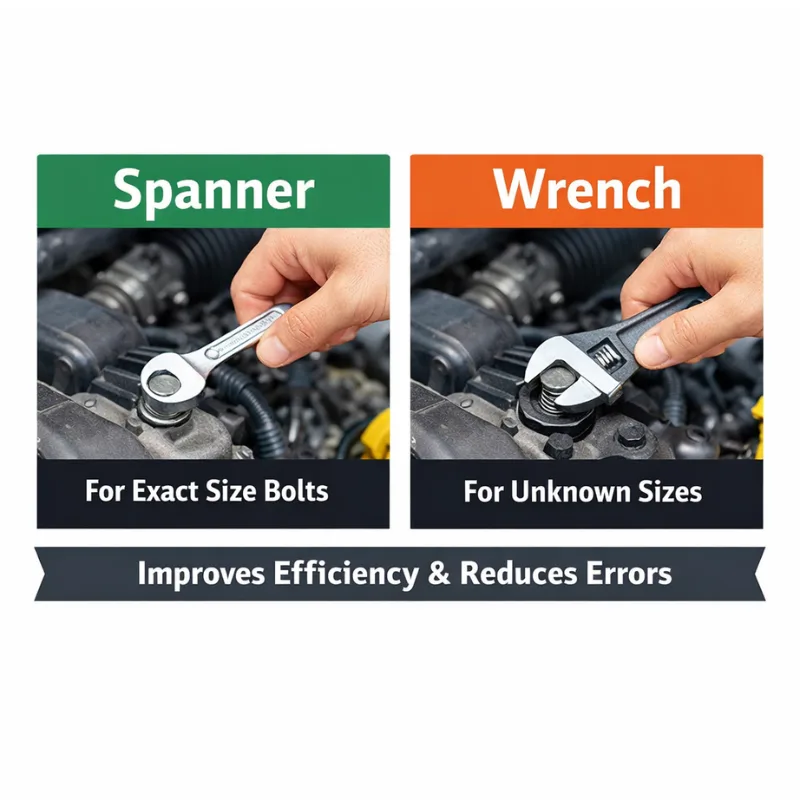
During automotive repairs, mechanics usually prefer ring or combination spanners because they wrap completely around the nut, providing a secure grip that won’t slip or round off the edges.
On the other hand, during plumbing work, a plumber will prefer an adjustable wrench or pipe wrench because pipes and fittings come in various unpredictable sizes, and carrying one adjustable tool is much easier.
Conclusion
Neither tool is universally better than the other. Spanners are the go-to choice for precise, exact-fit tasks in automotive and mechanical engineering. Wrenches offer the versatility and heavy-duty strength required for plumbing and general maintenance.
Using high-quality tools ensures a better grip, longer durability, and workplace safety. Choosing the correct tool depends entirely on your location, the type of work, and the required precision.
Using high-quality tools ensures better grip, durability, and safety in every task. JCBL Hand Tools provides a comprehensive range of spanners, wrenches, and professional hand tools built for precision, strength, and long-term performance across various applications.
FAQs
Yes, in most cases, they refer to the same tool. “Spanner” is the preferred term in British, Indian, and Australian English for a fixed-size tool, while “Wrench” is the standard American English term for any fastening tool.
Yes, but mainly for general or light tasks. For high-precision or high-torque work (like engine repairs), a fixed spanner is much safer because it won’t slip, wiggle, or round off the edges of the bolt.
Neither is universally better; it depends on the job. A spanner is superior for precise, tight spaces and exact-fit tasks. An adjustable wrench is better for flexibility when you need one tool to handle multiple fastener sizes (like in plumbing).
Both terms are absolutely correct. It purely depends on geography. If you are writing or working in the US/Canada, use Wrench. If you are in the UK, India, or Australia, Spanner is the more common term.
It comes down to language history. “Wrench” is derived from an Old English word meaning “to twist.” The US kept using this word for all twisting tools. On the other hand, the UK adopted “spanner” from the German word spannen, which means “to tension or fasten.”
Related Readings: