How Electroplating Improves Spanner Durability
- What Is Electroplating on a Spanner?
- How Does Electroplating Work on a Spanner?
- How Does Electroplating Improve Spanner Durability?
- Which Electroplating Finishes Are Used on Spanners?
- Does Electroplating Make a Spanner Stronger?
- What Determines the Durability of an Electroplated Spanner?
- How Do Manufacturers Check Electroplating Quality?
- What Should Buyers Check When Sourcing Electroplated Spanners?
- Electroplated vs. Unplated Spanners
- Conclusion
- FAQs
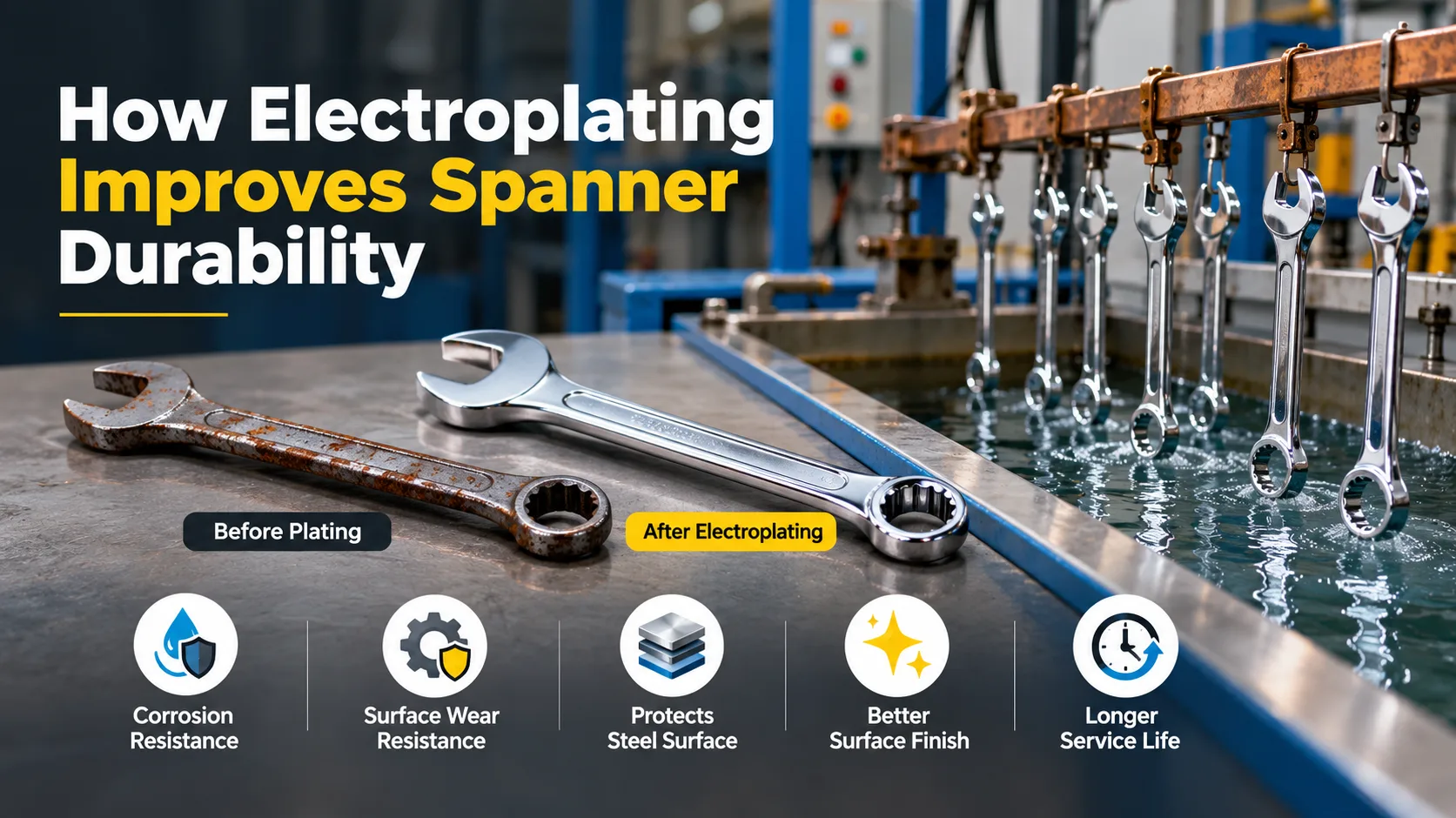
Electroplating improves spanner durability by depositing a protective metal layer onto the steel surface. Depending on the plating system, this coating can improve resistance to corrosion, oxidation, and surface wear, helping the spanner maintain its surface condition during repeated use and storage. However, electroplating mainly protects the surface; the spanner’s mechanical strength depends primarily on its steel, heat treatment, geometry, and manufacturing quality.
What Is Electroplating on a Spanner?
Electroplating is an electrochemical process used to deposit a thin layer of metal onto a spanner’s surface. An electrical current causes metal ions in an electrolyte solution to deposit onto the tool, creating a protective coating.
Nickel and nickel-chrome systems are commonly associated with plated hand-tool finishes because they can provide corrosion protection, surface durability, and a consistent appearance.
Before plating, the spanner must be properly cleaned and prepared. This is important because oil, dirt, oxidation, or other contaminants can interfere with coating adhesion.
How Does Electroplating Work on a Spanner?
The basic electroplating process involves several controlled stages:
Surface preparation → Cleaning → Electrolyte bath → Electrical current → Metal deposition → Rinsing → Final inspection
During plating, the spanner acts as the cathode, while the plating metal is connected as the anode. Both are placed in an electrolyte containing ions of the coating metal. When electrical current passes through the bath, the metal ions move toward the spanner and are deposited on its surface.
The resulting coating forms a controlled protective layer. Its performance depends on factors such as the plating material, coating thickness, surface preparation, current control, and adhesion.
How Does Electroplating Improve Spanner Durability?
1. Improves Corrosion Resistance
Steel can corrode when exposed to moisture, oxygen, salts, and other corrosive substances. Electroplating provides a protective surface layer that reduces direct exposure of the underlying steel.
This can be particularly useful for spanners stored or used in:
- Humid workshops
- Automotive service environments
- Industrial facilities
- Warehouses and transportation
- Areas exposed to moisture
The level of corrosion protection depends on the plating system, coating quality, and working environment.
2. Improves Surface Wear Resistance
Spanners are repeatedly handled and can experience abrasion during use, storage, and contact with other tools. Certain plating systems provide a harder surface that can improve resistance to everyday surface wear.
However, this does not mean the coating determines the tool’s overall mechanical performance. A durable plated surface cannot compensate for unsuitable steel or incorrect heat treatment.
3. Protects the Steel Surface
The base steel provides the structural foundation of a spanner. Protecting its surface helps reduce environmental exposure that can lead to oxidation and deterioration.
This is particularly relevant for tools that need to remain in storage for extended periods or operate in environments where corrosion is a concern.
4. Helps Maintain Surface Finish
Electroplating can provide a uniform metallic finish while helping reduce surface oxidation and discoloration.
For professional and industrial tools, consistent finishing can also contribute to:
- Product appearance
- Batch-to-batch consistency
- Surface cleanliness
- Long-term storage condition
Appearance, however, should be treated as a finishing characteristic rather than an indicator of mechanical strength.
5. Supports Longer Service Life
By reducing corrosion and surface deterioration, an appropriate plating system can help preserve the condition of a spanner over time.
Electroplating is therefore one factor supporting tool durability, rather than the sole factor determining service life.
Which Electroplating Finishes Are Used on Spanners?
Nickel Plating
Nickel plating provides a protective metallic layer with good corrosion resistance and a smooth surface finish. It can be used when corrosion protection and appearance are important requirements.
Nickel-Chrome Plating
Nickel-chrome plating combines a nickel layer with a chromium surface layer. This type of finish is commonly associated with hand tools where corrosion resistance, surface durability, and appearance are required.
The appropriate plating system should be selected according to the tool’s application, required performance, and applicable product specifications.
Does Electroplating Make a Spanner Stronger?
Electroplating primarily improves surface properties, not the fundamental strength of a spanner.
A spanner’s mechanical performance is influenced mainly by:
- Steel grade: Determines important material properties.
- Heat treatment: Helps achieve the required hardness and toughness.
- Tool geometry: Affects how the tool handles applied loads.
- Manufacturing accuracy: Ensures the finished tool meets its dimensional requirements.
Electroplating adds surface protection. It should therefore not be used as a substitute for appropriate material selection or heat treatment.
What Determines the Durability of an Electroplated Spanner?
- Base Steel: The steel grade determines much of the tool’s underlying mechanical performance.
- Heat Treatment: Controlled heat treatment helps establish the required hardness and toughness for the intended application.
- Surface Preparation: Cleaning and preparation before plating are critical to coating adhesion. Poor preparation can result in inconsistent coverage or premature coating failure.
- Coating Thickness and Uniformity: The coating should meet the specified thickness and provide consistent coverage. The appropriate thickness depends on the plating system and product requirements.
- Coating Adhesion: Good adhesion helps the coating remain attached to the steel during handling and use. Poor adhesion can lead to peeling, flaking, or localized deterioration.
- Operating Environment: Moisture, chemicals, abrasion, frequency of use, and storage conditions all affect how long the plated surface remains effective.
How Do Manufacturers Check Electroplating Quality?
For industrial and OEM spanners, plating quality can be evaluated through controlled inspection and testing.
Depending on the product specification, manufacturers may check:
- Coating thickness
- Coating adhesion
- Surface uniformity
- Corrosion resistance
- Surface defects
- Finished dimensions
- Overall surface finish
These checks help ensure the coating meets the required specification without interfering with functional areas of the tool.
What Should Buyers Check When Sourcing Electroplated Spanners?
B2B and OEM buyers should evaluate the plating as part of the complete tool specification.
Important points include:
- Base steel specification
- Heat-treatment requirements
- Plating material and finish
- Required coating thickness
- Coating adhesion
- Corrosion-resistance requirements
- Dimensional tolerances after plating
- Applicable testing and product requirements
- Consistency across production batches
This approach helps buyers assess both the protective finish and the underlying quality of the spanner.
Electroplated vs. Unplated Spanners
| Factor | Electroplated Spanner | Unplated Spanner |
| Corrosion protection | Protective plated surface | Depends on steel and other protection |
| Surface wear | Can provide additional surface resistance | Depends on material and surface condition |
| Appearance | Consistent metallic finish | Depends on the finishing process |
| Storage | Useful where corrosion protection is required | May require additional corrosion protection |
| Mechanical strength | Mainly determined by steel and heat treatment | Mainly determined by steel and heat treatment |
The appropriate option depends on the intended application, environmental exposure, and required surface protection.
Conclusion
Electroplating improves spanner durability mainly by protecting the steel surface against corrosion, oxidation, and wear. Its effectiveness depends on the plating material, surface preparation, coating thickness, adhesion, and process control. For industrial and OEM spanners, plating should be evaluated alongside steel grade, heat treatment, tool geometry, and manufacturing accuracy.
FAQs
Electroplating improves resistance to corrosion but does not make a spanner completely rust-proof. Corrosion performance depends on the coating system, coating quality, environmental exposure, and whether the plated surface becomes damaged.
Nickel and nickel-chrome are commonly used finishes for hand tools. The appropriate plating system depends on the required corrosion resistance, surface properties, appearance, and product specification.
There is no fixed service life for an electroplated finish. Durability depends on coating type and thickness, adhesion, surface preparation, frequency of use, moisture, chemicals, abrasion, and storage conditions.
Yes. Electroplating adds material to the tool surface, so coating thickness must be controlled on precision or functional surfaces to keep the finished dimensions within the required tolerance.
Not in the sense of increasing its fundamental load-bearing strength. Electroplating mainly improves surface protection and wear or corrosion resistance, while mechanical strength depends largely on the steel, heat treatment, geometry, and manufacturing quality.