What Is Cold Forging?
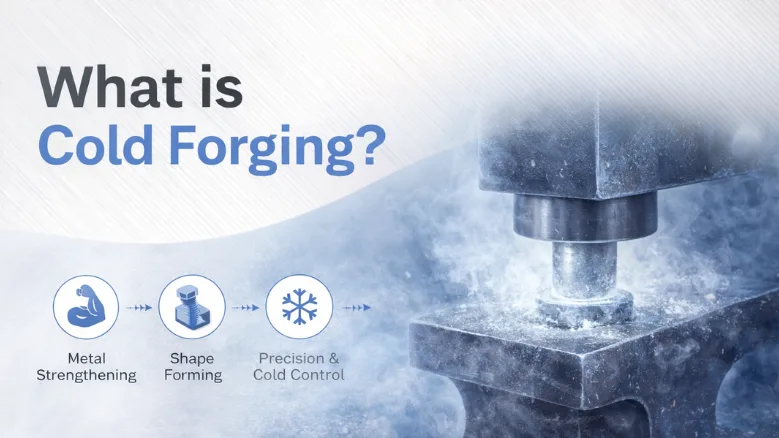
Cold forging is a well-used technique used in the development process that ensures the creation of precise components. Generally, cold forging differs from other forging technologies since the process does not require the application of any heating elements while the components are being produced.
Since the metal does not have to be heated in this case, this method provides manufacturers with better control over the dimensions and quality of the surfaces being created. Cold forging seems to be the perfect solution when the desired end product does not require maximum load-bearing capacity.
Due to these advantages, cold forging manufacturing is commonly used for fasteners, small tool parts, and high-volume industrial components where reliability and uniformity are critical.
What Is Cold Forging?
Cold forging is a technique used in the process of metal forming that involves the application of force without the heating of the metal. This process involves the forming of the metal at normal conditions, hence maintaining the structure with which the metal is originally endowed.
This method is commonly used in manufacturing where parts have specific tolerance requirements. These parts also have to maintain their size. There is no application of heat in this technique. Cold forging helps avoid changes in the parts when the material is exposed to heat. There is also the issue of surface problems.
Cold forging is best used in small parts that require precise dimensions, smooth surfaces, quality consistency, but not necessarily resistance to impact or strength in usage.
Advantages of Cold Forging
Cold forging is beneficial in several significant ways when considering manufacturing and related processes. This is particularly true when emphasis is placed on precision, efficiency, and consistency.
- High Dimensional Accuracy: Using the cold forging technique results in the production of components with tight tolerances and specific shapes.
- Smooth Surface Finish: The fact that it is processed under pressure and not subjected to heat means that it will have smooth and shiny surfaces when processed into finished items.
- Material Efficiency: Cold forging is a process that involves minimal waste in shaping the metal. Because the process is efficient in the usage of raw material, cold forging is a cost-effective technique.
Limitations of Cold Forging
Although the advantages of cold forging can be substantial, the limitations of the technique can also define the relevant applications.
- Not Suitable for Heavy-Duty Tools: Cold forging does not favor large or heavy tools that require bearing high impacts or extreme shock load conditions. This is generally not favorable for applications that require strength-oriented manufacturing processes.
- High Force Requirement: Shaping a metal piece at normal or room temperature demands considerable force. This restricts cold forging to small components that may be formed without undue stresses or distortion.
- Limited Shape Complexity: Some complex shapes can be hard to achieve in cold forging, particularly where the workpiece thickness is involved.
Due to these constraints, cold forging is often compared to a hot forging process when choosing the most optimal method for manufacturing.
Applications of Cold Forging
Cold forging is practiced widely in industries requiring precision, repeatability, and efficiency in production. The process is ideal for making those components where accuracy in dimensions, smooth finishes, and lot-to-lot consistency of quality is called for.
Screws
The most common cold-forged items include bolts, screws, nuts, and rivets. Cold forging ensures precision in thread formation, uniformity in shape, and smoothness in surface, features critically determining reliable assemblies and longevity.
Small Tool Component Fabrication
Cold forged parts find applications in many small tool components where exact fit, alignment, and good surface quality are required. For that matter, these parts enhance the general performance of the tool, which benefits from the dimensional accuracy and repeatability after cold forging.
Automotive and Industrial Components
Cold forging refers to the procedure used in the manufacture of small-size automotive and industrial parts that require uniformity, with demands for high volumes of production. The process offers accuracy and material efficiency in the fabrication of components such as connectors, precision fittings, and small shafts.
Electrical and Electronic Components
The terminal, pin, and many other connector parts require the most precise dimensions and cleanliness of surfaces for good electrical contact. Cold forging is applied for making terminals, pins, and connectors that demand strict size and quality stipulations.
Hardware and assembly components
Cold forging is widely used in the manufacturing process, especially for hardware parts like pins, clips, bushings, and washers. All these components have to be of a consistent shape with a reliable fit.
Consumer and Appliance Components
Cold forging of appliance and consumer products components made of metal to a very great extent provides smooth finish, consistent quality, and inexpensive mass production.
Learn about forging in manufacturing to better understand how cold forging fits into the bigger production landscape.
Conclusion
Cold forging is a reliable manufacturing process in which a great deal of accuracy, consistency, and quality can be assured for the produced metal components. The process offers excellent dimensional accuracy, smooth surface finish, and efficient material use by shaping metals at or near room temperature. These advantages make cold forging quite appropriate for fasteners, small tool components, and high-volume industrial parts.
While cold forging is not designed for heavy-duty or high-impact tools, it plays an important role in modern manufacturing where precision and repeatability are critical. Understanding what cold forging is, how it works, and where it is best applied helps manufacturers and buyers choose the most effective forging method for their specific requirements.
When used in the right applications, cold forging offers cost efficiency, consistent quality, and dependable performance across a wide range of industries.
FAQs
Cold forging is a manufacturing process where metal is shaped at or near room temperature using applied force.
Cold forging provides higher accuracy and surface quality, while hot forging is better suited for strength and heavy-duty applications.
Fasteners, small tool components, and precision industrial parts commonly use cold forging.
Yes, cold forging is cost-effective for high-volume production due to minimal material waste and reduced machining.
Cold forging is suitable for small hand tool components but not for heavy-duty hand tools.
Related Post

Top Hand Tools Supplier in Morocco
Finding the right supplier can make all the difference in ensuring quality, reliability, and durability [...]
Best Supplier of Hand Tools in Italy
Hand tools are an integral part of various industries, from construction and automotive to manufacturing [...]
A Leading Hand Tools Manufacturer Company In UAE – JCBL Hand Tools
When it comes to selecting the right hand tool, everyone including professionals, industrialists, and DIY [...]