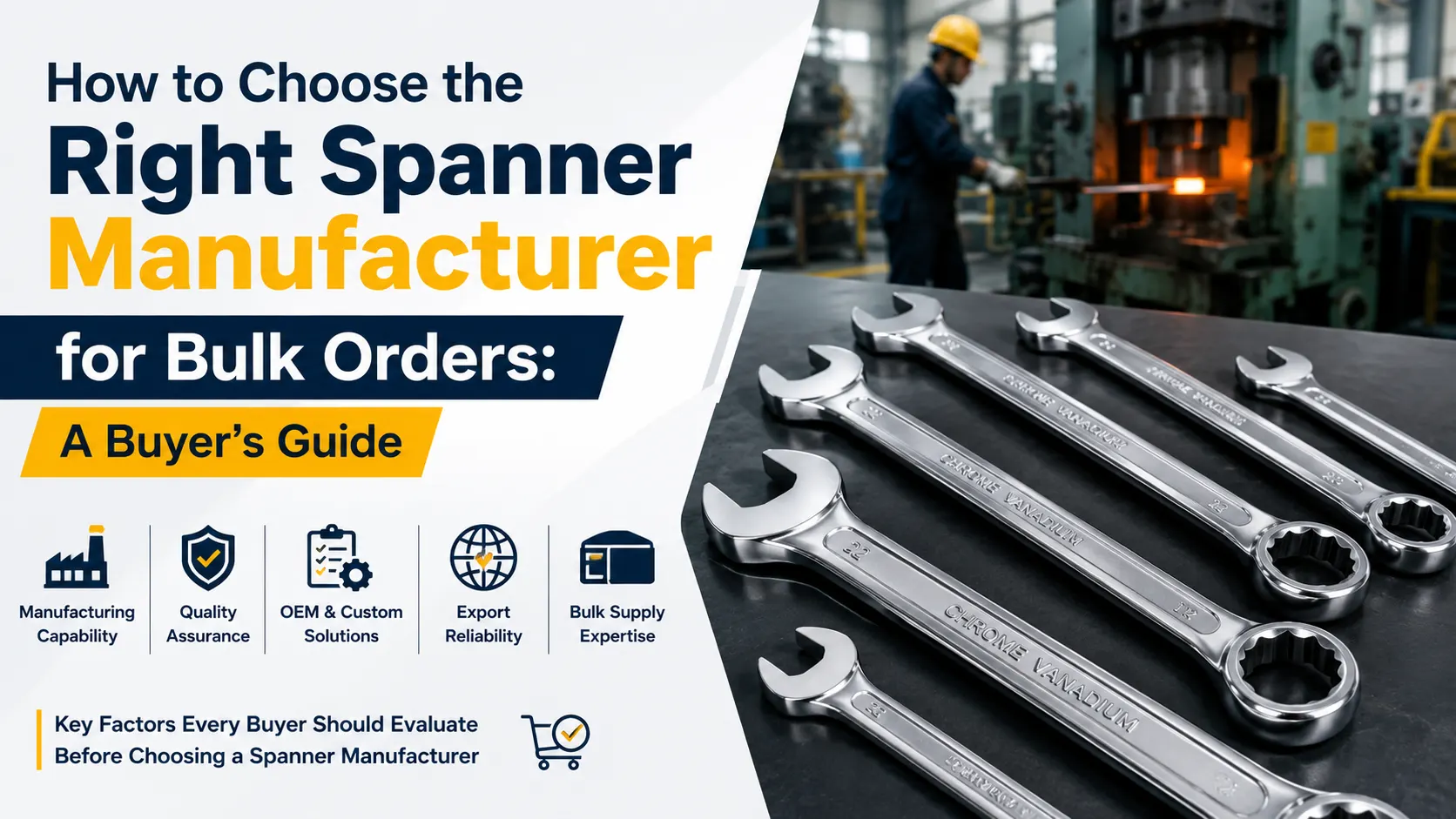
How to Choose the Right Spanner Manufacturer for Bulk Orders: A Buyer’s Guide
Finding a spanner manufacturer for bulk orders is not difficult; finding one that consistently delivers the right quality, quantity, and specifications is the real challenge. For importers, distributors, and OEM brands, the wrong supplier choice can result in inconsistent products, delayed shipments, customer complaints, and unexpected costs.
This blog explains the practical factors experienced buyers evaluate before selecting a reliable spanner manufacturer.
How to Choose a Reliable Spanner Manufacturer for Bulk Orders?
A reliable bulk spanner manufacturer should be evaluated on five core areas: manufacturing capability, material quality, quality control, OEM support, and export reliability. Buyers should verify production facilities, testing processes, certifications, previous export experience, and ability to meet large-volume requirements before finalizing a supplier.
1. Verify Whether the Supplier Is a Manufacturer or Just a Trader
This is a major pain point for importers.
Explain:
Many companies claim to supply spanners but do not manufacture them. Working directly with a manufacturer provides better control over:
- Product specifications
- Quality consistency
- Pricing
- Customization
- Production timelines
What buyers should verify:
- Manufacturing facility images/videos
- Production machinery
- In-house forging capability
- Quality inspection setup
- Production team experience
2. Evaluate Manufacturing Capability Before Discussing Price
A common mistake among bulk buyers is requesting quotations before understanding production capability.
A professional manufacturer should have control over:
- Forging operations
- Heat treatment
- CNC machining
- Surface finishing
- Plating processes
- Packaging
Manufacturing capability directly impacts product consistency during large-volume orders.
3. Check the Steel Grade and Tool Manufacturing Process
Not all spanners are manufactured with the same material standards.
For industrial applications, buyers usually look for:
- Chrome Vanadium (Cr-V) steel
- Alloy steel
- Carbon steel grades
Explain the complete manufacturing journey:
Raw material → Forging → Heat treatment → Machining → Surface finishing → Inspection → Packaging
This gives buyers confidence that the manufacturer understands tool engineering rather than only assembly.
4. Assess Quality Control Beyond Certifications
Many suppliers mention certifications, but serious buyers evaluate the actual inspection process.
A reliable manufacturer should check:
Incoming Material Quality
- Chemical composition
- Hardness
- Material strength
Production Quality
- Dimensions
- Forging accuracy
- Heat treatment results
Final Product Quality
- Torque performance
- Surface finish
- Corrosion resistance
- Packaging quality
Certifications support credibility, but consistent inspection systems determine actual product reliability.
5. Check OEM and Private Label Experience
For distributors and brands, OEM capability is often more important than standard products.
A capable OEM spanner manufacturer should support:
- Custom logo marking
- Brand packaging
- Retail boxes
- Customized tool sets
- Barcode labeling
- Country-specific requirements
This helps businesses create differentiated products instead of competing only on price.
6. Review Production Capacity and Supply Reliability
A manufacturer suitable for small orders may not be suitable for bulk requirements.
Before placing an order, ask:
- What is your monthly production capacity?
- How many machines are dedicated to spanner production?
- What is your average lead time?
- How do you manage urgent requirements?
Reliable supply is especially important for importers managing inventory cycles.
7. Understand Export Capability
A good domestic supplier is not always a good international supplier.
Export-ready manufacturers understand:
- International packaging standards
- Shipping documentation
- Container loading
- Inspection requirements
- Import regulations
Indian manufacturing clusters such as Ludhiana and Jalandhar in Punjab have established hand tool production ecosystems serving domestic and overseas markets.
8. Compare Manufacturers Using Total Value, Not Lowest Price
The cheapest quotation is not always the most economical option.
A better comparison includes:
| Factor | Why It Matters |
| Material quality | Determines tool life |
| Manufacturing process | Affects performance |
| Quality inspection | Reduces rejection rate |
| Production capacity | Ensures supply continuity |
| OEM support | Helps build brand value |
| Export experience | Reduces shipment issues |
9. Request Samples Before Bulk Production
Professional buyers rarely finalize large orders without product validation.
Before bulk production, evaluate:
- Finish quality
- Weight consistency
- Marking accuracy
- Packaging
- Strength performance
- Compliance requirements
A sample approval process reduces risks during large shipments.
10. Evaluate Long-Term Partnership Potential
The best manufacturers are not just suppliers; they become supply chain partners.
Look for:
- Transparent communication
- Technical support
- Continuous improvement
- Flexible customization
- Reliable after-sales response
A long-term manufacturing relationship helps businesses maintain consistent quality and market reputation.
Bulk Spanner Manufacturer Evaluation Checklist
| Evaluation Area | Questions to Ask |
| Manufacturing | Do you own the production facility? |
| Materials | Which steel grades do you use? |
| Processes | Do you perform forging and heat treatment in-house? |
| Quality | What inspections are performed? |
| OEM | Can you support private labeling? |
| Capacity | Can you handle recurring bulk orders? |
| Export | Have you supplied international markets? |
For a detailed guide, Read “How to Evaluate a Spanner Manufacturing Company“
Common Mistakes Buyers Make When Selecting a Spanner Manufacturer
Choosing Only Based on Price
Low prices may indicate compromises in:
- Material quality
- Manufacturing processes
- Inspection standards
Ignoring Production Verification
Always verify:
- Factory capabilities
- Previous projects
- Manufacturing processes
Not Discussing Quality Requirements Clearly
Specifications should include:
- Material grade
- Finish requirements
- Packaging details
- Testing expectations
Why Choose an Experienced Indian Spanner Manufacturer?
India has become a competitive sourcing destination for hand tools because of:
- Established forging capabilities
- Skilled workforce
- Strong export network
- OEM manufacturing expertise
- Competitive production costs
Manufacturing hubs in Punjab, including Ludhiana and Jalandhar, are recognized for producing a wide range of industrial hand tools.
Conclusion
Selecting the right spanner manufacturer for bulk orders requires evaluating more than pricing. Buyers should focus on manufacturing capability, material standards, quality systems, OEM expertise, and export experience.
The right supplier can help businesses achieve consistent product quality, reliable deliveries, and long-term supply chain stability.
FAQs
Choose a spanner manufacturer with proven manufacturing experience, quality certifications, reliable production capacity, OEM capabilities, and strict quality control processes. Also evaluate their export experience, delivery performance, and ability to meet your product specifications consistently.
Before placing a bulk order, verify the manufacturer’s material quality, manufacturing process, quality inspection system, production capacity, certifications, lead times, and OEM or private labeling capabilities. Requesting product samples can also help assess quality before full-scale production.
OEM capability allows manufacturers to produce spanners with your brand name, custom packaging, and product specifications. This helps distributors, wholesalers, and private-label brands offer differentiated products while maintaining consistent quality.
Many international buyers source spanners from India because of its established hand tool manufacturing industry, skilled workforce, competitive production costs, and strong export capabilities. Manufacturing hubs such as Ludhiana and Jalandhar are well known for supplying industrial hand tools to global markets.
You can verify a manufacturer’s quality by reviewing its certifications, inspecting its production processes, evaluating quality control procedures, requesting product samples, and checking its experience with bulk and export orders. A factory audit or third-party inspection can provide additional confidence before large purchases.
Related Readings: