How to Source Spanners in Bulk from India: A B2B Buyer’s Guide
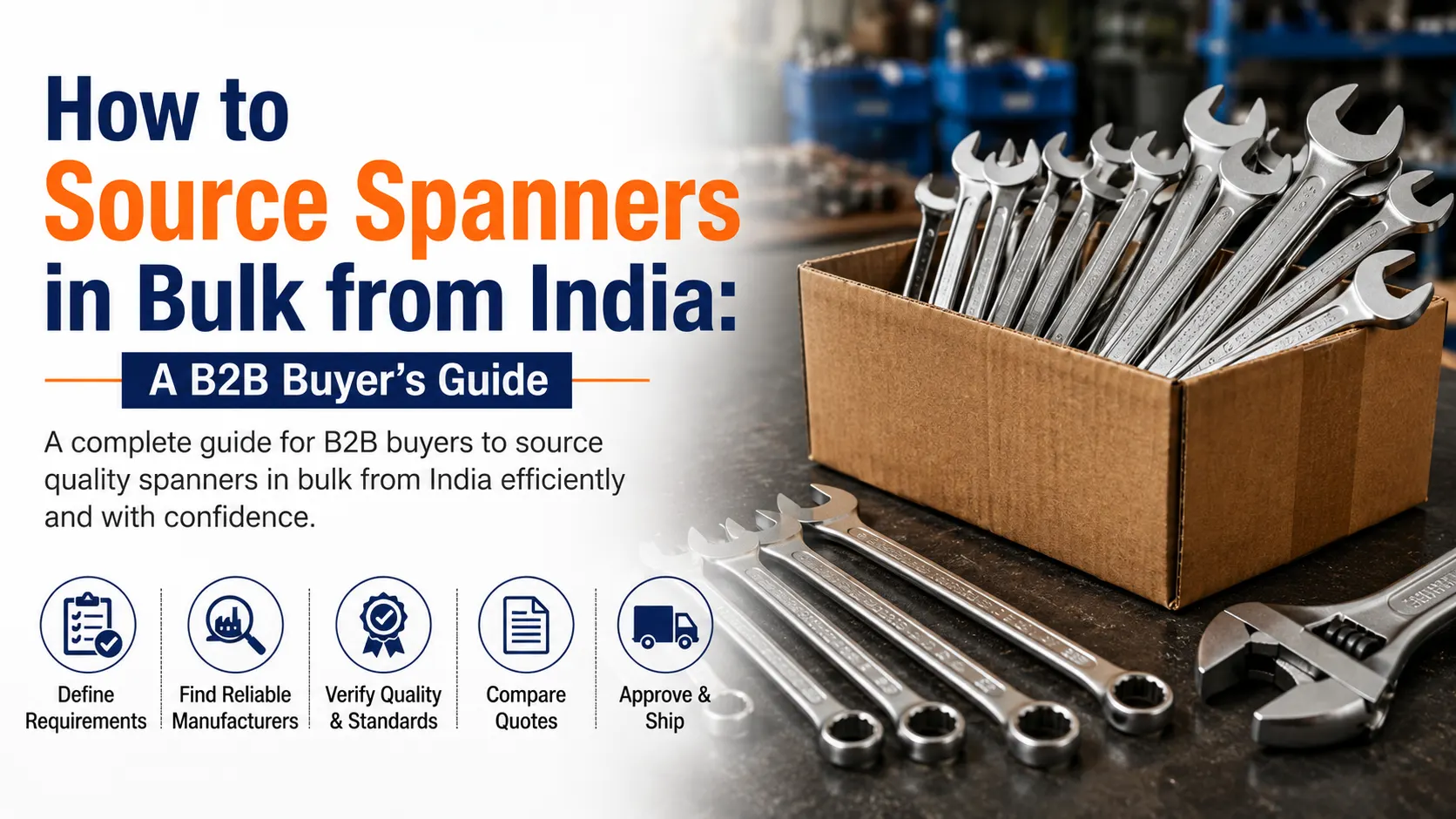
Sourcing spanners in bulk from India requires more than comparing supplier prices. B2B buyers need to define product specifications, identify capable manufacturers, verify quality and standards, compare equivalent quotations, approve samples, and finalize production and shipping terms.
This guide explains how to source bulk spanners from India efficiently while reducing quality, cost, and supply risks.
How to Source Spanners in Bulk from India
The sourcing process can be simplified into seven steps:
- Define your spanner requirements
- Find suitable Indian manufacturers
- Verify manufacturing and quality capabilities
- Send a detailed RFQ
- Evaluate quotations and samples
- Approve specifications and production
- Complete inspection and shipment
The most important principle is to finalize the technical specification before comparing prices. This ensures suppliers are quoting for the same product.
Step-by-Step Guide to Source Spanners in Bulk from India
1. Define Your Spanner Specifications
Before approaching manufacturers, prepare a clear product specification. Include:
- Spanner type
- Metric or imperial sizes
- Size range
- Material or steel grade
- Applicable standard
- Heat-treatment requirements
- Surface finish
- Logo or product marking
- Quantity per size
- Packaging requirements
- Target market
Common bulk-sourced products include combination spanners, single open end spanners, double open-end spanners, ring spanners, tubular box spanners, adjustable wrenches and specialty spanners.
For OEM or private-label orders, also provide logo files, packaging artwork, barcode requirements and product drawings where applicable.
What should a bulk spanner RFQ include?
A bulk spanner RFQ should specify the product type, sizes, material, standard, finish, quantity, branding, packaging, quality requirements, destination and delivery timeline. A detailed RFQ allows manufacturers to provide comparable quotations and reduces specification-related errors during production.
2. Find Spanner Manufacturers in India
Shortlist manufacturers based on their ability to produce the specific spanners you require, not simply their product range.
For B2B sourcing, look for manufacturers with:
- Forging and forming capabilities
- Machining and heat treatment
- Finishing and plating
- Quality inspection systems
- OEM/private-label experience
- Bulk production capacity
- Export experience
India has an established hand-tool manufacturing base, including manufacturing clusters in Punjab and other industrial regions. However, capabilities vary significantly between suppliers, so buyers should verify individual manufacturers rather than relying on general claims about Indian manufacturing.
3. Verify the Manufacturer Before Ordering
Before placing a bulk order, verify three areas.
Manufacturing Capability
Ask whether key processes such as forging, machining, heat treatment, finishing and packaging are performed in-house or controlled through qualified suppliers.
Quality Control
Confirm how the manufacturer checks:
- Dimensions
- Hardness
- Workmanship
- Surface finish
- Plating
- Marking
- Torque or performance requirements where applicable
Production and Export Capability
Confirm the manufacturer’s ability to meet your required quantity and delivery schedule. International buyers should also verify export documentation, packaging and shipping experience.
A supplier’s website can help with initial screening, but samples, technical documents and direct verification should support major purchasing decisions.
4. Check Applicable Spanner Standards
The applicable product standard should be identified before production.
Relevant Indian standards include:
| IS 2028:2004 | Open-Jaw Wrenches (Spanners) |
| IS 2029:1998 | Ring Wrenches (Spanners) |
| IS 4508 | Open-Ended Slugging Wrenches |
| IS 4509 | Ring Slugging Wrenches |
| IS 6149 | Single-Ended Open-Jaw Adjustable Wrenches |
BIS documentation covers requirements such as dimensions, material, hardness, workmanship, finish, and performance testing for applicable wrench standards. The Hand Tools (Quality Control) Order, 2025 also covers several wrench and spanner standards under the BIS certification framework. Buyers should verify the latest requirements applicable to their specific product and market before ordering.
For exports, buyers should additionally confirm the standards and regulatory requirements of the destination market, which may include DIN or ASME/ANSI specifications depending on the product and market.
5. Request Samples Before Bulk Production
Never rely solely on photographs or product descriptions for a large order.
Request a production-representative sample and compare it with your specification.
Bulk Spanner Sample Checklist
- Correct type and size
- Material
- Dimensions
- Hardness
- Jaw/ring fit
- Workmanship
- Surface finish
- Plating
- Marking
- Packaging
- Performance requirements where applicable
For standardized products, testing should follow the applicable technical requirements rather than relying only on visual inspection.
Once approved, the sample and specification should become the reference standard for bulk production.
6. Compare Quotations on a Like-for-Like Basis
The lowest unit price is not necessarily the lowest procurement cost.
Compare suppliers based on:
| Factor | What to Check |
| Unit price | Same product specification and quantity |
| MOQ | Minimum quantity per SKU |
| Material | Steel grade and specification |
| Finish | Plating/coating requirements |
| Branding | Logo and marking costs |
| Packaging | Bulk or customized packaging |
| Tooling | Included or additional |
| Lead time | Production and dispatch schedule |
| Inspection | Included or additional |
| Shipping | Agreed Incoterm and freight responsibility |
| Payment | Agreed payment terms |
A quotation should always be evaluated against the same technical and commercial requirements.
7. OEM and Private-Label Spanner Sourcing
Indian manufacturers can also support OEM and private-label programs, depending on their capabilities.
Typical requirements include the following:
- Custom logo marking
- Customized specifications
- Product sets
- Retail packaging
- Labels and barcodes
- Custom cartons
- Repeat-order production
For private-label buyers, evaluate more than branding capability. The manufacturer should also be able to maintain consistent dimensions, material, finish, packaging, and quality across repeat orders.
Benefits of sourcing spanners in bulk from India
For B2B buyers, India can offer access to:
- Established hand-tool manufacturing capabilities
- Forged and heat-treated spanners
- Standard and customized products
- OEM and private-label production
- Bulk manufacturing
- Export-oriented suppliers
- Customized branding and packaging
The actual benefits depend on the manufacturer’s capabilities, product requirements, and order volume.
Common Mistakes to Avoid
When sourcing spanners in bulk from India, avoid:
- Choosing a supplier based only on price
- Ordering without approving samples
- Leaving material specifications undefined
- Failing to identify the applicable standard
- Comparing quotations with different specifications
- Not confirming packaging requirements
- Ignoring production capacity and lead time
- Changing specifications after production begins
A clear specification and documented approval process prevent most of these problems.
Conclusion
To successfully source spanners in bulk from India, start with a precise specification, shortlist qualified manufacturers, verify their capabilities, request comparable quotations, and approve samples before production.
For B2B buyers, the right supplier is not simply the one offering the lowest price. Manufacturing capability, product quality, standards compliance, customization, production capacity and supply reliability should determine the final sourcing decision.
FAQs
Popular spanner brands in India include JCBL Hand Tools, Eastman, Taparia, Stanley, and Tata Agrico. For bulk or private-label sourcing, however, buyers should prioritize manufacturer capability, product quality, applicable standards, OEM support, MOQ, and export capacity rather than brand name alone.
Choose a manufacturer with proven forging, machining, heat-treatment, finishing, and quality-control capabilities. Verify applicable standards, production capacity, OEM experience, and export capability, then request samples and technical documentation before placing a bulk order.
There is no standard MOQ for bulk spanners in India. It depends on the spanner type, sizes, quantity, customization, packaging, and production requirements. Ask manufacturers to provide MOQ and pricing separately for each product or SKU.
Yes. Indian manufacturers can offer private-label spanners with custom logos, specifications, packaging, labels, and bulk production. Before ordering, confirm the manufacturer’s MOQ, customization capabilities, sample-approval process, and ability to maintain consistent quality across repeat orders.
Check the material, dimensions, applicable standard, hardness, workmanship, finish, markings, packaging, and performance requirements. Always approve a production-representative sample before bulk manufacturing and ensure the final purchase order matches the approved specifications.