How to Evaluate a Spanner Manufacturing Company: A B2B Buyer’s Guide
- What Should You Check When Evaluating a Spanner Manufacturer?
- Step-by-Step Guide to Evaluate a Spanner Manufacturing Company
- How to Verify That a Supplier Is Actually a Manufacturer
- Spanner Manufacturer Evaluation Scorecard
- Red Flags When Choosing a Spanner Manufacturer
- How to Select the Right Spanner Manufacturing Company
- Conclusion
- FAQs
Choosing a spanner manufacturing company requires more than comparing quotations. B2B buyers should evaluate a manufacturer’s forging and heat-treatment capabilities, material control, dimensional accuracy, quality systems, applicable standards, production capacity, sample quality, customization capabilities, and export experience. The final decision should be based on documented capability and consistent performance, not price alone.
For companies sourcing spanners from India, these checks are especially important when qualifying a supplier for bulk, OEM, private-label, or export orders.
What Should You Check When Evaluating a Spanner Manufacturer?
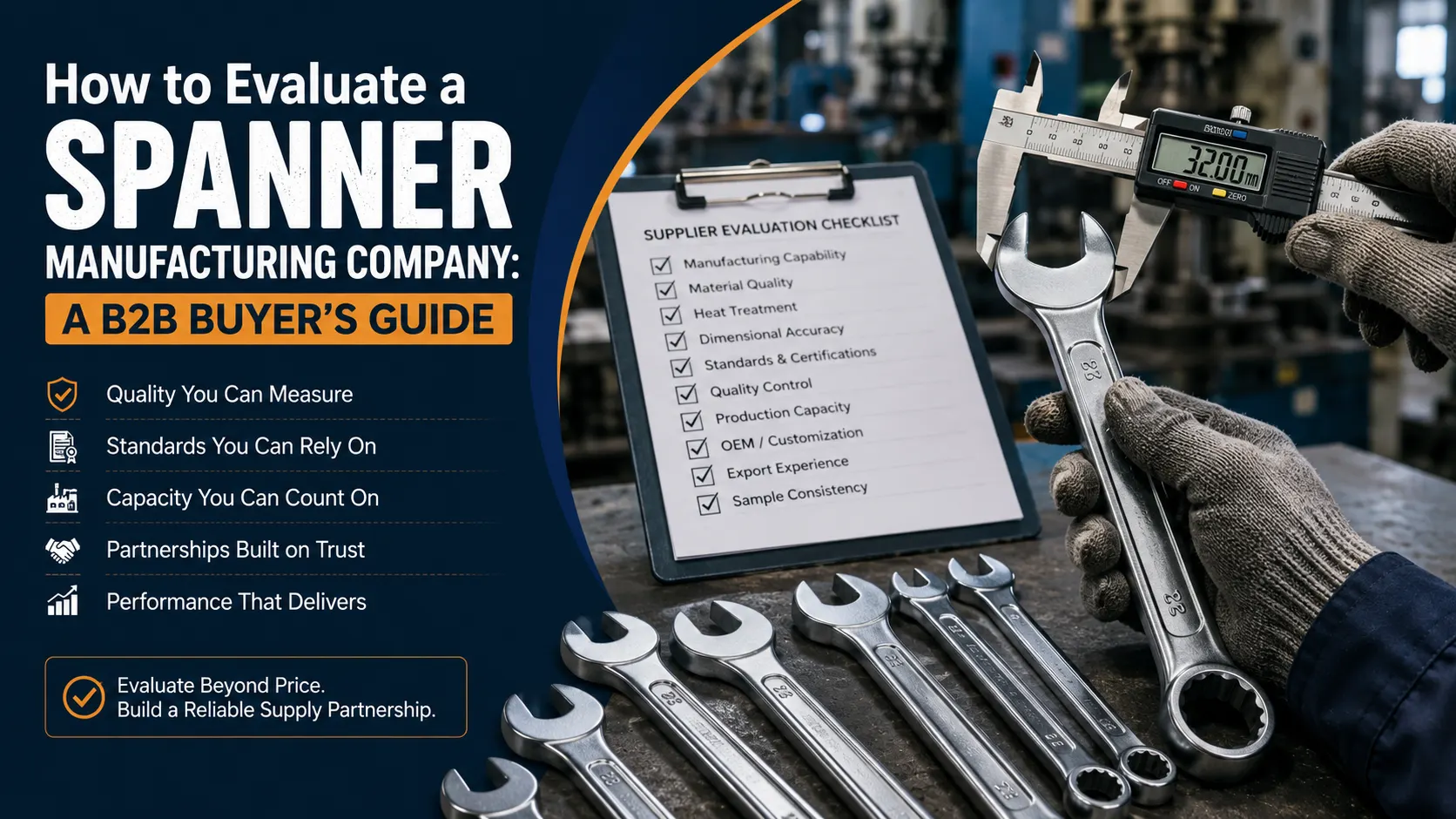
Evaluate a spanner manufacturer across these 10 areas:
- Manufacturing and forging capability
- Material and steel-grade control
- Heat-treatment process
- Dimensional accuracy and workmanship
- Product standards and certifications
- Quality inspection and testing
- Production capacity and lead time
- OEM and private-label capability
- Export and documentation experience
- Sample and repeat-production consistency
The goal is to determine whether the manufacturer can produce your specified spanner consistently at the required volume, quality level, and delivery schedule.
Step-by-Step Guide to Evaluate a Spanner Manufacturing Company
1. Verify the Manufacturer’s Production Capability
Confirm whether the company actually manufactures spanners or primarily outsources production.
Check its in-house capabilities for the following:
- Forging and trimming
- Heat treatment
- Machining and grinding
- Surface finishing
- Marking and packaging
- Inspection and testing
Also verify production equipment, tooling capability, process ownership, and experience with your required spanner type and size range. Outsourcing is acceptable when the manufacturer has clear control and inspection procedures.
2. Check Material and Steel-Grade Control
A reliable manufacturer should specify the exact steel grade rather than using terms such as “high-quality steel.”
Verify:
- Steel grade and specification
- Approved material source
- Incoming material inspection
- Material certificates or test reports, where required
- Batch or lot traceability, where applicable
Ask for the material specification and evidence that incoming steel is checked against it.
3. Evaluate Forging and Heat Treatment
For forged spanners, forging and heat treatment directly affect strength, durability, and dimensional stability.
- Check forging for equipment, die and tooling capability, trimming quality, dimensional control, and defect inspection.
- Check heat treatment for hardening and tempering processes, specified hardness range, testing methods and frequencies, batch records, and procedures for failed results.
A capable manufacturer should be able to explain what is controlled, how it is measured, and how non-conforming batches are handled.
4. Verify Dimensions, Workmanship and Performance
Evaluate the finished spanner against the approved specification, including the following:
- Width across flats and opening dimensions
- Overall dimensions and tolerances
- Jaw or ring geometry
- Surface finish and burrs
- Fit with the intended fastener
- Applicable torque or performance requirements
Requirements vary by spanner type and market. For example, ISO 691 specifies dimensions and opening tolerances for wrench and socket openings.
Verify that critical dimensions are measured using defined inspection methods and recorded against the approved specification.
5. Confirm Applicable Standards and Certifications
Identify the standards applicable to your specific spanner and target market. These may include DIN, ISO, ASME, BIS/IS, or customer-specific requirements.
For spanners manufactured in India, verify whether relevant BIS requirements apply to the product. Also check certifications such as ISO 9001 where relevant.
Do not treat certification as proof of product quality. Verify the certificate’s scope, validity, issuing body, and relevance to the manufacturing operation.
6. Examine the Quality-Control System
Evaluate quality control at three stages:
| Stage | Key Checks |
| Incoming | Steel grade, material condition and documentation |
| In-process | Forging, dimensions, heat treatment and finishing |
| Final | Dimensions, hardness, appearance, markings and performance |
Before production, agree on the required inspection criteria and documentation, such as material certificates, inspection reports, test reports, or certificates of conformity.
7. Verify Production Capacity and Delivery Reliability
A manufacturer that produces good samples may not necessarily handle large or repeat orders reliably.
Check:
- Production capacity by SKU
- MOQ
- Lead time
- Current production load
- Tooling availability
- Complete size-range capability
- Repeat-order capacity
- Delay-management procedures
The key question is: “Can the manufacturer consistently reproduce the approved specification at your required volume and delivery schedule?”
8. Check OEM and Private-Label Capability
For branded spanners, verify whether the manufacturer can consistently reproduce your approved specifications and branding.
Check capabilities for:
- Logo marking
- Customer-specific specifications
- Surface finish
- Custom packaging
- Labels and barcodes
- Special inspection requirements
- Repeat production to an approved sample
Confirm MOQ, tooling requirements, packaging quantities, artwork approval, and repeat-production procedures before ordering.
9. Evaluate Export Capability When Sourcing from India
International buyers should also assess the manufacturer’s export readiness.
Verify experience with:
- Export packaging
- Commercial invoices and packing lists
- Certificates of origin, where required
- Product and inspection documentation
- Freight coordination
- Destination-market requirements
The exact documentation depends on the destination country and product, so confirm requirements before shipment.
10. Approve a Production-Representative Sample
Always evaluate a representative sample before bulk production.
Check it against the approved specification for:
- Material
- Dimensions and fit
- Workmanship
- Surface finish
- Markings
- Hardness, where applicable
- Performance
- Packaging
The sample should represent normal production, not a specially prepared piece. Once approved, use the sample and specification as the reference for bulk and repeat orders.
How to Verify That a Supplier Is Actually a Manufacturer
Before qualifying a company as a spanner manufacturer in India, ask:
- Where does forging take place?
- Is heat treatment performed in-house?
- Which processes are outsourced?
- Who controls outsourced operations?
- Who owns the dies and tooling?
- Who performs the final inspection?
- Can the company provide evidence of production capability?
- Can it repeatedly manufacture the same specification?
This helps distinguish a manufacturing partner from a supplier that primarily coordinates production through third parties.
Spanner Manufacturer Evaluation Scorecard
Use a simple weighted assessment instead of selecting a supplier based only on price:
| Evaluation Area | Suggested Weight |
| Manufacturing capability | 15% |
| Material control | 15% |
| Quality system | 20% |
| Standards and compliance | 10% |
| Production capacity | 10% |
| Sample quality | 10% |
| OEM/private label | 5% |
| Export capability | 5% |
| Commercial reliability | 10% |
Adjust the weighting according to your product, market, and procurement priorities.
Red Flags When Choosing a Spanner Manufacturer
Be cautious when a supplier
- Cannot clearly explain its manufacturing process
- Provides vague material specifications
- Cannot demonstrate relevant quality controls
- Refuses reasonable sample evaluation
- Offers a significantly lower price without defining the specification
- Cannot substantiate production-capacity claims
- Provides certificates without clear scope or validity
- Changes specifications between quotation, sample, and production
- Cannot explain how outsourced processes are controlled
How to Select the Right Spanner Manufacturing Company
The right manufacturer is the one that can consistently meet your technical specifications, quality requirements, production volume, and delivery schedule.
A practical qualification sequence is:
Manufacturing capability → Material control → Process control → Quality verification → Standards → Capacity → Sample approval → Commercial and export qualification.
For B2B buyers sourcing spanners from India, this approach provides a more reliable basis for supplier selection than comparing quotations alone.
Conclusion
Evaluating a spanner manufacturing company requires more than comparing prices. Check its manufacturing capability, material and process control, quality system, applicable standards, production capacity, sample quality, and export readiness. For B2B buyers sourcing from India, approving a production-representative sample and verifying the manufacturer’s ability to maintain consistent quality at scale can help reduce quality, delivery, and compliance risks.
FAQs
Verify its manufacturing processes, material specifications, forging and heat treatment, quality controls, applicable standards, production capacity, sample quality, customization capability, and export experience.
Check whether the manufacturer can meet your exact product specification consistently, then verify its material control, process capability, inspection system, capacity, lead time, sample quality, and documentation.
Request a production-representative sample and compare its material, dimensions, workmanship, finish, markings, hardness, and required performance against the approved specification.
No. ISO 9001 evaluates a quality management system; it does not by itself confirm that a particular spanner meets your technical requirements. Product specifications, testing, samples, manufacturing capability, and inspection records should also be evaluated.
Yes. Sample approval allows the buyer to verify the product against the agreed specification before committing to full production and provides a reference for subsequent batches.