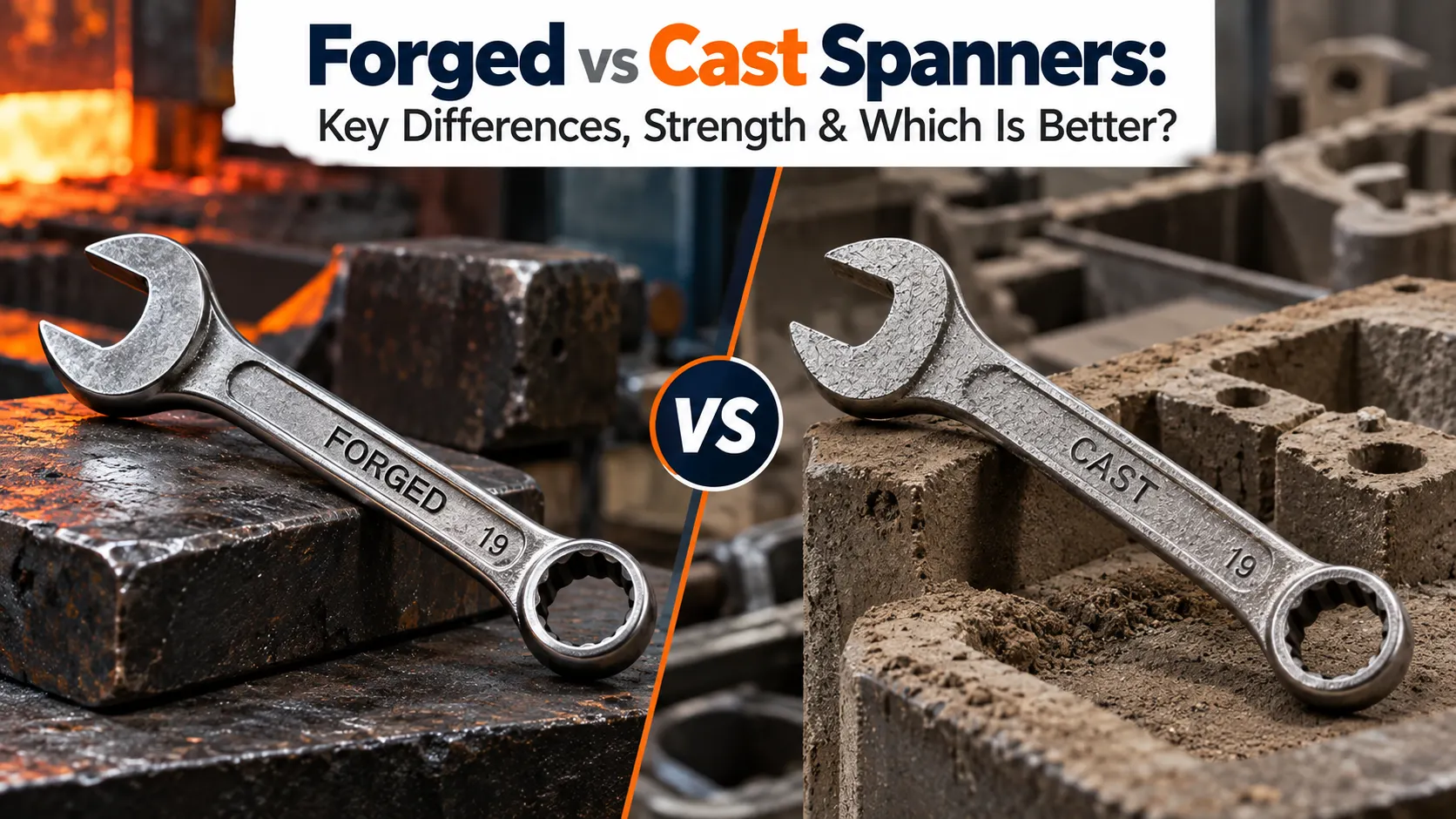
Forged vs Cast Spanners: Key Differences, Strength & Which Is Better?
- Forged vs Cast Spanners: Quick Comparison
- What Is a Forged Spanner?
- What Is a Cast Spanner?
- Forged vs. Cast Spanners: What Is the Difference?
- Are Forged Spanners Stronger Than Cast Spanners?
- Which Is Better: Forged or Cast Spanners?
- Forged vs Cast Spanners for B2B Buyers
- Forged Spanners in India: What Global Buyers Should Check
- How to Choose Between Forged and Cast Spanners
- Conclusion
- FAQs
Forged and cast spanners differ primarily in how the metal is formed. Forged spanners are shaped from solid steel under controlled pressure, while cast spanners are produced by pouring molten metal into a mold. For applications involving high torque, repeated loading, or impact, properly manufactured forged spanners are generally preferred because forging can provide favorable grain flow, toughness, and resistance to fatigue. However, final performance also depends on material grade, geometry, heat treatment, manufacturing quality, and testing.
Forged vs Cast Spanners: Quick Comparison
| Factor | Forged Spanners | Cast Spanners |
| Manufacturing | Solid steel shaped under pressure | Molten metal solidified in a mold. |
| Grain structure | Grain flow can follow the tool geometry | Structure develops during solidification |
| Strength | Generally high for comparable designs | Depends on alloy and casting quality |
| Toughness | Generally well suited to demanding loads | Depends on material and process |
| Porosity risk | Forming can reduce internal voids | Casting can have porosity or shrinkage defects |
| Dimensional control | Forging plus machining can provide high consistency | Depends on casting and machining controls |
| Complex shapes | More process-intensive | Often easier to produce |
| Cost | Generally higher | Can be more economical |
| Typical application | Industrial, automotive and professional use | Less demanding or specialized applications |
What Is a Forged Spanner?
A forged spanner is made by shaping a solid steel billet or bar under controlled pressure, commonly using dies. In hot forging, the steel is heated before being formed. The forged blank is then typically trimmed, machined, heat treated, finished, and inspected.
One important advantage of forging is grain flow. Plastic deformation during forging can orient the steel’s grain structure to follow the shape of the component. For a tool that repeatedly transmits torque, this can contribute to good toughness and resistance to fatigue and impact loading.
However, forging does not automatically guarantee a superior spanner. Steel grade, forging temperature, die design, heat treatment, dimensional accuracy, and inspection all influence the finished product.
What Is a Cast Spanner?
A cast spanner is produced by melting an alloy and pouring it into a mould. After solidification, the component is removed, cleaned, machined where necessary, and finished.
Casting can be advantageous when complex geometries are required or when manufacturing economics favor the process. However, solidification can introduce defects such as porosity, inclusions, or shrinkage cavities if the process is not properly controlled.
Therefore, a cast spanner should not be judged solely by the fact that it is cast. Its alloy, design, casting process, heat treatment, inspection, and intended application must also be considered.
Forged vs. Cast Spanners: What Is the Difference?
1. Strength and Load Resistance
For comparable designs and materials, forging generally provides favorable mechanical properties for tools exposed to high loads. The forming process can produce a continuous grain flow and reduce certain internal discontinuities.
This makes forged spanners a common choice for applications involving high torque and repeated mechanical loading.
2. Toughness and Impact Resistance
Spanners can experience sudden loads when loosening tight fasteners or working in demanding maintenance environments.
A properly designed and heat-treated forged spanner can provide the toughness required for these conditions. Cast spanners may perform well in suitable applications, but their resistance to impact and repeated stress depends heavily on alloy selection and casting quality.
3. Porosity and Internal Defects
Casting involves liquid metal solidifying inside a mold. Poorly controlled solidification can result in internal voids or shrinkage defects.
Forging applies substantial mechanical deformation to solid metal, which can help close certain internal voids and produce a more consistent structure.
For B2B buyers, this is why manufacturing-process control and inspection records matter as much as the stated material grade.
4. Dimensional Accuracy
Spanner jaws and ring openings must maintain accurate dimensions to engage fasteners correctly.
Forged blanks can be subsequently machined to achieve the required dimensions and tolerances. Cast components may also achieve good accuracy, but depending on the design, additional machining and tighter process controls may be necessary.
Are Forged Spanners Stronger Than Cast Spanners?
Generally, a properly manufactured forged spanner will offer better strength and toughness than a comparable cast spanner for demanding torque and impact applications. However, the manufacturing method alone does not determine performance. Steel grade, geometry, heat treatment, dimensional accuracy, casting or forging quality, and product testing must also be considered.
Which Is Better: Forged or Cast Spanners?
For most heavy-duty, automotive, industrial, and professional applications, forged spanners are generally the preferred choice.
Choose forged spanners when:
- High or repeated torque is expected
- Impact resistance is important
- Long-term durability is a priority
- The tool will be used in professional or industrial environments
- Consistent mechanical performance is required
A cast spanner may be suitable when:
- The application has lower mechanical demands
- Complex geometry is required
- Manufacturing cost is a major consideration
- The manufacturer can demonstrate suitable material and quality controls
The right choice should therefore be based on application requirements rather than price or manufacturing method alone.
Forged vs Cast Spanners for B2B Buyers
For bulk procurement, buyers should compare complete product specifications rather than simply choosing the lowest quotation.
Key factors include:
| Procurement Factor | What to Verify |
| Material | Steel/alloy grade and specification |
| Manufacturing | Forging or casting process |
| Heat treatment | Hardness and toughness requirements |
| Dimensions | Size, tolerances and head geometry |
| Standards | Applicable DIN, ISO, ASME, BS, or Indian standards |
| Testing | Torque, hardness and dimensional inspection as applicable |
| Finish | Plating, polishing or specified coating |
| Capacity | Production volume and lead time |
| Customization | Logo, packaging and private-label requirements |
| Quality control | In-process and final inspection procedures |
For hand-operated wrenches, ISO 1711-1:2019 specifies minimum Rockwell hardness and torsional-strength requirements for covered hand-operated wrenches and sockets.
Forged Spanners in India: What Global Buyers Should Check
India is an established manufacturing base for hand tools, and buyers sourcing forged spanners from India should evaluate the manufacturer’s production and quality capabilities rather than relying only on price.
Before placing a bulk or private-label order, verify:
- In-house forging capability
- Steel sourcing and material traceability
- Heat-treatment facilities
- Machining and finishing processes
- Dimensional and hardness inspection
- Applicable product standards
- OEM/private-label production experience
- Manufacturing capacity and lead times
- Export documentation and packaging capability
India also has specific standards covering spanners. For example, BIS lists IS 2028 for open-jaw wrenches and IS 2029 for ring wrenches, while its current hand-tool listings also include standards for other spanner categories.
How to Choose Between Forged and Cast Spanners
The simplest decision rule is
Choose forged spanners when strength, toughness, repeated torque, and durability are critical. Consider cast spanners when the application is less demanding, and casting provides a practical advantage in geometry or cost.
For B2B procurement, approve a production-representative sample before bulk manufacturing and verify the agreed material, dimensions, heat treatment, finish, markings, packaging, and applicable testing requirements.
Conclusion
Forged spanners are generally the better choice for demanding applications where strength, toughness, and resistance to repeated loading are important. Casting can offer advantages for certain geometries and cost-sensitive applications, but product quality depends heavily on alloy selection and process control.
For B2B buyers, the best decision is not simply forged vs. cast. Evaluate the complete specification: material grade, manufacturing process, heat treatment, dimensions, applicable standards, testing, quality control, production capability, and total cost.
FAQs
Yes. Properly manufactured forged spanners are generally preferred for heavy-duty applications because they can provide high strength and toughness for repeated torque and impact loading.
Forging can require dedicated dies, controlled heating and forming, trimming, heat treatment, machining, finishing, and inspection. These additional manufacturing stages can increase the production cost.
They can be suitable for specific industrial applications when their material, design, manufacturing quality, and tested performance meet the required operating conditions. The application should determine the specification.
Visual inspection is not always conclusive, particularly after machining and surface finishing. The most reliable approach is to obtain the manufacturing specification or process declaration directly from the manufacturer.
For high-torque, repeated-load, automotive, workshop, and heavy-duty industrial applications, forged spanners are generally the preferred option. Cast spanners can be considered where the application and verified product specifications permit them.