OEM vs. ODM Spanner Manufacturing: Key Differences for B2B Buyers
- Quick Answer: OEM vs ODM Spanner Manufacturing
- What Is OEM Spanner Manufacturing?
- What Is ODM Spanner Manufacturing?
- OEM vs. ODM Spanners: Key Differences
- OEM Spanner Manufacturing: Advantages and Limitations
- ODM Spanner Manufacturing: Advantages and Limitations
- When Should You Choose OEM Spanner Manufacturing?
- When Should You Choose ODM Spanner Manufacturing?
- OEM vs ODM Spanner Manufacturing: Which Is Better?
- What Should B2B Buyers Check Before Ordering?
- Conclusion
- FAQs
When sourcing spanners from a manufacturer, buyers typically choose between OEM and ODM manufacturing. The difference is mainly about who controls the product design, specifications, development work, and intellectual property.
OEM spanner manufacturing is generally suitable when a buyer has its own design, drawings, or detailed specifications. ODM spanner manufacturing is more suitable when the buyer wants to use an existing or manufacturer-developed design with selected customization and branding.
Understanding these models helps B2B buyers evaluate customization, tooling, MOQ, lead time, quality control, and product ownership before committing to production.
Quick Answer: OEM vs ODM Spanner Manufacturing
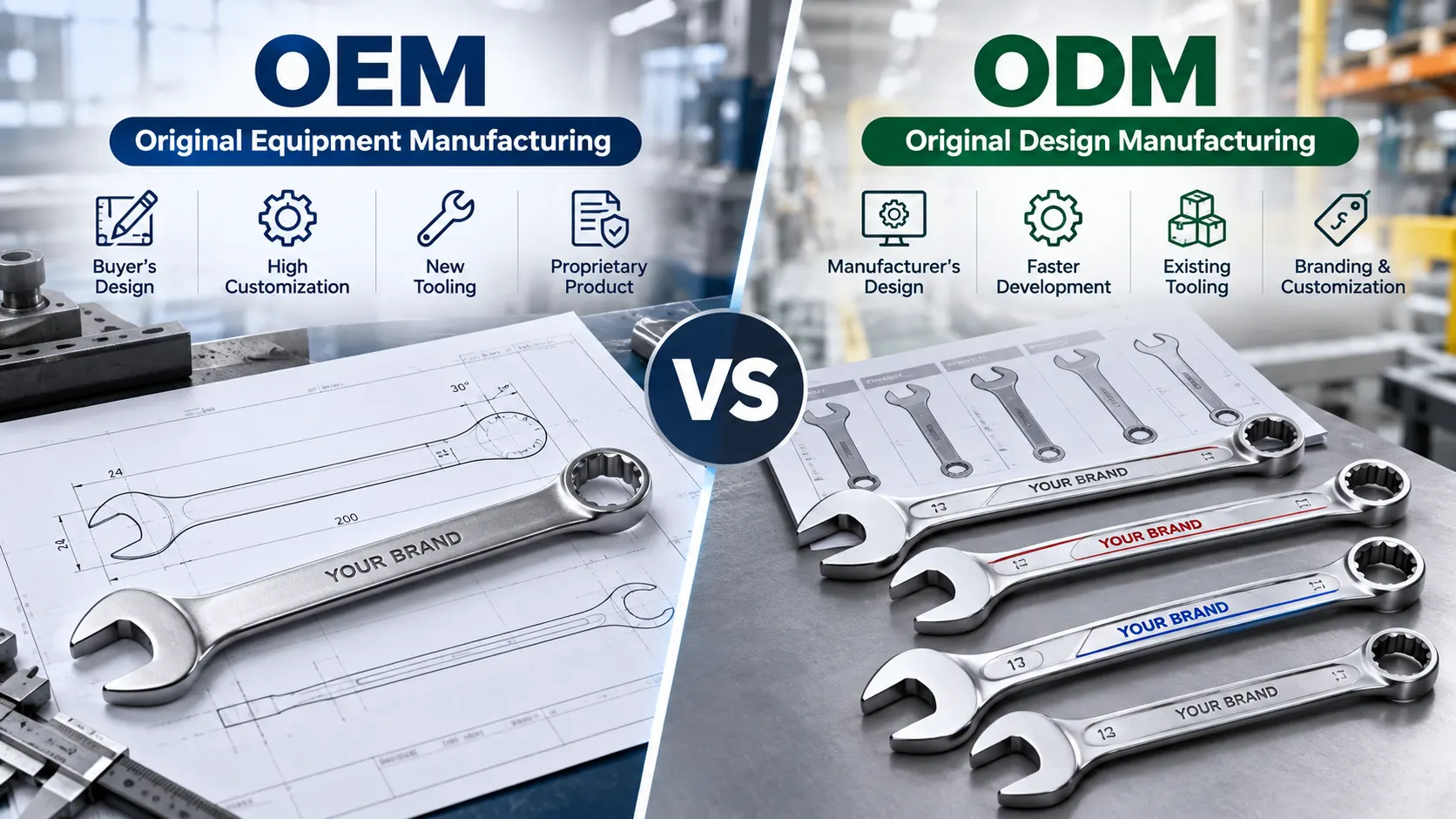
OEM spanner manufacturing means the manufacturer produces spanners according to the buyer’s design, drawings, specifications, or technical requirements. ODM spanner manufacturing means the manufacturer provides an existing or developed product design that the buyer can customize, brand, and purchase.
| Factor | OEM Spanner Manufacturing | ODM Spanner Manufacturing |
| Product design | Buyer-controlled | Manufacturer-controlled or developed |
| Customization | High | Moderate to high, depending on supplier |
| Development responsibility | Shared, often buyer-led | Mainly manufacturer-led |
| Tooling | May require new tooling | Existing tooling may be usable |
| Development time | Usually longer | Usually shorter |
| Product differentiation | High | Moderate |
| Best suited for | Proprietary requirements | Faster market entry |
What Is OEM Spanner Manufacturing?
OEM, or Original Equipment Manufacturing, refers to production based on the buyer’s specified product design or technical requirements.
In an OEM spanner project, the buyer may provide engineering drawings, dimensions, material specifications, surface-finish requirements, branding details, packaging specifications, or inspection criteria. The manufacturer then produces the spanners according to the approved requirements.
OEM manufacturing is particularly useful when the buyer needs a product that differs from standard catalog designs.
For example, a buyer may require a specific jaw geometry, thickness, material grade, hardness range, surface treatment, marking system, or dimensional tolerance. These requirements can be incorporated into the production specification before mass manufacturing.
What Is ODM Spanner Manufacturing?
ODM, or Original Design Manufacturing, refers to a model in which the manufacturer provides an existing or manufacturer-developed product design that the buyer can customize and sell under its own brand.
An ODM spanner manufacturer may already have product designs, tooling, manufacturing processes, and production capabilities in place. The buyer can then select a suitable design and request permitted changes such as branding, packaging, finish, or selected dimensions.
ODM can therefore reduce the amount of product-development work required from the buyer.
OEM vs. ODM Spanners: Key Differences
1. Design and Product Development
OEM gives the buyer greater control over product design and specifications, while ODM relies more on the manufacturer’s existing or developed design.
- OEM: Buyer provides or controls the design, drawings, and technical specifications.
- ODM: Manufacturer provides the underlying design, which the buyer can select or customize.
2. Customization
OEM generally offers greater customization because the product is developed around the buyer’s specifications.
Customization may include:
- Dimensions and geometry
- Material grade
- Heat treatment and hardness
- Surface finish
- Logo and marking
- Packaging
- Inspection requirements
ODM customization is possible but usually depends on the manufacturer’s existing design and capabilities.
3. Tooling and Development Costs
OEM may require new tooling and engineering work when the buyer’s design differs from existing products. ODM can reduce these requirements when existing designs and tooling are suitable.
Tooling may include dies, fixtures, gauges, or other production equipment. The actual requirement depends on the product design and should be confirmed with the manufacturer.
4. Lead Time
ODM can offer a shorter development timeline when an existing design is ready for production.
OEM projects may require additional steps such as:
- Specification review
- Engineering and tooling
- Sample production
- Testing and approval
- Mass production
Actual lead time depends on product complexity, tooling, order quantity, and production capacity.
5. Quality and Specification Control
OEM gives buyers greater control over technical and quality specifications.
These may include:
- Material and hardness
- Dimensions and tolerances
- Surface finish
- Marking and packaging
- Inspection and sampling requirements
ODM buyers should define the same quality criteria clearly, even when using an existing manufacturer design.
6. Intellectual Property and Ownership
OEM and ODM differ in how design and intellectual property may be owned, so buyers should define these terms contractually.
For OEM, clarify ownership and permitted use of:
- Engineering drawings
- Product designs
- Custom modifications
- Tooling
- Technical documents
For ODM, confirm which elements remain the manufacturer’s property and whether any market or product exclusivity applies.
Design ownership, tooling ownership, confidentiality, and exclusivity should always be documented in the commercial agreement rather than assumed from the OEM or ODM model.
OEM Spanner Manufacturing: Advantages and Limitations
Advantages
- Greater control over product specifications
- Higher customization potential
- Better suitability for proprietary designs
- Greater product differentiation
- Ability to define detailed technical and inspection requirements
Limitations
- Potentially higher development and tooling requirements
- More buyer involvement during development
- Longer development cycles for complex products
- Greater responsibility for defining specifications
ODM Spanner Manufacturing: Advantages and Limitations
Advantages
- Faster development when an existing design is suitable
- Lower product-development involvement for the buyer
- Existing manufacturing processes may be available
- Suitable for standardized or moderately customized products
- Can simplify product launch
Limitations
- Less control over the underlying design
- Lower differentiation when using widely available designs
- Customization may be limited
- Design and IP ownership require careful clarification
When Should You Choose OEM Spanner Manufacturing?
OEM is generally the better option when:
- You already have product drawings or specifications.
- The spanner requires unique dimensions or geometry.
- You need extensive customization.
- Product differentiation is important.
- You have specific material or hardness requirements.
- You need strong control over technical specifications.
- Ownership of a proprietary design is commercially important.
In simple terms, choose OEM when product control and customization matter most.
When Should You Choose ODM Spanner Manufacturing?
ODM can be a better fit when:
- An existing design meets most of your requirements.
- You need faster product development.
- Your customization requirements are limited.
- You want to reduce engineering involvement.
- You need a manufacturer to contribute product-development expertise.
- Speed to market is more important than having a unique design.
In simple terms, choose ODM when development speed and manufacturing convenience matter more than complete design control.
OEM vs ODM Spanner Manufacturing: Which Is Better?
Neither model is universally better. The right choice depends on the buyer’s technical, commercial, and product-development requirements.
| Buyer Requirement | Better Fit |
| Proprietary product design | OEM |
| Maximum customization | OEM |
| Unique specifications | OEM |
| Strong product differentiation | OEM |
| Existing manufacturer design | ODM |
| Faster development | ODM |
| Lower development involvement | ODM |
| Standard or lightly customized product | ODM |
For example, a tool brand launching a spanner with proprietary dimensions may benefit from OEM manufacturing. A distributor looking to add a branded version of an existing spanner design may find ODM more practical.
What Should B2B Buyers Check Before Ordering?
Before selecting an OEM or ODM spanner manufacturer, clarify:
- Product specifications: Confirm dimensions, materials, hardness, finish, marking, and other technical requirements.
- Samples: Establish how samples will be produced, reviewed, and approved.
- Tooling: Confirm whether new tooling is required and who owns it.
- Quality control: Define inspection methods and acceptance criteria.
- MOQ and capacity: Check minimum order quantities and production capacity.
- Lead time: Separate tooling, sampling, and mass-production timelines.
- IP and confidentiality: Clearly document design, drawing, tooling, and exclusivity terms.
- Packaging and branding: Confirm labeling, logo placement, packaging specifications, and export requirements.
Conclusion
OEM and ODM spanner manufacturing serve different B2B procurement needs. OEM is generally the stronger choice when buyers need proprietary designs, extensive customization, and greater control over specifications. ODM is better suited to buyers seeking faster development based on an existing or manufacturer-developed design.
Before selecting either model, buyers should evaluate design control, customization, tooling, MOQ, lead time, quality requirements, and IP ownership. A clear technical and commercial agreement can help ensure that the selected manufacturing model matches the product and procurement strategy.
FAQs
Generally, yes. OEM manufacturing gives the buyer greater control over product specifications and design requirements. ODM manufacturing typically starts from a manufacturer-developed or existing design, so customization depends on what the supplier is equipped to modify.
It can be. ODM may reduce development time when the manufacturer already has a suitable design, tooling, and production process. OEM projects can require additional engineering, tooling, sampling, and approval before mass production.
OEM is generally better for highly customized spanners with proprietary dimensions, geometry, materials, or technical specifications. ODM can work well when the required product is close to an existing manufacturer design.
Ownership depends on the contractual arrangement. OEM buyers may own buyer-developed designs, while ODM manufacturers may retain rights to their underlying designs. Buyers should define design, tooling, modification, confidentiality, and exclusivity rights in writing.
Not always. New tooling is required only when the specified product cannot be manufactured using the manufacturer’s existing tooling or production setup. Confirm the requirement after reviewing the technical design.