DIN vs. ANSI Spanners: Key Differences, Standards & Buying Guide
- DIN vs. ANSI Spanners: What Is the Difference?
- What Are DIN Spanners?
- What Are ANSI/ASME Spanners?
- DIN vs ANSI Spanners: Key Differences
- Is DIN Better Than ANSI/ASME for Spanners?
- Are DIN and ANSI Spanners Interchangeable?
- What Should B2B Buyers Check Before Ordering?
- DIN vs ANSI Spanners: Which Should Industrial Buyers Choose?
- Conclusion
- FAQs
DIN and ANSI spanners differ mainly in the standards used to define their dimensions, performance, testing, and safety requirements. DIN refers to the German standards system, while relevant U.S. wrench requirements are covered by ASME B107 standards within the American National Standards framework. Neither is universally better. The right choice depends on the exact standard specified for the application, customer, OEM, or project.
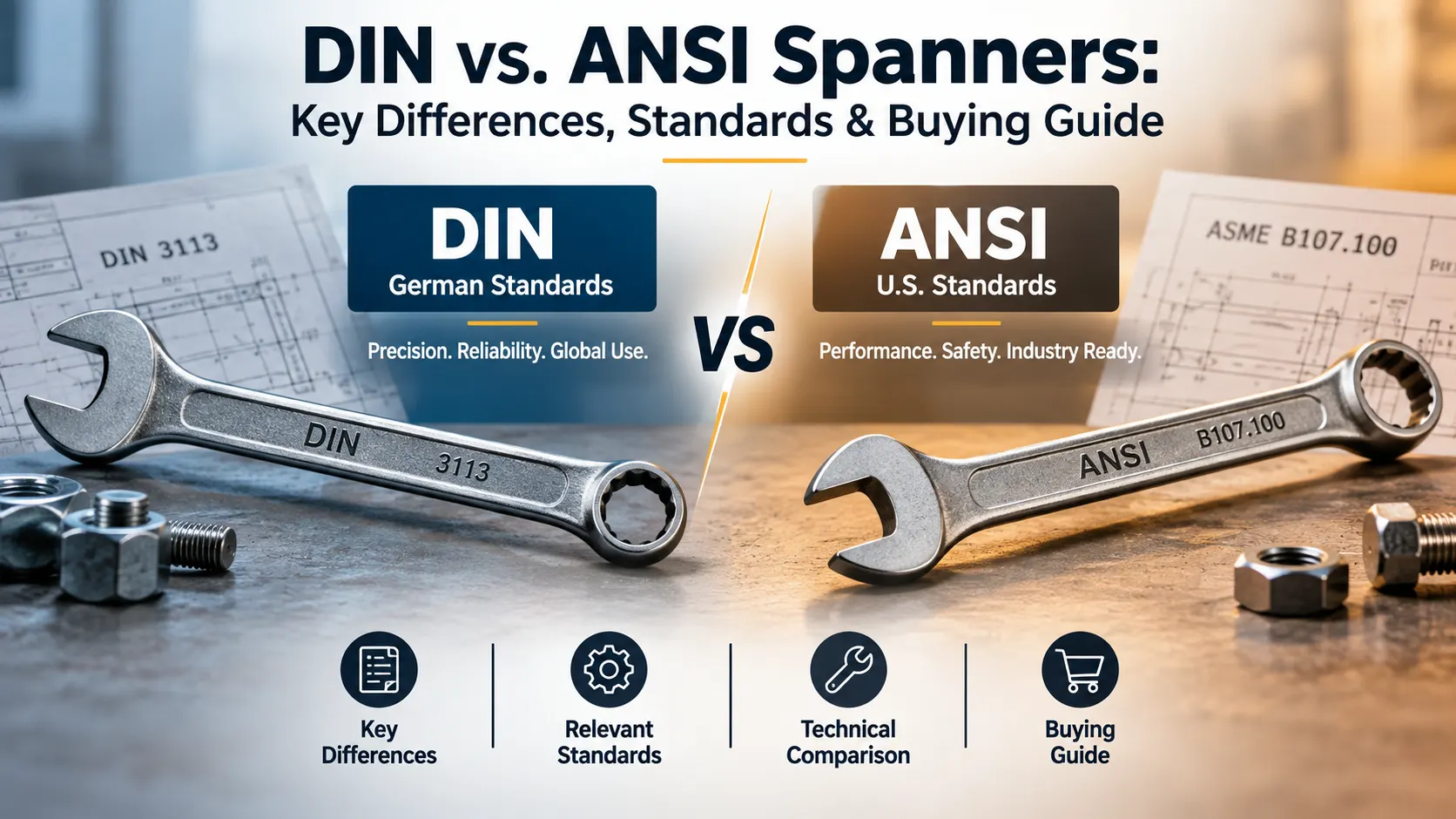
DIN vs. ANSI Spanners: What Is the Difference?
The main difference between DIN and ANSI spanners is the standards framework they are specified against.
DIN, or Deutsches Institut für Normung, is Germany’s national standards organization. DIN publishes standards for different products and applications, including specific hand-tool requirements.
ANSI, or the American National Standards Institute, administers and coordinates the U.S. voluntary standards and conformity assessment system. ANSI itself is not the organization that writes every technical hand-tool standard. Relevant wrench requirements are published through standards developers such as ASME and may be approved as American National Standards.
For example, DIN 3113 covers combination wrenches with equal openings, while ASME B107.100 covers flat wrenches and establishes general, dimensional, performance, and safety requirements for combination wrenches and other wrench configurations within its scope.
DIN vs. ANSI Spanners at a Glance
| Feature | DIN Spanners | ANSI/ASME Spanners |
| Standards framework | German DIN standards | U.S. American National Standards framework |
| Example standard | DIN 3113 | ASME B107.100 |
| Technical requirements | Defined by the applicable DIN standard | Defined by the applicable ASME B107 standard |
| Performance/testing | Depends on the specific DIN standard | Depends on the specific ASME B107 standard |
| Typical specification environment | DIN-based European/German requirements | U.S. and North American requirements |
| Procurement focus | Exact DIN designation | Exact ASME B107 designation |
Important: DIN does not simply mean “metric,” and ANSI/ASME does not simply mean “imperial.” The applicable standard and the actual wrench specification determine the tool’s requirements.
What Are DIN Spanners?
DIN spanners are wrenches manufactured or specified according to an applicable DIN standard.
There is no single standard called “the DIN spanner standard.” Different wrench types can have different DIN specifications, so buyers should identify the exact standard required for the tool.
Example: DIN 3113 Combination Wrench
DIN 3113:2007-09 is a current DIN standard for combination wrenches with equal openings and specifies test torque series A and C.
This makes DIN 3113 a useful reference when discussing DIN combination spanners, but it should not be treated as a specification for every type of DIN wrench.
For industrial purchasing, the important information is therefore not simply “DIN spanner.” The buyer should specify the exact DIN designation, wrench type, and size requirements.
What Are ANSI/ASME Spanners?
“ANSI spanner” is a common market term, but the technical specification should be identified more precisely.
ANSI coordinates the U.S. voluntary standards system and provides oversight for the American National Standards process. Individual standards are developed by accredited standards developers.
For hand tools, the ASME B107 series contains relevant wrench standards.
Example: ASME B107.100 Flat Wrenches
ASME B107.100-2023, Flat Wrenches, provides general, dimensional, performance, and safety requirements for combination wrenches and other flat-wrench configurations covered by the standard. It is designated as an American National Standard.
Therefore, when a U.S. customer asks for an “ANSI-compliant spanner,” the buyer or manufacturer should confirm which ASME B107 standard and wrench configuration are actually required.
DIN vs ANSI Spanners: Key Differences
The differences are best understood by comparing the standards rather than assuming one system represents a completely different type of wrench.
1. Standards System
DIN spanners are specified against applicable German DIN standards.
ANSI/ASME spanners are specified against applicable U.S. standards, such as the ASME B107 series. ANSI provides oversight within the American National Standards system rather than acting as the technical publisher of every wrench standard.
2. Technical Requirements
Both systems can establish requirements for dimensions, performance, testing, and safety, but the requirements depend on the specific standard and wrench type.
For example, DIN 3113 specifies test torque series for the combination wrenches it covers, while ASME B107.100 establishes requirements for flat wrenches within its scope.
3. Wrench Configuration
The exact wrench configuration matters.
A DIN standard may address a particular combination-wrench design, while an ASME B107 standard may cover several flat-wrench configurations. Therefore, comparing “DIN spanner” with “ANSI spanner” without identifying the wrench type can lead to an inaccurate specification.
4. Market and Procurement Requirements
DIN specifications are commonly encountered in European and German equipment supply chains, while ASME/ANSI requirements are commonly encountered in U.S. and North American specifications.
However, global manufacturers and distributors can encounter either standard depending on the customer, OEM, export market, or project specification.
Is DIN Better Than ANSI/ASME for Spanners?
No. Neither DIN nor ANSI/ASME is universally better.
A spanner’s suitability depends on its specific design, material, size, manufacturing quality, applicable standard, and required performance.
For industrial applications, the better choice is the one that matches the required specification.
Choose a DIN-specified spanner when:
- The OEM or customer requires a DIN standard.
- The equipment specification is based on a DIN requirement.
- The project documentation identifies a particular DIN wrench standard.
- The buyer needs compliance with a specified German or European standard.
Choose an ANSI/ASME-specified spanner when:
- The customer requires an applicable ASME B107 standard.
- The project specification calls for an American National Standard.
- The tool is being sourced for a U.S. or North American specification.
- Specific ASME performance or dimensional requirements are part of the purchase specification.
Are DIN and ANSI Spanners Interchangeable?
They can be physically interchangeable when the wrench opening, fastener size, and configuration are compatible, but physical fit does not establish standards compliance.
For example, a DIN combination wrench may fit a fastener that could also be operated by another wrench of the same nominal size. That does not mean the DIN tool automatically meets an ASME B107 requirement.
This distinction matters in OEM supply, industrial procurement, engineering projects, and contract manufacturing.
If a customer specifies a particular standard, the manufacturer or supplier should verify the tool against that exact requirement rather than relying only on its size or appearance.
What Should B2B Buyers Check Before Ordering?
For bulk sourcing of DIN or ANSI/ASME spanners, specify the technical requirements clearly.
- Exact standard: Do not specify only “DIN” or “ANSI.” Identify the applicable standard, such as DIN 3113 or ASME B107.100, where appropriate.
- Wrench type: Specify whether the requirement is for a combination, open-end, box, flare-nut, or another wrench configuration.
- Size range: Confirm the required opening sizes and measurement system. The standard should not be assumed from the terms “DIN” or “ANSI” alone.
- Performance requirements: Check the applicable torque, load, proof, or other performance requirements specified by the relevant standard.
- Technical documentation: For OEM and industrial orders, request the relevant technical specifications, test documentation, certificates, or compliance records when required by the contract or project.
- Customer or OEM specification: If the end customer has specified a particular standard, that requirement should take priority over a general preference for DIN or ANSI/ASME tools.
DIN vs ANSI Spanners: Which Should Industrial Buyers Choose?
For B2B buyers, the decision can be simplified:
- DIN specified by the customer: source the applicable DIN-compliant spanner.
- ASME B107 specified: source the applicable ASME-compliant spanner.
- No standard specified: define the required wrench type, dimensions, performance, and quality requirements before purchasing.
- OEM or contract application: follow the exact technical specification and documentation requirements.
- Export orders: confirm the standard required by the destination market or customer rather than assuming the local standard applies.
The key is to purchase against an exact technical specification, not simply a label such as “DIN spanner” or “ANSI spanner.”
Conclusion
DIN and ANSI spanners are primarily a standards and specification comparison, not a question of which system produces a universally better wrench. DIN standards such as DIN 3113 and U.S. standards such as ASME B107.100 define requirements for specific wrench types and applications.
For manufacturers, distributors, OEMs, and industrial buyers, the best approach is to identify the exact standard, wrench configuration, size, performance requirements, and documentation needed before ordering. Matching the tool to the customer’s or project’s specification provides a more reliable basis for procurement than choosing solely by brand, size, or country of origin.
FAQs
DIN spanners are specified according to applicable German DIN standards, while relevant U.S. wrench requirements are covered by standards such as the ASME B107 series within the American National Standards framework.
No. Neither is universally better. The correct choice depends on the application, wrench type, required performance, and customer or OEM specification.
No. DIN is a standards system, not simply a designation for metric tools. The actual dimensions and requirements depend on the applicable DIN standard.
No. ANSI is not a measurement system. It is associated with the U.S. standards framework. The applicable wrench standard can define the relevant dimensional requirements.
DIN 3113:2007-09 is a DIN standard for combination wrenches with equal openings, including specified test torque series A and C.
ASME B107.100-2023 is a relevant American National Standard for flat wrenches and specifies general, dimensional, performance, and safety requirements for combination wrenches and other configurations within its scope.