Satin Finish vs. Mirror Finish Spanners: Which Is Better?
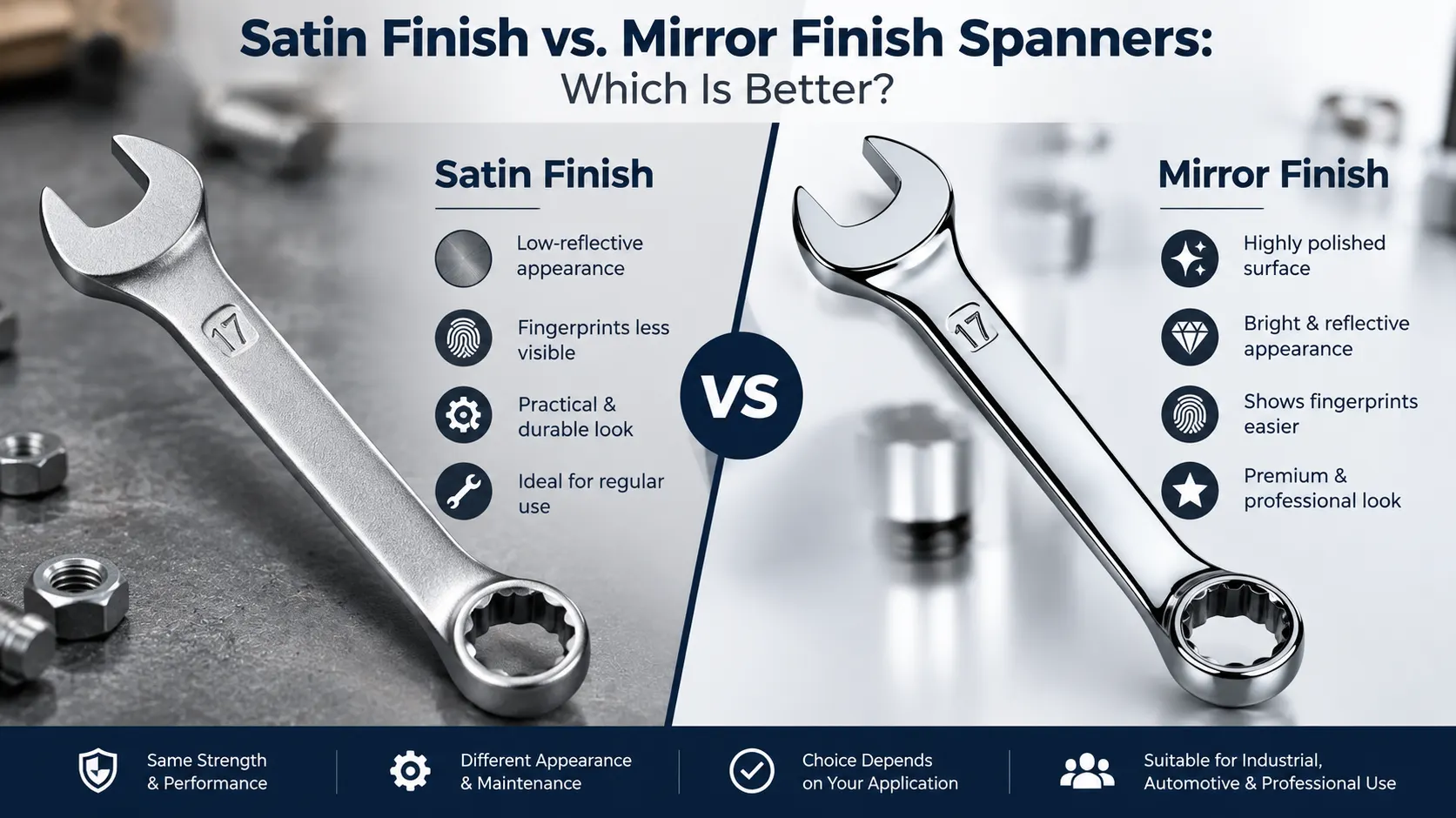
Satin finish and mirror finish spanners are both widely used in automotive, industrial, maintenance, construction, and workshop applications. The main difference is the surface finish: satin spanners have a subdued, low-sheen appearance, while mirror finish spanners have a highly polished and reflective surface.
For B2B buyers, distributors, importers, and manufacturers, the better choice depends on the required appearance, glare, surface-mark visibility, maintenance expectations, and product specifications. The finish alone does not determine a spanner’s strength, torque capacity, or overall quality.
What Is a Satin Finish Spanner?
A satin finish spanner has a controlled low-sheen or brushed surface rather than a highly reflective polish. It provides a more understated appearance and is often selected for tools intended for regular handling.
Key characteristics
- Low-reflective appearance
- Brushed or satin-looking surface
- Fingerprints are generally less conspicuous
- Minor handling marks can be less visually prominent
- Suitable for professional and industrial tool ranges
Satin-finished spanners are available in chrome-vanadium steel with features such as heat treatment and nickel-chrome plating. For example, Indian manufacturers list satin-finished spanners made from chrome-vanadium steel and manufactured to DIN or ASME-related specifications.
Where are satin-finish spanners used?
They are suitable for automotive workshops, industrial maintenance, machinery servicing, assembly work, construction equipment maintenance, and general mechanical applications.
Their main practical advantage is the understated surface appearance, particularly when tools are handled repeatedly.
What Is a Mirror Finish Spanner?
A mirror finish spanner has a highly polished, reflective surface. The polished finish gives the tool a bright appearance and is commonly associated with professional or premium tool ranges.
Key characteristics
- Highly polished surface
- Bright, reflective appearance
- Smooth-looking finish
- Fingerprints and smudges can be easier to see
- Provides a polished professional appearance
Mirror-polished spanners are also available in chrome-vanadium steel with heat treatment and nickel-chrome or chrome plating. Current product specifications from Indian manufacturers show mirror-polished spanners being offered alongside satin-finished alternatives.
Where are mirror finish spanners used?
Mirror finish spanners are commonly suited to professional workshops, automotive servicing, industrial maintenance, tool sets, OEM programs, export ranges, and private-label products where a polished appearance is part of the specification.
Satin vs. Mirror Finish Spanners: Key Differences
Satin and mirror finish spanners mainly differ in surface appearance, reflectivity, visibility of handling marks, maintenance, and finish requirements. These differences are primarily cosmetic and practical; the finish itself does not determine the spanner’s strength or torque capacity.
1. Surface Appearance
Satin finish spanners have a brushed, low-sheen appearance, while mirror finish spanners have a bright, highly polished surface.
A satin finish gives the spanner a more understated and practical look. A mirror finish creates a smooth, reflective appearance that is often associated with premium professional tool ranges. For OEMs, distributors, and tool buyers, the choice may depend on the required appearance of the finished product or tool range.
2. Glare and Reflectivity
Satin finish spanners generally reflect less light than mirror finish spanners.
The lower reflectivity of a satin surface can be useful in workshops with strong overhead lighting. Mirror finishes are more reflective and can produce more visible glare under direct or intense lighting. However, glare depends on the lighting conditions and working environment.
3. Fingerprints and Minor Marks
Satin finishes generally make fingerprints, smudges, and minor handling marks less noticeable than mirror finishes.
Frequent handling can leave visible marks on highly polished mirror surfaces. A satin finish tends to maintain a more consistent appearance during regular workshop use, while mirror finishes may require more frequent cleaning to maintain their polished appearance.
4. Cleaning and Maintenance
Both satin and mirror finish spanners can be maintained with routine cleaning, but surface marks are usually more visible on mirror finishes.
Satin surfaces can conceal minor handling marks more effectively. On mirror-polished surfaces, fingerprints, smudges, and fine scratches may be easier to notice. For professional tool sets, this difference can affect how often the tools need to be cleaned to maintain their appearance.
5. Corrosion Protection
A mirror finish does not automatically provide better corrosion resistance than a satin finish.
Corrosion resistance depends on the complete surface-treatment system, including the base material, surface preparation, plating or coating, and manufacturing quality. The visible finish should therefore not be used as the sole indicator of corrosion protection.
For B2B procurement, buyers should verify the specified plating or coating, corrosion-resistance requirements, and surface-treatment standard rather than selecting a spanner based only on how shiny or matte it looks.
6. Professional Appearance
Mirror finish spanners generally provide a brighter, more polished appearance, while satin finish spanners offer a more understated and practical look.
Mirror finishes can suit premium tool ranges, professional sets, OEM products, and applications where visual presentation is important. Satin finishes are often preferred when a practical appearance and less noticeable handling marks are more important.
Quick Overview
| Difference | Satin Finish | Mirror Finish |
| Appearance | Brushed, low-sheen | Bright, highly polished |
| Reflectivity | Lower | Higher |
| Fingerprints | Less noticeable | More noticeable |
| Minor marks | Less noticeable | More noticeable |
| Maintenance appearance | More forgiving | Marks are easier to see |
| Visual style | Practical, understated | Premium, polished |
| Corrosion protection | Depends on surface treatment | Depends on surface treatment |
Key takeaway: Satin finish is generally more practical for frequent handling and lower-reflective applications, while mirror finish is better suited to products where a bright, polished appearance is a priority. For industrial and B2B purchasing, evaluate the material, heat treatment, dimensions, applicable standards, and surface-treatment specification separately from the finish.
Does Finish Affect Spanner Strength or Torque Capacity?
No. The surface finish alone does not determine spanner strength or torque capacity.
Mechanical performance is influenced by factors such as:
- Steel grade and material quality
- Forging or manufacturing process
- Heat treatment
- Hardness
- Spanner geometry and dimensions
- Dimensional accuracy
- Manufacturing tolerances
- Applicable standards
- Quality-control procedures
For example, manufacturers list chrome-vanadium, drop-forged, heat-treated spanners with either satin or mirror finishes. This shows why surface finish should be evaluated separately from the construction and mechanical specifications of the tool.
Which Finish Is Better for B2B Spanner Procurement?
There is no universal winner. The appropriate finish depends on the product’s intended use and purchasing specification.
Choose satin finish when:
- Lower surface reflectivity is preferred
- The tool will be handled frequently
- Fingerprints and minor marks should be less noticeable
- A practical, understated appearance is desired
- The product is primarily intended for workshop or maintenance use
Choose mirror finish when:
- A highly polished appearance is important
- The tool is part of a premium professional range
- A bright surface is required by the product specification
- Surface marks need to be visually easy to identify
- OEM, distributor, or private-label requirements call for a polished finish
Conclusion
Satin and mirror finish spanners differ mainly in appearance, reflectivity, and how visible handling marks are. Satin finishes offer a practical, low-sheen surface, while mirror finishes provide a brighter, polished appearance. Neither finish alone determines strength or torque performance. For B2B procurement, choose based on the intended application and evaluate the material, heat treatment, applicable standards, and surface-treatment specifications alongside the finish.
FAQs
Neither is universally better. Satin finish is often preferred for a practical, low-sheen appearance, while mirror finish is preferred when a bright, polished appearance is required.
No. Strength depends on factors such as material, forging or manufacturing process, heat treatment, geometry, dimensions, and quality control, not simply the surface finish.
Satin finish can be a practical choice for frequent workshop use because it has a lower-sheen appearance and generally makes fingerprints and minor handling marks less noticeable.
Not necessarily. Corrosion resistance depends on the complete surface-treatment system, including plating or coating and surface preparation. A shiny appearance alone does not prove superior corrosion protection.
Both can be maintained with normal tool care. Satin finishes generally make fingerprints and minor handling marks less noticeable, while these marks may be more visible on mirror-polished surfaces.
No. Torque capacity depends on the tool’s design, material, dimensions, manufacturing quality, and applicable specifications rather than whether its surface is satin or mirror finished.