Standard vs. Deep Offset Ring Spanners: Key Differences, Uses & Selection Guide
- What Is a Standard Ring Spanner?
- What Is a Deep Offset Ring Spanner?
- Standard vs. Deep Offset Ring Spanners: Key Differences
- When Should You Use a Standard Ring Spanner?
- When Should You Use a Deep Offset Ring Spanner?
- Standard vs Deep Offset: Which Ring Spanner Is Right for Your Application?
- What Should B2B Buyers Check When Sourcing Ring Spanners?
- Quick Decision Guide
- Conclusion
- FAQs
Choosing between a standard and deep offset ring spanner largely depends on one factor: how easily the fastener can be accessed. Both provide a closed-ring grip around a nut or bolt, but their head geometry and offset make them suitable for different working conditions.
A standard ring spanner is generally suitable for accessible fasteners, while a deep offset ring spanner provides additional clearance where fasteners are recessed or surrounded by other components. For industrial buyers, distributors, and OEM procurement teams, selecting the right design can improve tool usability and ensure better fit with the intended application.
What Is a Standard Ring Spanner?
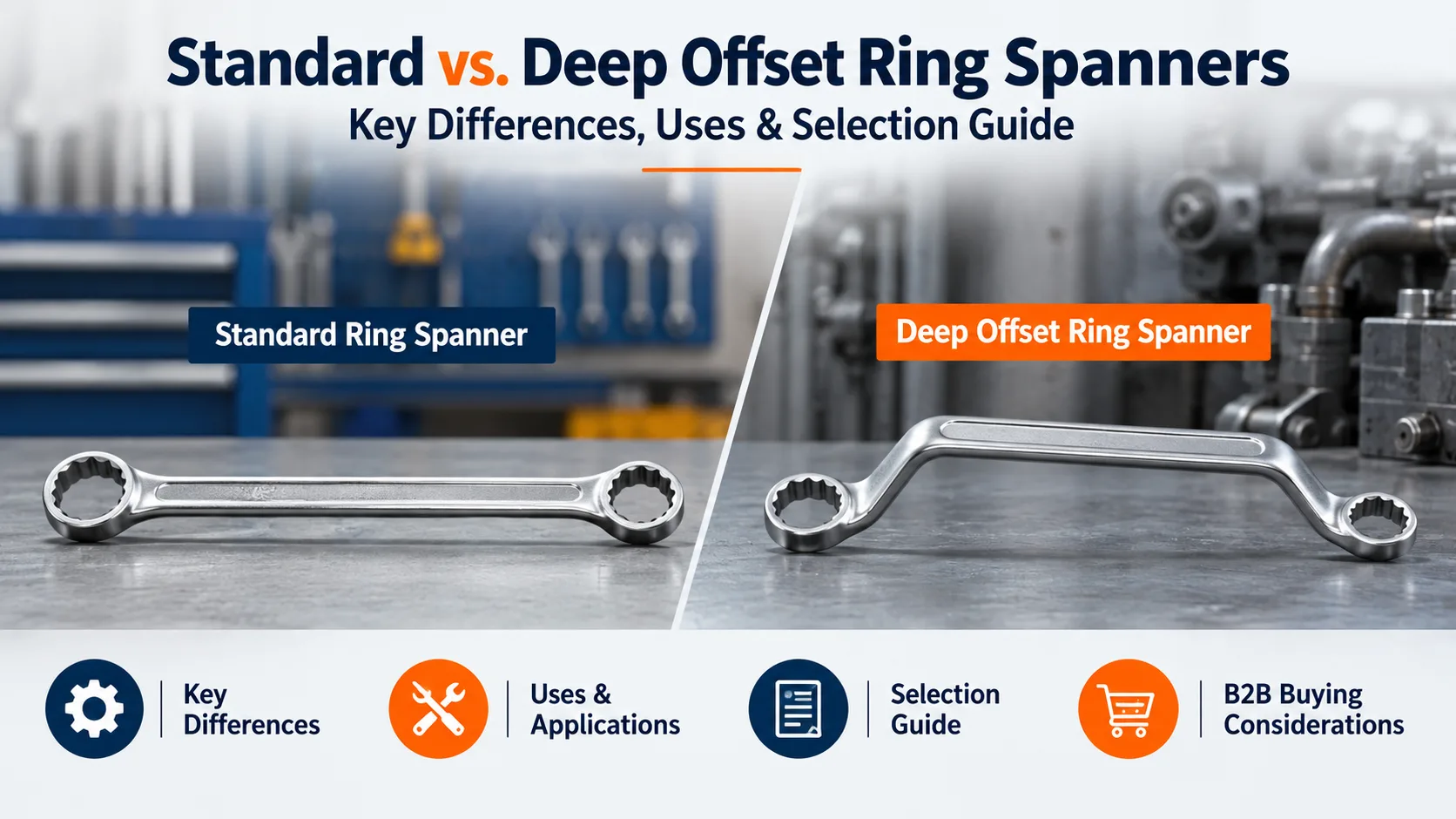
A standard ring spanner is a closed-ended hand tool designed to grip the flats of a hexagonal nut or bolt. Its ring head provides engagement around the fastener rather than contacting it from only two sides.
The relatively standard head position makes it suitable when the fastener is readily accessible, and there is sufficient clearance around the working area.
A standard ring spanner is generally preferred for:
- Routine assembly and maintenance
- Easily accessible fasteners
- Applications with sufficient surrounding clearance
- General industrial and workshop use
Its main advantage is straightforward access without requiring additional head offset.
What Is a Deep Offset Ring Spanner?
A deep offset ring spanner has a more pronounced offset between the ring head and handle. This geometry creates additional clearance between the user’s hand, the handle, and surrounding components.
The design is particularly useful when a nut or bolt is positioned below an obstruction, recessed into an assembly, or located where a standard ring spanner cannot provide comfortable access.
A deep offset ring spanner is generally preferred for:
- Recessed fasteners
- Fasteners surrounded by components
- Restricted-access maintenance
- Applications requiring additional handle clearance
The exact geometry can vary between manufacturers and product specifications, so buyers should assess the actual offset and dimensions rather than relying on the product name alone.
Standard vs. Deep Offset Ring Spanners: Key Differences
| Feature | Standard Ring Spanner | Deep Offset Ring Spanner |
| Head geometry | Standard offset/profile | Deeper offset/profile |
| Fastener access | Best for accessible fasteners | Better for recessed or obstructed fasteners |
| Clearance | Normal working clearance | Greater handle clearance |
| Restricted spaces | Suitable where access is adequate | Better suited to restricted access |
| Typical use | General maintenance and assembly | Specialized maintenance and assembly |
| Selection priority | Accessibility and size | Accessibility, depth and clearance |
The fundamental difference is not the ring’s ability to grip the fastener. Both designs use a closed ring; the key distinction is how the head is positioned relative to the handle and how that geometry affects access.
When Should You Use a Standard Ring Spanner?
A standard ring spanner is the practical choice when the fastener is exposed, and there are no surrounding components that interfere with the tool.
Choose a standard design when:
- The nut or bolt is easy to reach.
- There is adequate clearance around the fastener.
- The handle does not contact nearby components.
- The application involves routine fastening or maintenance.
- A deeper offset provides no meaningful access advantage.
For general industrial maintenance, standard ring spanners can therefore cover a wide range of straightforward fastening applications.
When Should You Use a Deep Offset Ring Spanner?
A deep offset ring spanner becomes more useful when access is the primary challenge.
Choose a deep offset design when:
- The fastener sits below a surrounding surface or component.
- Nearby parts restrict the movement of a standard spanner.
- Additional clearance is needed between the handle and the assembly.
- The fastening point is recessed or difficult to approach directly.
- Maintenance work requires better access without changing the fastener itself.
The deeper offset does not automatically make the tool better. Its value comes from matching the tool’s geometry to the physical location of the fastener.
Standard vs Deep Offset: Which Ring Spanner Is Right for Your Application?
The simplest way to choose is to assess the fastener location and available clearance.
Choose a standard ring spanner if the fastener is accessible and surrounding components do not interfere with the handle.
Choose a deep offset ring spanner if the fastener is recessed, obstructed, or positioned where additional clearance is required.
For maintenance teams working across different machinery, keeping both designs available can be practical because the required geometry can change from one fastening point to another.
What Should B2B Buyers Check When Sourcing Ring Spanners?
For bulk procurement, the choice between standard and deep offset should go beyond the product name. Buyers should verify the specifications that affect fit, consistency, and service performance.
1. Ring Opening Dimensions
The opening must correspond accurately to the required fastener size. ISO 691 specifies tolerances for wrench and socket openings for metric fasteners, making dimensional accuracy an important consideration when evaluating manufactured spanners.
2. Head Geometry and Offset
For deep offset models, confirm the actual offset and head dimensions. This is particularly important when the spanner is being specified for a particular machine or restricted-access application.
3. Material and Heat Treatment
Ask the manufacturer for information on the steel specification and applicable heat-treatment process. These factors influence the tool’s mechanical properties and consistency.
4. Torque and Performance Testing
For industrial and bulk requirements, buyers should check whether the manufacturer’s testing process covers applicable torque and performance requirements. India’s ring-wrench specification, IS 2029, includes requirements relating to dimensions, workmanship, hardness, and torque testing.
5. Batch Consistency
For distributors, OEMs, and industrial procurement teams, consistency across large quantities is as important as the specification of an individual tool. Size accuracy, head geometry, finish, and overall workmanship should remain consistent from batch to batch.
India’s Bureau of Indian Standards currently lists ring wrenches under IS 2029, and its published information includes ring-wrench testing and specification references.
Quick Decision Guide
| Application | Recommended Choice |
| Accessible fastener | Standard ring spanner |
| Routine maintenance | Standard ring spanner |
| Recessed fastener | Deep offset ring spanner |
| Fastener surrounded by components | Deep offset ring spanner |
| Limited handle clearance | Deep offset ring spanner |
| Mixed industrial maintenance | Combination of both |
Conclusion
The choice between a standard and deep offset ring spanner comes down to fastener accessibility and clearance. Standard ring spanners are suitable for straightforward, accessible fastening points, while deep offset ring spanners are better suited to recessed or obstructed locations where additional clearance is needed.
For B2B buyers sourcing ring spanners in India or from Indian manufacturers, evaluating dimensions, head geometry, material quality, testing, and manufacturing consistency helps ensure that the selected tools match the application’s requirements and perform reliably across bulk orders.
FAQs
The main difference is the head geometry. A standard ring spanner has a conventional head position suited to accessible fasteners, while a deep offset ring spanner has greater head offset to provide additional clearance for recessed or obstructed fastening points.
A deep offset ring spanner is used where a fastener is recessed, surrounded by components, or positioned in an area with limited clearance. Its deeper head geometry helps provide access while keeping the handle farther away from surrounding parts.
Neither is universally better. A standard ring spanner is generally more suitable for accessible fasteners, while a deep offset design is advantageous where additional clearance is required. The correct choice depends on the fastening location and surrounding geometry.
A deep offset ring spanner is generally more suitable when the main limitation is clearance around the fastener. However, the required offset and head dimensions should be checked against the actual application before selecting the tool.
B2B buyers should check opening dimensions, head geometry, material, heat treatment, torque or performance testing, applicable standards, finish, and batch-to-batch consistency. For deep offset models, the specified offset and clearance should also match the intended application.