Drop-Forged vs Machined Spanners: Key Differences, Strength & Applications
- Drop-Forged vs Machined Spanners: Quick Answer
- What Is a Drop-Forged Spanner?
- What Is a Machined Spanner?
- Drop-Forged vs Machined Spanners: Key Differences
- Which Spanner Manufacturing Process Should You Choose?
- What Should Buyers Check Before Ordering Spanners?
- Drop-Forged vs Machined Spanners: Which Is Better?
- Conclusion
- FAQs
When sourcing spanners for industrial, automotive, maintenance, or OEM applications, the manufacturing process can affect strength, dimensional accuracy, production cost, customization, and long-term performance. Two common approaches are drop forging and machining.
So, which is better: a forged or machined spanner? The answer depends on the application, material, required tolerances, production volume, and performance requirements. Drop forging is generally well suited to repeat, high-volume production and demanding applications, while machining offers greater flexibility for specialized designs and lower-volume requirements.
Drop-Forged vs Machined Spanners: Quick Answer
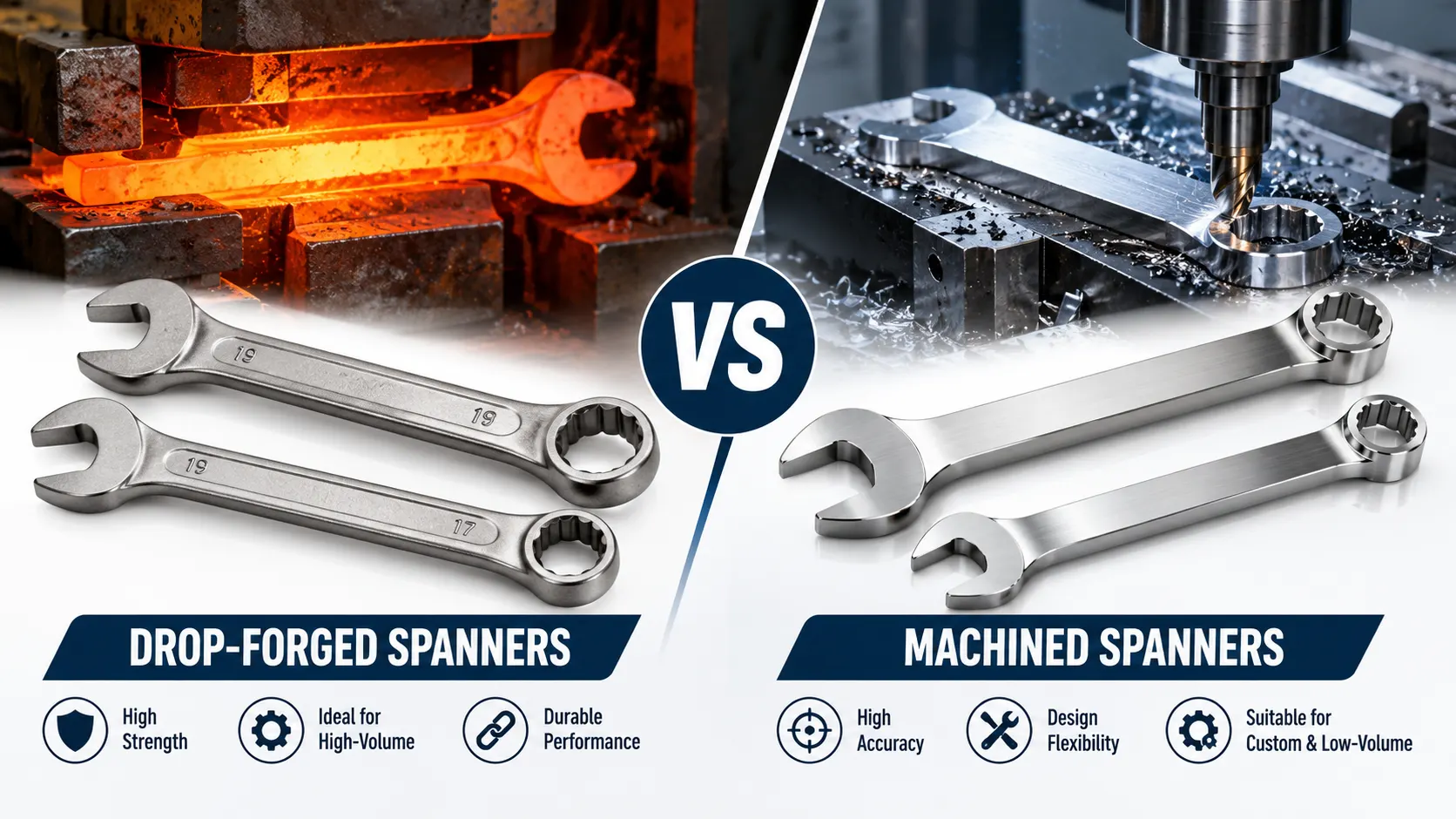
Drop-forged spanners are typically preferred for high-volume and demanding applications because controlled forging can produce robust tool geometries and efficient material distribution. Machined spanners offer excellent dimensional control and design flexibility, making them useful for specialized, custom, or lower-volume production. However, the manufacturing method alone does not determine tool performance; material, heat treatment, geometry, tolerances, and quality control also matter.
| Factor | Drop Forged Spanner | Machined Spanner |
| Manufacturing | Metal shaped using dies and controlled force | Material removed from a blank |
| Strength | Well suited to demanding applications | Depends on material, geometry and processing |
| Dimensional control | High, often with final machining | High-through controlled machining |
| Production volume | Generally suited to larger runs | Useful for smaller or specialized runs |
| Customization | Possible, but tooling may be required | Generally more flexible |
| Initial tooling | Higher due to forging dies | Usually lower |
| Unit economics | Often favorable at scale | Can be higher for large production runs |
What Is a Drop-Forged Spanner?
A drop forged spanner is produced by shaping heated metal between dies using controlled impact or pressing force. The forged blank is then trimmed, heat-treated, machined where required, and finished.
A typical manufacturing sequence may include:
- Preparing the steel or alloy blank
- Heating the material to the required forging temperature
- Forming it between dies
- Removing excess material
- Heat treating the forged component
- Machining critical surfaces or openings
- Grinding, finishing, and inspection
The important point for buyers is that drop forging does not mean the entire spanner is finished without machining. Critical dimensions and functional surfaces may still require machining after forging.
Why use drop forging?
Drop forging is attractive for spanners that need repeatable geometry and reliable performance across larger production quantities. The process can efficiently form the overall tool profile while supporting robust designs suitable for repeated mechanical loading.
However, the final strength of a forged spanner depends on more than the forging process. Steel grade, heat treatment, geometry, forging quality, and subsequent processing all influence performance.
What Is a Machined Spanner?
A machined spanner is manufactured primarily by removing material from a suitable metal blank to create the required profile and dimensions. Depending on the design, manufacturers may use CNC milling, cutting, drilling, grinding, and other machining operations.
Machining provides manufacturers with considerable control over the finished geometry. It can therefore be useful when a buyer needs unusual dimensions, specialized profiles, prototypes, or relatively small production quantities.
Why use machining?
Machined spanners can be a practical choice when:
- Custom dimensions are required
- Product designs may change frequently
- Production volumes are limited
- Specialized profiles are needed
- Tight dimensional control is important
Machining does not automatically make a spanner superior or inferior to a forged product. Its main advantage is manufacturing flexibility and controlled material removal.
Drop-Forged vs Machined Spanners: Key Differences
1. Manufacturing Process
Drop forging shapes heated metal between dies, while machining removes material from a blank to create the required geometry. A forged spanner may still require machining for critical dimensions, while a machined spanner may undergo heat treatment and finishing.
2. Strength and Load Handling
Drop forged spanners can be well suited to demanding load applications, but manufacturing method alone does not determine strength. Material grade, heat treatment, geometry, dimensional accuracy, and manufacturing quality all affect performance under torque and repeated loading.
3. Dimensional Accuracy
Machining offers precise control over dimensions and tolerances, while forged spanners can achieve consistent dimensions through controlled dies and subsequent machining. Accurate working openings are particularly important for achieving proper fastener fit and reducing the risk of damage.
4. Production Volume
Drop forging is generally more economical for high-volume, repeat production, while machining is often better suited to smaller batches, prototypes, and frequently modified designs. Buyers should evaluate production volume alongside tooling and unit costs.
5. Cost
Neither process is universally cheaper. Drop forging typically involves higher upfront die costs but can deliver lower unit costs at scale. Machining may require less dedicated tooling but can have higher per-unit costs because of machine time, material removal, and setup.
6. Customization and Design Flexibility
Machining generally provides greater flexibility for custom dimensions and design changes. Drop forging can also produce customized spanners, but new designs may require dedicated dies, making tooling cost and expected production volume important considerations for OEM buyers.
7. Finishing and Quality Control
Both forged and machined spanners may require heat treatment, grinding, deburring, coating, marking, dimensional inspection, and performance testing. Buyers should therefore evaluate the complete manufacturing and quality-control process rather than judging quality solely by whether a spanner is forged or machined.
Which Spanner Manufacturing Process Should You Choose?
The better process depends on your purchasing requirements.
Choose drop forged spanners when:
- Production volumes are high
- The tool will face demanding mechanical loads
- Repeat production is expected
- Consistent tool geometry is required
- Long-term tooling economics support the investment
Choose machined spanners when:
- Production quantities are relatively low
- Custom dimensions are required
- Designs may change frequently
- Specialized profiles are needed
- Flexible production is more important than mass-production economics
For B2B procurement, the best choice is not simply forged and machined. Buyers should compare material, required performance, tolerances, annual volume, tooling cost, finishing, inspection requirements, and total unit economics.
What Should Buyers Check Before Ordering Spanners?
Before placing a bulk order, confirm:
- Material grade and specification
- Manufacturing process
- Heat-treatment requirements
- Critical dimensions and tolerances
- Spanner opening accuracy
- Required load or torque performance
- Surface finish and coating
- Applicable product standards
- Inspection and testing procedures
- MOQ and tooling charges
- Sample approval process
- Production lead time
- Packaging and product marking
Where applicable, buyers should identify the relevant hand-tool standard for the product and market rather than relying on generic claims such as “industrial grade.” ASME B107 standards, for example, cover requirements related to the design, performance, tolerances, and safety of various hand tools, including wrenches.
Drop-Forged vs Machined Spanners: Which Is Better?
Drop-forged spanners are generally a strong fit for high-volume, repeat production and demanding applications, while machined spanners offer greater flexibility for specialized, custom, and lower-volume requirements.
For industrial and OEM buyers, the manufacturing process should be selected according to the actual application, material, performance requirements, dimensional tolerances, production volume, tooling investment, and total cost.
The most reliable sourcing decision is therefore based on verified specifications and manufacturing quality, not simply whether a spanner is labeled forged or machined.
Conclusion
Choosing between drop-forged and machined spanners depends on the application, production volume, required tolerances, customization, and total cost. Drop forging is generally well suited to high-volume, demanding applications, while machining offers greater flexibility for specialized or lower-volume requirements. For B2B buyers, the best choice is the process that delivers the required performance, consistency, and economics, not simply the one labeled “forged” or “machined.”
FAQs
They can be well suited to high-load applications, but strength depends on material, geometry, heat treatment, manufacturing quality, and other factors, not forging alone.
Machining can provide very tight dimensional control, particularly for specialized geometries. However, properly controlled forged spanners can also achieve consistent dimensions, often with final machining of critical areas.
Forged spanners may offer better unit economics at high production volumes, while machining can be more economical for smaller or customized orders. Tooling, material, machining time, and quantity all affect the final cost.
Machining generally offers greater flexibility for low-volume or frequently modified designs. Drop forging can also be used for custom spanners when the expected production volume justifies dedicated tooling.
Drop forging is often a suitable option for large, repeat orders because dedicated tooling costs can be spread across a larger production quantity. The final choice should also consider performance and quality requirements.