How Are Combination Spanners Manufactured? A Step-by-Step Guide
Combination spanners are manufactured by cutting and heating alloy-steel blanks, forming them through closed-die forging, trimming excess material, machining the working ends, heat treating the tool, applying the required surface finish, and completing dimensional and functional inspections. The exact process can vary by manufacturer, steel grade, spanner design, and specification.
For B2B buyers, understanding the combination spanner manufacturing process provides useful insight into product consistency, mechanical performance, dimensional accuracy, and supplier capabilities.
Combination Spanner Manufacturing Process at a Glance
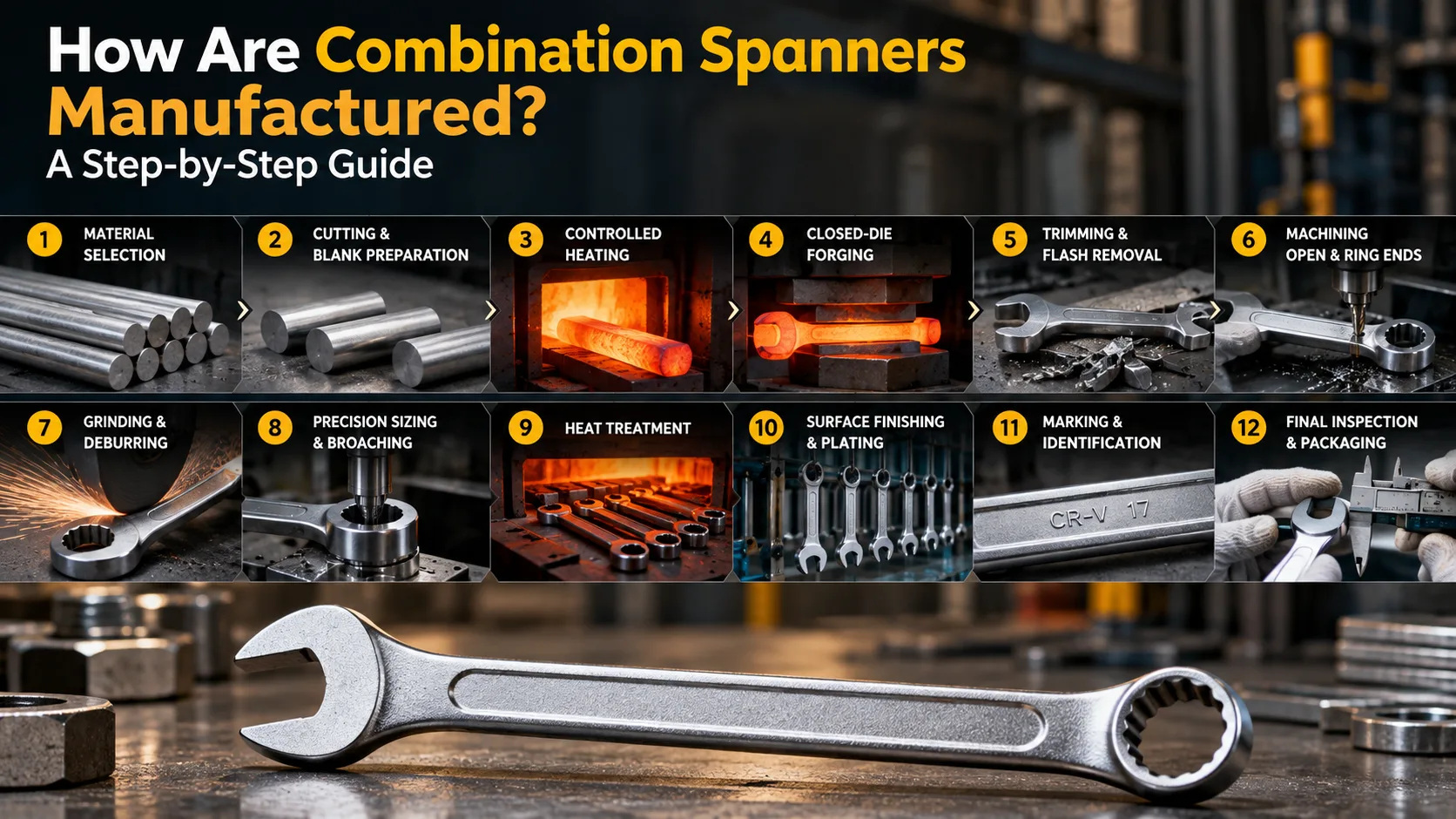
A typical production sequence is:
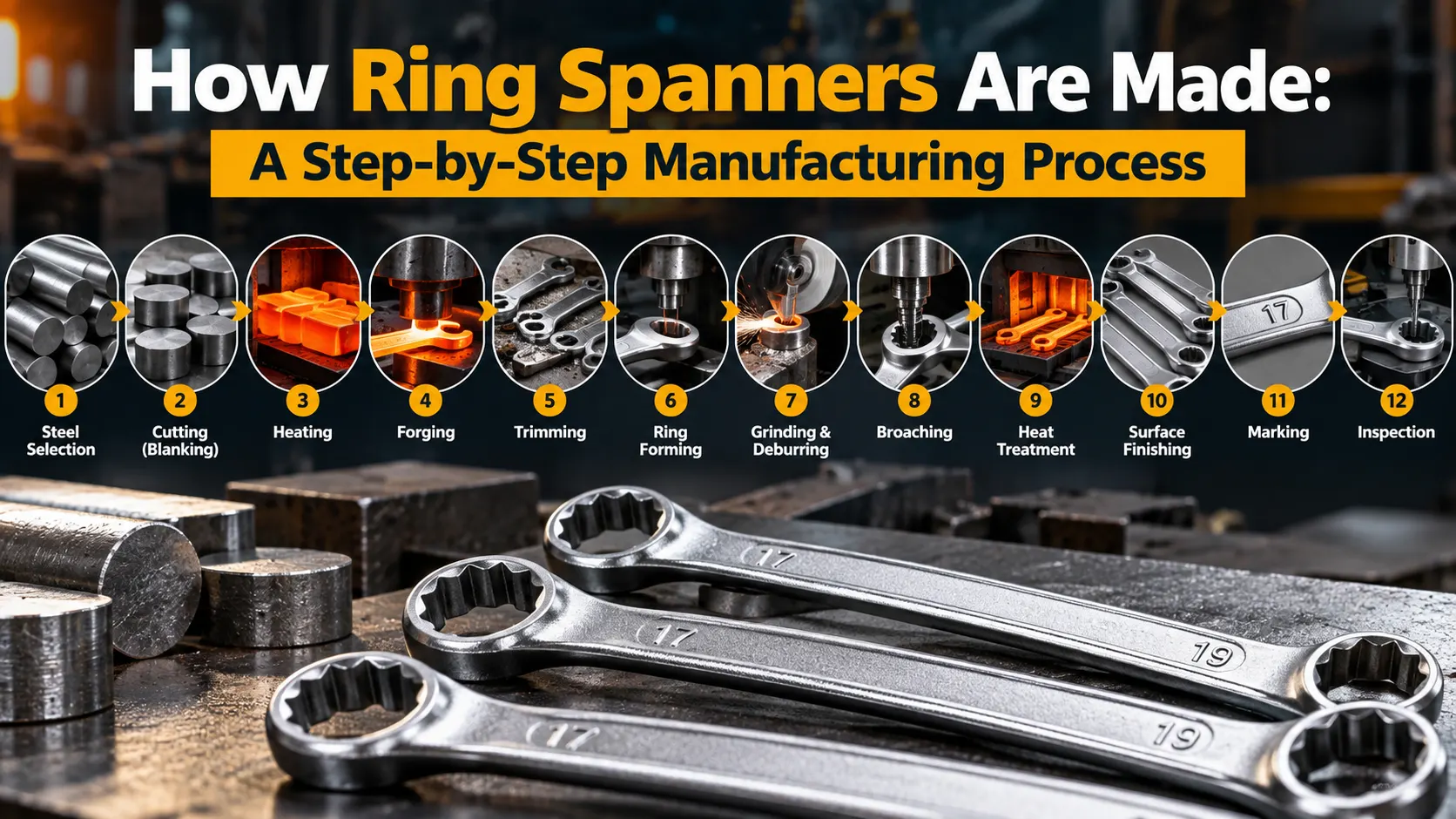
- Material selection and inspection
- Steel cutting and blank preparation
- Controlled heating
- Closed-die or drop forging
- Trimming and flash removal
- Open-end and ring-end machining
- Grinding and deburring
- Precision sizing and broaching
- Heat treatment
- Surface finishing and plating
- Marking and identification
- Final inspection and packaging
Not every manufacturer uses identical equipment or follows precisely the same sequence. Operations can be combined, rearranged, or modified according to the tool design and production specification.
How Are Combination Spanners Manufactured?
Combination spanners are typically manufactured through 12 main steps, starting with steel selection and ending with final inspection and packaging. The core process combines hot forging, precision machining, heat treatment, and surface finishing.
1. Material Selection and Inspection
Alloy steel, commonly chrome vanadium steel, is selected according to the required strength, toughness, hardness, and product specification. Key checks may include:
- Steel grade and chemical composition
- Material dimensions and surface condition
- Mill certificates or material documentation
Consistent raw material provides a reliable starting point for subsequent forging and heat treatment.
2. Cutting and Blank Preparation
Steel stock is cut into controlled-length blanks suitable for forging. The manufacturer controls:
- Blank length and weight
- Material volume required for the die cavity
- Cutting consistency between batches
Accurate blanks help maintain uniform material distribution and reduce unnecessary material waste.
3. Controlled Heating
The steel blanks are heated to a controlled temperature suitable for hot forging. Depending on the production setup, manufacturers may use:
- Industrial furnaces
- Induction heating systems
- Temperature monitoring and control
The required heating range depends on the steel grade and forging process.
4. Closed-Die or Drop Forging
Closed-die forging forms the main body and structural geometry of the combination spanner. During forging:
- The heated blank is placed between shaped dies.
- Controlled force forms the handle, open end, and ring end.
- Excess material may form flash around the die.
Forging establishes the primary shape before the critical working surfaces are precision-finished.
5. Trimming and Flash Removal
Trimming removes excess metal produced around the forged part. This operation:
- Removes forging flash
- Cleans the outer profile
- Prepares the blank for machining and finishing
The result is a more defined forged component ready for the next production stages.
6. Forming the Open and Ring Ends
The two working ends are formed and finished to their specified dimensions and profiles.
- Open end: The jaws are shaped to achieve the required opening and fastener fit.
- Ring end: The internal profile is formed to provide proper engagement with the fastener.
Dimensional accuracy at both ends is important for reliable fit and torque transfer.
7. Grinding and Deburring
Grinding removes burrs, sharp edges, and surface irregularities from the forged and machined component. Typical objectives include:
- Smoothing edges and surfaces
- Removing residual burrs
- Preparing the tool for surface treatment
Material removal is controlled to avoid changing critical dimensions or working profiles.
8. Precision Sizing and Broaching
Broaching and other precision machining operations establish accurate dimensions and working profiles. Depending on the design, these operations may be used to:
- Refine the ring-end profile
- Achieve specified tolerances
- Improve consistency between production batches
This stage is particularly important where precise fastener engagement is required.
9. Heat Treatment
Heat treatment develops the hardness, strength, and toughness required for service. A typical process may include:
- Hardening: Increases hardness and strength
- Tempering: Balances hardness with toughness
- Hardness testing: Verifies the resulting properties
Heat-treatment parameters are determined by the steel grade and product specification.
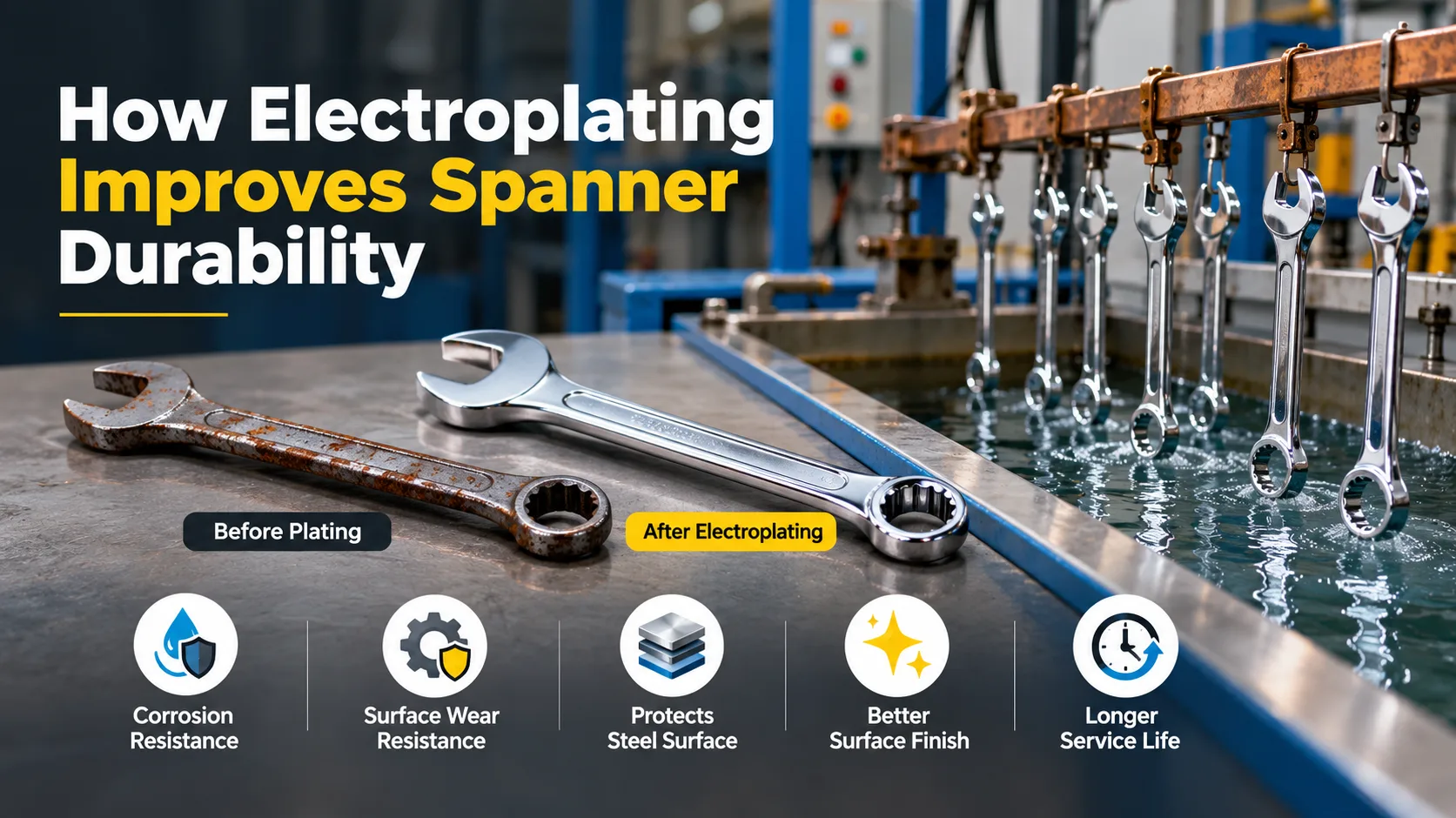
10. Surface Finishing and Plating
After heat treatment, the spanner receives its specified surface finish. Depending on the product, finishing may include:
- Cleaning or surface preparation
- Polishing or blasting
- Nickel or chrome plating
- Other specified protective coatings
The finish can improve corrosion resistance, appearance, and handling characteristics.
11. Marking and Identification
Finished combination spanners are marked with the information required for product identification. Common markings include:
- Spanner size
- Brand or manufacturer name
- OEM/private-label identification where required
- Other specified product markings
Clear marking supports product identification and traceability.
12. Final Inspection and Packaging
The finished spanners are inspected against the applicable quality and customer requirements before shipment. Common quality checks include:
| Quality Check | Purpose |
| Dimensional inspection | Verifies critical dimensions and profiles |
| Hardness testing | Checks heat-treatment results |
| Visual inspection | Identifies surface and forging defects |
| Gauge/profile checks | Verifies working-end fit |
| Torque or load testing | Evaluates functional strength |
| Plating inspection | Checks surface finish and coverage |
| Marking inspection | Confirms product identification |
Once approved, the spanners are packaged according to the buyer’s specified packaging, labeling, and shipping requirements.
What Determines the Quality of a Combination Spanner?
A combination spanner’s quality depends on the entire manufacturing system, rather than one production stage.
The most important factors are:
- Material consistency: Provides a reliable starting point for production.
- Forging control: Establishes consistent overall geometry.
- Dimensional accuracy: Ensures proper engagement with fasteners.
- Machining quality: Controls critical working profiles.
- Heat-treatment consistency: Develops the required mechanical properties.
- Surface treatment: Provides the specified finish and protection.
- Inspection: Identifies non-conforming products before shipment.
This is particularly important for OEM and bulk orders, where maintaining the same specifications across thousands of pieces is often more important than the appearance of an individual sample.
What Should B2B Buyers Check When Sourcing Combination Spanners?
When evaluating a combination spanner manufacturer, buyers should verify more than the unit price. Key points include:
- Steel grade and material documentation
- Forging and machining capabilities
- Heat-treatment process and hardness requirements
- Dimensional and profile tolerances
- Surface finish and plating specification
- Inspection and testing procedures
- Product marking and traceability
- OEM/private-label capabilities
- Packaging requirements
- Production capacity and batch consistency
A pre-production sample or approval sample can also help buyers verify dimensions, finish, markings, packaging, and overall workmanship before moving to larger orders.
Conclusion
The combination spanner manufacturing process combines material control, hot forging, precision machining, heat treatment, surface finishing, and inspection. Forging establishes the tool’s primary form, while later operations control its working profiles, mechanical properties, dimensions, and surface quality.
For B2B buyers, understanding these stages makes it easier to assess manufacturers on the factors that matter most: material consistency, production control, dimensional accuracy, heat-treatment capability, finishing quality, inspection systems, and reliable batch-to-batch performance.
FAQs
Chrome vanadium steel is commonly used for forged combination spanners, although the exact steel grade depends on the required specification and performance requirements.
Many combination spanners are produced using hot closed-die or drop forging. The forged blank is then trimmed, machined, heat treated, finished, and inspected.
Heat treatment develops the required combination of hardness, strength, and toughness so the tool can withstand repeated service loads.
Broaching is used to create or refine accurate profiles and dimensions on critical working surfaces, including the ring end, depending on the manufacturer’s process.
Chrome plating provides a durable surface finish and can improve resistance to corrosion and surface wear while giving the tool a consistent appearance.