What Is Warm Forging?
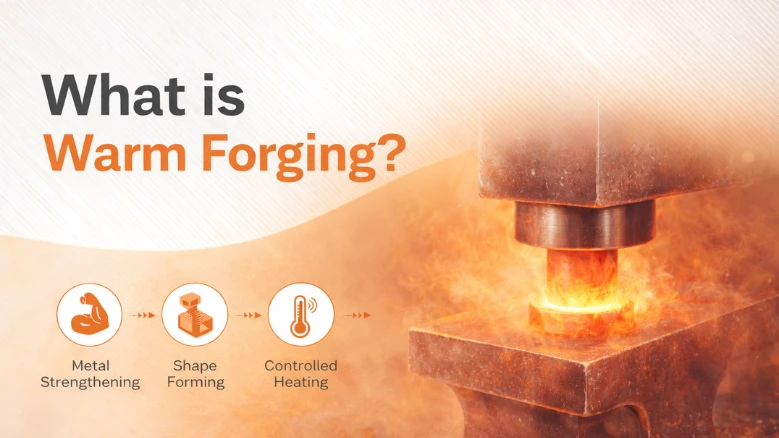
Warm forging is an advanced metal forming process that bridges the gap between cold forging and hot forging. It combines the dimensional accuracy of cold forging with the improved metal flow and strength typically associated with hot forging, making it suitable for producing components with strict performance and tolerance requirements.
In industries such as automotive manufacturing, industrial tooling, and hand tool production, warm forging is widely used where components must endure mechanical stresses like cyclic loading, wear, and fatigue while maintaining dimensional stability.
What Is Warm Forging?
Warm forging is a metal forging process performed at intermediate temperatures, usually between 600°C and 900°C, offering strength and dimensional accuracy.
At this temperature:
- The metal is softened to be easily deformable
- Yet strong enough to retain a controlled grain structure
- Oxidation and scaling are minimized compared to hot forging
It is an intermediate temperature metal forging process, and it is suitable for the production of warm forged parts that require both mechanical strength and dimensional accuracy.
Warm forging is different from hot forging, which emphasizes ease of deformation, and cold forging, which emphasizes precision but uses more deformation force.
How Warm Forging Works
To ensure material homogeneity, tool longevity, and product quality, a step-by-step procedure is followed. Here is the step-by-step warm forging process:
- Heating: The metal is evenly heated to a certain warm forging temperature. This step requires careful temperature control to prevent overheating or uneven metal deformation.
- Lubrication and Die Preparation: Lubricants are applied to the metal to lower friction, enhance surface finish, and extend die life.
- Forging Process: The heated metal is placed inside the forging dies, where moderate forces are applied to deform the metal into the required component shape.
- Cooling and Finishing: The components are cooled in a controlled environment to preserve mechanical properties, followed by minimal finishing or machining if required.
Why This Process Matters:
- Lower forging force than cold forging
- Better material flow without excessive grain growth
- Higher consistency in mass production
This well-rounded process enables the production of near-net-shape components with minimal waste and high consistency.
Advantages of Warm Forging
Warm forging offers several technical and commercial advantages that make it a preferred process for precision-driven industries.
Better Accuracy Than Hot Forging
- Tighter dimensional tolerances
- Improved surface quality
- Reduced need for extensive post-forging machining
Better Strength Than Cold Forging
- Optimized grain flow improves mechanical strength
- Enhanced fatigue and impact resistance
- Lower risk of internal stress buildup
Additional Benefits:
- Reduced material waste
- Lower energy consumption compared to hot forging
- Longer die and tooling life
- Improved consistency in high-volume production
These benefits make warm forging highly suitable for hand tools and industrial components that must meet strict quality standards.
When Warm Forging Is Preferred
Warm forging is preferred when manufacturers seek a well-rounded process that combines strength, accuracy, and efficiency. It is preferred for:
- Medium-duty tools subjected to repeated mechanical loads
- Precision components with complex shapes
- Components where cold forging forces are too high
- Applications where hot forging tolerances are inadequate
For manufacturers, warm forging makes possible the production of dependable tools that work consistently well in harsh industrial and professional settings.
Applications of Warm Forging
Warm forging is widely adopted across industries where performance reliability and dimensional stability are critical. Common applications of warm forging include:
- Gears and gear blanks
- Shafts and couplings
- Fasteners and transmission parts
- Spanners, wrenches, and sockets
- Mechanical fittings
- Tool bodies requiring high wear resistance
Compared to hot forging, warm forging provides superior dimensional accuracy, while offering greater material strength than cold forging, making it ideal for components that must endure long service life.
Conclusion
Warm forging is a highly efficient and reliable manufacturing process that fills the gap between hot and cold forging. By combining controlled deformation, improved strength, and dimensional accuracy, it enables the production of components that meet modern industrial demands.
For industries focused on tool reliability, performance consistency, and long-term durability, warm forging offers a strategic advantage in both quality and cost efficiency.
At JCBL Hand Tools, forging is backed by engineering expertise, controlled manufacturing processes, and rigorous quality standards. Our experience with advanced forging techniques—including warm forging—allows us to deliver high-performance hand tools and components trusted across industries.
Looking for durable, precision-forged hand tools?
Explore manufacturing capabilities of JCBL Hand Tools and discover products engineered for strength, accuracy, and reliability.
Warm forging is a metal forming process performed at intermediate temperatures, offering a balance between mechanical strength and dimensional accuracy.
Warm forging uses lower temperatures than hot forging, resulting in reduced oxidation, better surface finish, and tighter tolerances.
Warm forging is cost-effective for precision components, as it reduces machining, material waste, and tooling wear compared to other forging methods.
Warm forging is commonly used in automotive parts, industrial tools, and hand tools requiring strength, precision, and durability.
Warm forging is better for complex shapes and medium-duty components, as it requires lower forming forces while maintaining strong mechanical properties.
Related Post
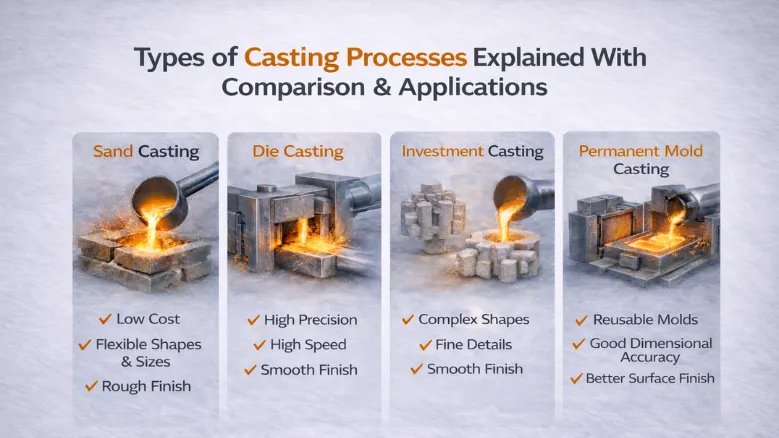
Types of Casting Processes Explained With Comparison & Applications
Mainly, there are four types of casting processes, including sand casting, die casting, investment casting, [...]
What is Forging? Process, Benefits
Forging is a manufacturing process where metal is shaped using compressive force (usually after heating) [...]
What Is Hot Forging?
In the world of industrial tool-making, strength and dependability are not optional items; they are [...]