Types of Casting Processes Explained With Comparison & Applications
- What Are Casting Processes?
- What Are the Main Types of Casting Processes?
- Types of Casting Processes
- Sand Casting
- Die Casting
- Investment Casting
- Permanent Mold Casting
- Which Casting Process Is Best?
- Which Casting Process Should You Choose?
- Which Industries Use Casting Processes?
- What Are the Industry Standards and Quality Considerations in Casting?
- Conclusion
- FAQs
Casting processes are manufacturing methods where molten metal is poured into a mold to create specific shapes. The main types of casting processes include sand casting, die casting, investment casting, and permanent mold casting. These methods are widely used by manufacturers and exporters in India, the United States, Europe, and global supply chains to produce high-performance metal components.
What Are Casting Processes?
Casting processes are metal forming methods in which molten material is poured into a mold and allowed to solidify into a desired shape. They are widely used to manufacture complex components that are difficult or expensive to produce using other methods.
Casting processes are commonly used by casting manufacturers in India, North America, and Europe due to their scalability, cost efficiency, and ability to produce intricate geometries.
Learn more in our guide on what is casting.
What Are the Main Types of Casting Processes?
The four main types of casting processes are:
- Sand casting
- Die casting
- Investment casting
- Permanent mold casting
These methods differ in mold type, production cost, precision, and industrial applications.
Types of Casting Processes
| Casting Type | Mold Type | Precision | Cost | Production Volume | Best For |
| Sand Casting | Expendable sand | Medium | Low | Low–Medium | Large parts |
| Die Casting | Metal die | High | High | High | Mass production |
| Investment Casting | Ceramic mold | Very High | Medium-High | Medium | Complex parts |
| Permanent Mold Casting | Reusable metal | High | Medium | Medium-High | Consistent parts |
Sand Casting
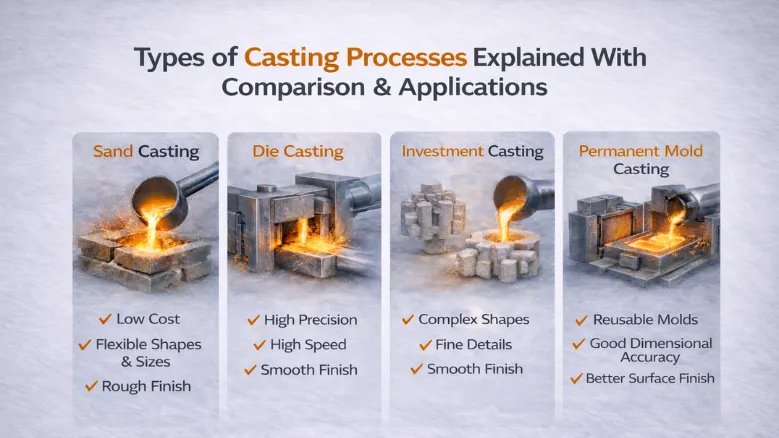
Sand casting is one of the most widely used casting processes, where molten metal is poured into a sand mold to form the desired shape. It is especially popular among casting manufacturers in India and emerging markets due to its low cost and flexibility.
Process Insight
A pattern is used to create a cavity in the sand mold, into which molten metal is poured. After solidification, the mold is broken to retrieve the final component.
Applications
- Engine blocks
- Agricultural machinery components
- Heavy equipment parts
Advantages
- Low tooling cost
- Suitable for large and heavy components
- Flexible design capability
Limitations
- Rough surface finish
- Lower dimensional accuracy
Die Casting
Die casting is a high-pressure casting process where molten metal is injected into a steel mold to produce precise and high-quality components. It is widely used in high-volume manufacturing in the US and Europe, especially in automotive and electronics industries.
Process Insight
Molten metal is forced into the die cavity under high pressure, enabling excellent surface finish and tight tolerances.
Applications
- Automotive components
- Electrical housings
- Consumer products
Advantages
- High production efficiency
- Excellent surface finish
- High dimensional accuracy
Limitations
- High initial tooling cost
- Limited to non-ferrous metals such as aluminum and zinc
Investment Casting
Investment casting, also known as lost-wax casting, is a precision casting method used to produce highly detailed and complex components. It is widely used in global aerospace and precision engineering industries.
Process Insight
A wax pattern is coated with ceramic material to create a mold. The wax is then melted away, and molten metal is poured into the cavity.
Applications
- Aerospace components
- Medical devices
- Precision engineering parts
Advantages
- Exceptional accuracy and surface finish
- Suitable for complex geometries
- Minimal machining required
Limitations
- Higher cost compared to sand casting
- Longer production cycle
Permanent Mold Casting
Permanent mold casting uses reusable metal molds to produce components with improved consistency and mechanical properties. It is commonly used in industrial manufacturing and global supply chains.
Process Insight
Molten metal is poured into a preheated reusable mold, allowing repeated use and improved production efficiency.
Applications
- Automotive parts
- Industrial equipment components
- Medium-scale production items
Advantages
- Better surface finish than sand casting
- Improved mechanical properties
- Reusable molds reduce long-term costs
Limitations
- Higher initial mold cost
- Less flexibility for complex designs
Which Casting Process Is Best?
The best casting process depends on application requirements, production volume, material type, and cost considerations.
- Sand casting → Low cost, large components
- Die casting → High-volume, precision parts
- Investment casting → Complex and detailed designs
- Permanent mold casting → Consistent quality production
Which Casting Process Should You Choose?
The right casting process depends on production volume, component complexity, material requirements, and cost efficiency. For metal casting exporters and manufacturers in India, the US, and Europe, selecting the correct method ensures quality, compliance, and global competitiveness.
Based on Production Volume
Sand casting is ideal for low to medium production due to its low tooling cost and flexibility. For high-volume manufacturing, die casting is preferred because it enables faster production and consistent output.
Based on Component Complexity
Investment casting is best suited for intricate and high-precision components. For simpler designs, sand casting and permanent mold casting offer more cost-effective solutions.
Based on Material Requirements
Sand casting supports a wide range of materials, including iron and steel, while die casting is limited to non-ferrous metals. Investment casting is ideal for high-performance alloys used in aerospace and engineering applications.
Based on Cost Efficiency
Sand casting has the lowest upfront cost, making it suitable for short production runs. Die casting and permanent mold casting become more economical for large-scale production due to lower per-unit cost.
Quick Guide to Choose the Casting Process
| Requirement | Best Casting Method |
| Low volume | Sand casting |
| High volume | Die casting |
| Complex parts | Investment casting |
| Consistent output | Permanent mold casting |
Which Industries Use Casting Processes?
Casting processes are used in automotive, agricultural machinery, construction, and aerospace industries to produce durable, complex, and high-performance components.
Casting is widely adopted across manufacturing hubs in India, North America, and Europe, where industries require scalable and cost-efficient production methods.
Automotive Industry
Casting is used to produce engine blocks, transmission housings, and structural components that require strength and durability under continuous operation.
Agricultural Machinery
Casting is essential for manufacturing heavy-duty components such as machinery housings and structural parts that operate in harsh environments.
Construction & Infrastructure
Casting is used in heavy equipment and structural components that require high load-bearing capacity and long-term durability.
Aerospace Industry
Precision casting is used to manufacture complex and high-performance components with strict quality and safety requirements.
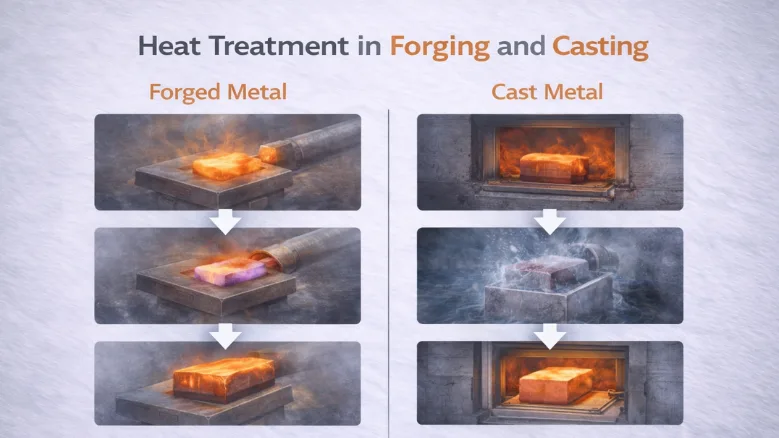
Explore more in our guide on the difference between cast and forged.
What Are the Industry Standards and Quality Considerations in Casting?
Casting quality is ensured through controlled process parameters, material traceability, dimensional accuracy, and compliance with global standards such as ISO and ASTM.
What Are the Key Quality Factors in Casting?
- Controlled mold design and cooling ensure proper solidification and prevent defects such as shrinkage or cracks
- Material traceability allows tracking from raw material to finished product for quality assurance
- Dimensional inspection ensures components meet required tolerances
Common Casting Industry Standards
- ISO quality management systems ensure consistent production and process control
- ASTM standards define material properties and testing methods
- Heat treatment certifications ensure mechanical performance and durability
These practices are essential for exporters supplying to regulated markets such as the US, Europe, and the Middle East.
Conclusion
Casting processes are essential for manufacturing complex, durable, and cost-efficient metal components across industries. The four main types, sand casting, die casting, investment casting, and permanent mold casting, are selected based on production needs, material requirements, and application demands.
For manufacturers and exporters in India and global markets, choosing the right casting process is not just a technical decision; it directly impacts product quality, cost efficiency, and long-term competitiveness.
FAQs
There are four main types of casting processes: sand casting, die casting, investment casting, and permanent mold casting.
Sand casting is the most commonly used method due to its low tooling cost and flexibility for large components.
Die casting is generally not suitable for tools because it is limited to non-ferrous metals, while tools often require stronger ferrous materials.
Common materials used in casting include iron, steel, aluminum, zinc, magnesium, and various industrial alloys.
Casting is cost-effective for producing complex shapes and large components, especially in high-volume production.
Sand casting is widely used in India due to its low cost and flexibility, while die casting and investment casting are preferred in the US and Europe for precision and high-volume production.
Related Readings