Why GS-Certified Spanners Matter: Safety, Compliance & Buyer Confidence
- What Is GS Certification in Spanners?
- Which Standards Are Relevant to GS-Certified Spanners?
- Why Do GS-Certified Spanners Matter?
- GS Certification vs CE Marking: What’s the Difference?
- What Should Buyers Check Before Purchasing GS-Certified Spanners?
- Why GS Certification Matters for Industrial Buyers and Distributors
- Conclusion
- FAQs
- Related Articles
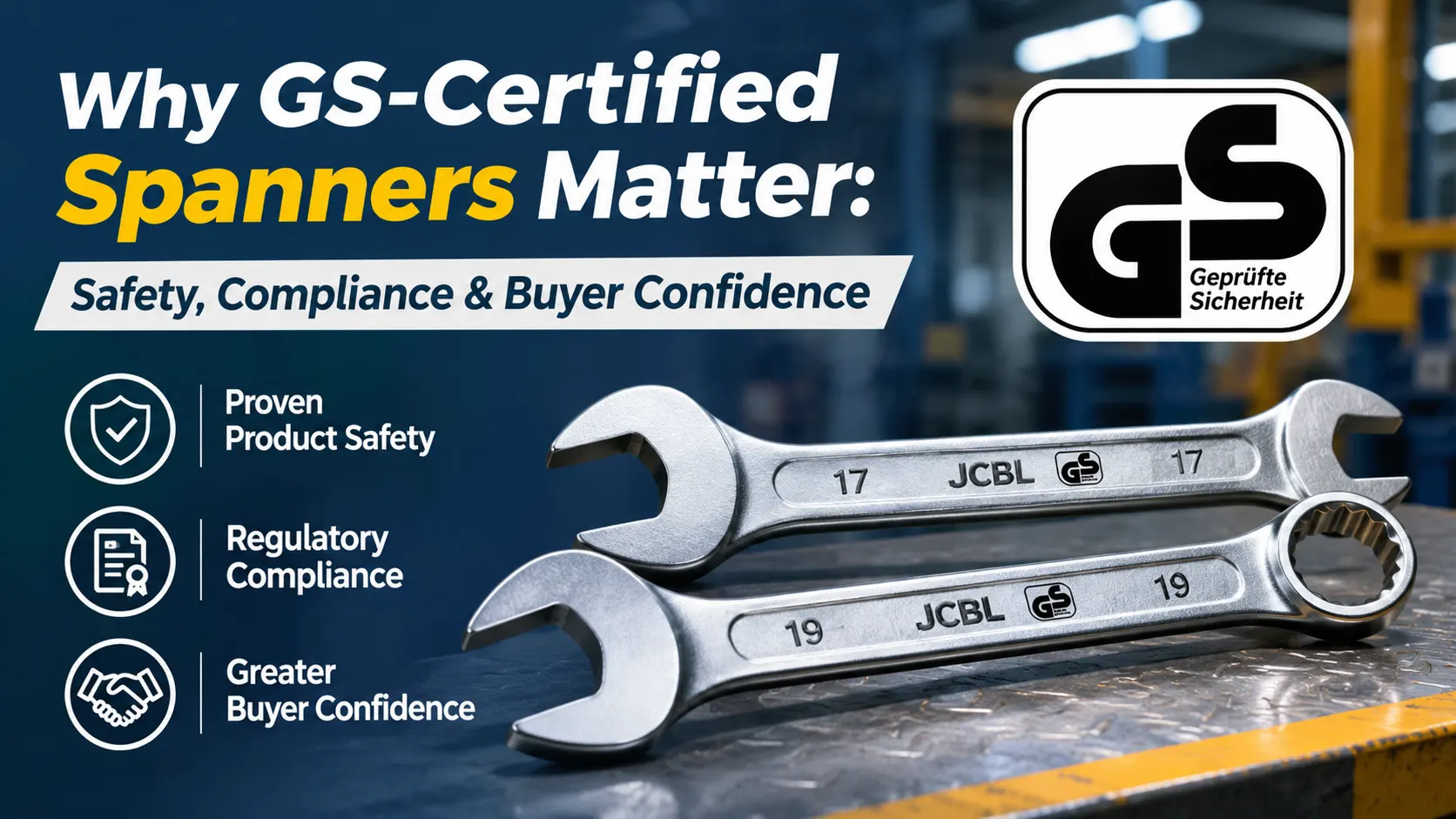
GS-certified spanners are independently tested hand tools that meet applicable product safety requirements under Germany’s Product Safety Act (ProdSG). The GS mark, short for Geprüfte Sicherheit (Tested Safety), indicates that an authorised certification body has assessed the product’s safety and monitors its manufacturing process.
For industrial buyers, distributors, and tool importers, GS certification provides documented evidence of product safety, supporting informed purchasing and supplier evaluation decisions.
What Is GS Certification in Spanners?
GS certification is a voluntary German product safety certification regulated under the German Product Safety Act (Produktsicherheitsgesetz or ProdSG). It indicates that an authorised, independent GS body has tested a product type and verified its compliance with applicable safety requirements.
The certification process involves:
- Independent Product Testing: Assessment of the product against applicable safety requirements and technical specifications.
- Manufacturing Assessment: Evaluation of production facilities and manufacturing controls to ensure consistency with the tested product type.
- Production Monitoring: Periodic checks to verify that manufactured products continue to meet certification requirements.
- Certification Documentation: Issuance of a certificate identifying the approved product and defining its validity period.
GS certification is voluntary and applies to the specific certified product type, not automatically to every product manufactured by the same company.
Which Standards Are Relevant to GS-Certified Spanners?
Spanners are evaluated against applicable product-specific standards depending on their design, configuration, and intended application. Some relevant DIN standards include:
- DIN 3110: Applicable to specific double-ended open-jaw spanners.
- DIN 3113: Covers specified combination spanners.
- DIN 838: Relates to specific double-ended offset ring spanners.
These standards address product-specific requirements and help establish the technical basis for assessing relevant spanner designs. Testing may involve parameters such as hardness, torque resistance, and dimensional accuracy, depending on the applicable standard and certification scope.
Manufacturers should confirm the relevant standard and testing requirements with their authorised certification body rather than assuming that every spanner is assessed against all three standards.
Why Do GS-Certified Spanners Matter?
GS certification provides independent evidence of product safety beyond a manufacturer’s internal quality checks. Its importance for industrial applications can be understood through five key considerations.
1. Independent Verification of Product Safety
A manufacturer’s internal inspections are important, but independent testing adds another level of verification. GS-certified spanners undergo assessment by an authorised third-party body to establish whether the tested product meets applicable safety requirements.
This gives buyers documented assurance that product safety has been evaluated independently rather than being supported exclusively by manufacturer claims.
2. Greater Confidence in Tool Selection
Spanners are used in mechanical assembly, automotive servicing, equipment maintenance, and industrial operations. Selecting tools with independently verified safety credentials helps procurement teams make more informed purchasing decisions.
GS certification provides a verifiable reference when comparing suppliers and evaluating product safety documentation.
3. Manufacturing Consistency and Production Monitoring
Safety verification must extend beyond initial product testing. GS certification includes production monitoring to check whether manufactured products continue to match the tested product type.
This helps identify inconsistencies between certified designs and ongoing manufacturing output, giving bulk buyers additional confidence in the production controls associated with certified products.
4. Support for Workplace Safety
Appropriate tool selection is an important part of workplace safety management. Spanners must meet application requirements, have suitable dimensions, and be used according to their intended purpose.
GS certification provides additional evidence for evaluating product safety before tools are introduced into workplace operations. However, it does not eliminate operational risks. Correct handling, inspection, and maintenance remain essential.
5. Stronger Supplier Credibility
For manufacturers supplying international markets, independently verified product credentials can strengthen buyer confidence.
A valid GS certificate demonstrates that the specified product has undergone independent safety assessment. It also gives procurement professionals a documented reference when reviewing supplier credentials and product claims.
GS Certification vs CE Marking: What’s the Difference?
GS certification and CE marking serve different purposes under the German and European product regulatory frameworks.
| GS Certification | CE Marking |
|---|---|
| Voluntary product safety certification. | Mandatory where applicable EU legislation requires it. |
| Requires independent assessment by an authorised GS body. | Generally based on the manufacturer’s conformity assessment. |
| Includes product testing and production monitoring. | Third-party assessment is required only for certain product categories and procedures. |
| Demonstrates verified compliance with applicable safety requirements within its certification scope. | Indicates conformity with applicable EU harmonisation legislation. |
The main distinction is that GS certification requires independent third-party testing, whereas CE marking generally relies on the manufacturer’s conformity assessment.
GS certification does not replace CE marking obligations where applicable EU legislation requires CE marking. The two marks are not interchangeable.
What Should Buyers Check Before Purchasing GS-Certified Spanners?
A GS logo alone is not sufficient proof of valid certification. Industrial buyers, importers, and distributors should verify the following before placing orders:
- Authentic GS Mark: Check that the product carries a legitimate GS mark with the identification details required by the certification body.
- Authorised Certification Body: Confirm that the certificate was issued by a body authorised to award the GS mark for the relevant product category.
- Certificate Validity: Check the certificate’s validity period and confirm that it has not been suspended or withdrawn.
- Product Identification and Scope: Match the certificate number, product description, model, and certification scope with the exact spanner being supplied. Certification of one product does not automatically cover an entire range.
- Technical Specifications: Independently assess material, dimensions, design, finish, and application suitability. GS certification does not automatically guarantee superior durability, torque capacity, or overall product quality.
These checks help buyers distinguish genuinely certified products from tools carrying unsupported safety claims.
Why GS Certification Matters for Industrial Buyers and Distributors
For B2B buyers, product certification is an important part of supplier evaluation and procurement risk management.
When sourcing spanners in bulk, businesses must assess whether suppliers can provide reliable product documentation and meet the requirements of their target markets.
GS-certified spanners offer several procurement advantages:
- Documented Safety Verification: Independent certification records provide evidence beyond manufacturer declarations.
- Supplier Evaluation: Certification offers an additional reference when comparing manufacturers and their product credentials.
- Informed Procurement: Verified product information supports more confident purchasing decisions.
- Market Expectations: GS certification can help meet buyer or project-specific requirements where independently tested products are preferred or specified.
For international importers and distributors, certificate verification and destination-market compliance checks remain essential before bulk purchasing.
Conclusion
GS certification provides additional assurance when evaluating spanners for industrial and professional applications. Through independent product testing, certification, and manufacturing surveillance, it offers documented evidence of compliance with applicable safety requirements.
For manufacturers, distributors, importers, and procurement teams, verifying GS certification supports informed supplier evaluation and product selection. However, certification should always be considered alongside technical specifications, application suitability, and destination-market requirements.
Choosing the right spanner means looking beyond its specifications to understand how its safety and conformity have been verified.
FAQs
1. What does GS mean on a spanner?
GS stands for Geprüfte Sicherheit, meaning Tested Safety in German. The mark indicates that an authorised independent certification body has assessed the product and verified its compliance with applicable safety requirements.
2. Are GS-certified spanners safer than non-certified spanners?
GS-certified spanners have undergone independent safety assessment and certification. This provides additional documented assurance compared with products supported only by a manufacturer’s own safety declaration. However, the absence of a GS mark does not automatically mean a product is unsafe.
3. Is GS certification mandatory for spanners?
No. GS certification is voluntary under the German Product Safety Act. Manufacturers can apply through an authorised GS body if their products are eligible and meet the applicable requirements.
4. What is the difference between GS certification and CE marking?
GS certification involves independent third-party safety testing, whereas CE marking generally involves the manufacturer’s assessment of conformity with applicable EU legislation. CE marking is mandatory where relevant EU legislation requires it, while GS certification is voluntary.
5. How can buyers verify a GS-certified spanner?
Buyers should check the GS mark, issuing certification body, certificate number, validity period, and exact product identification. They can also consult the certification body’s published certificate records.
6. Does GS certification guarantee spanner quality and durability?
No. GS certification verifies compliance with applicable product safety requirements within its certification scope. It is not a comprehensive quality or durability rating. Buyers should separately evaluate material specifications, construction, dimensions, and performance requirements.
7. Can spanners manufactured outside Germany receive GS certification?
Yes. GS certification is not restricted to products manufactured in Germany. Manufacturers in other countries can apply through an authorised GS certification body, provided their products meet the applicable requirements. The certification applies to the specified product, not automatically to the manufacturer’s entire product range.