How OEM Spanners Are Manufactured: Step-by-Step Process
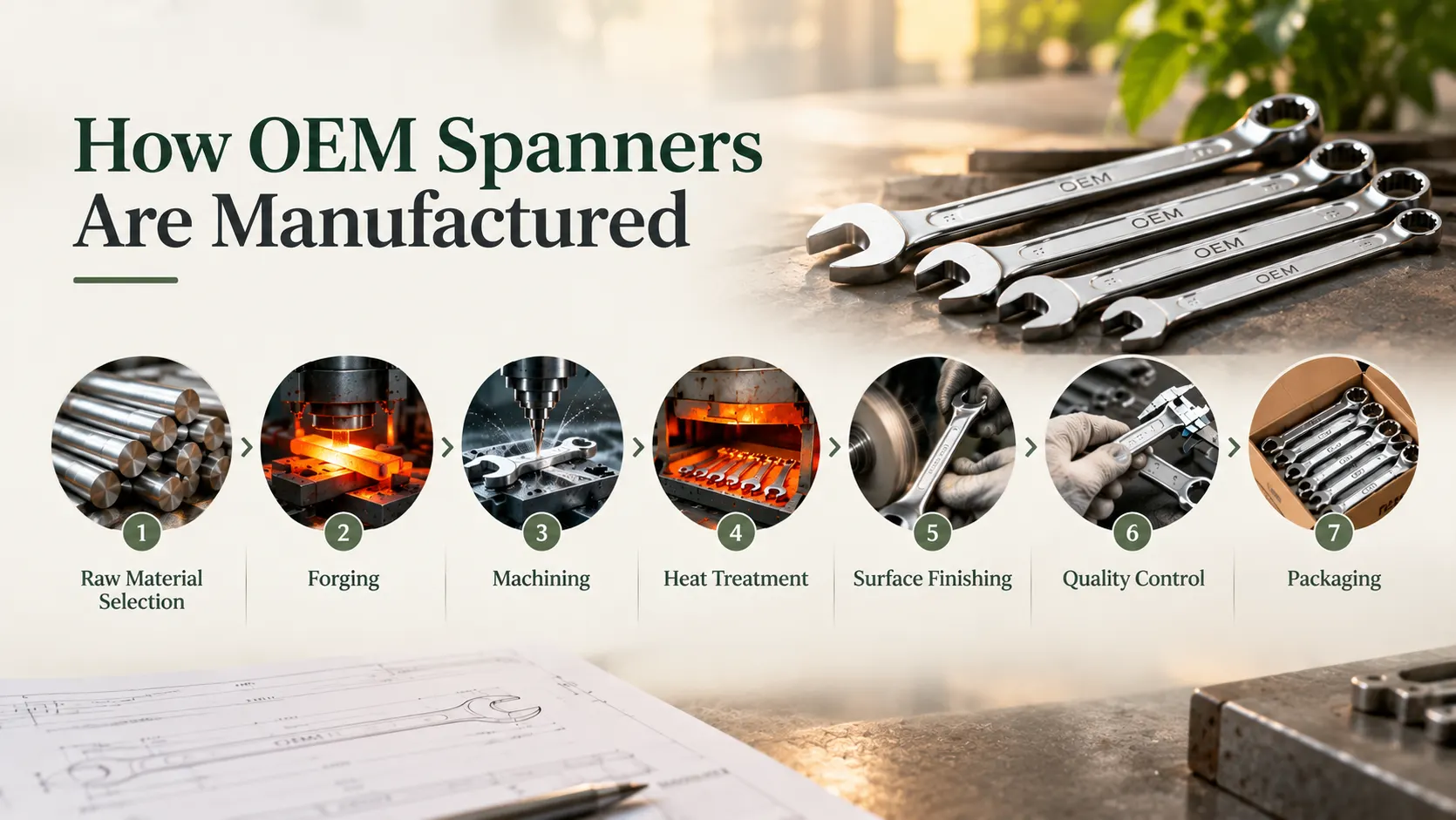
OEM spanners are manufactured by converting specified steel or other approved material into finished tools through specification review, material preparation, forging or forming, trimming, heat treatment, precision machining, surface finishing, branding, quality inspection, and packaging. The exact manufacturing process varies according to the spanner type, design, material, dimensional requirements, applicable standards, and OEM buyer specifications.
What Is OEM Spanner Manufacturing?
OEM spanner manufacturing means producing spanners according to a buyer’s agreed technical and commercial requirements rather than supplying only a standard catalog product.
An OEM order may specify:
- Material grade
- Spanner size and dimensions
- Product design or technical drawing
- Manufacturing tolerances
- Hardness or performance requirements
- Surface finish
- Brand and markings
- Packaging
- Inspection and testing requirements
For manufacturers in India supplying domestic or international markets, these specifications are normally established before production begins.
How Are OEM Spanners Manufactured?
The manufacturing process for commonly forged OEM spanners generally follows these stages.
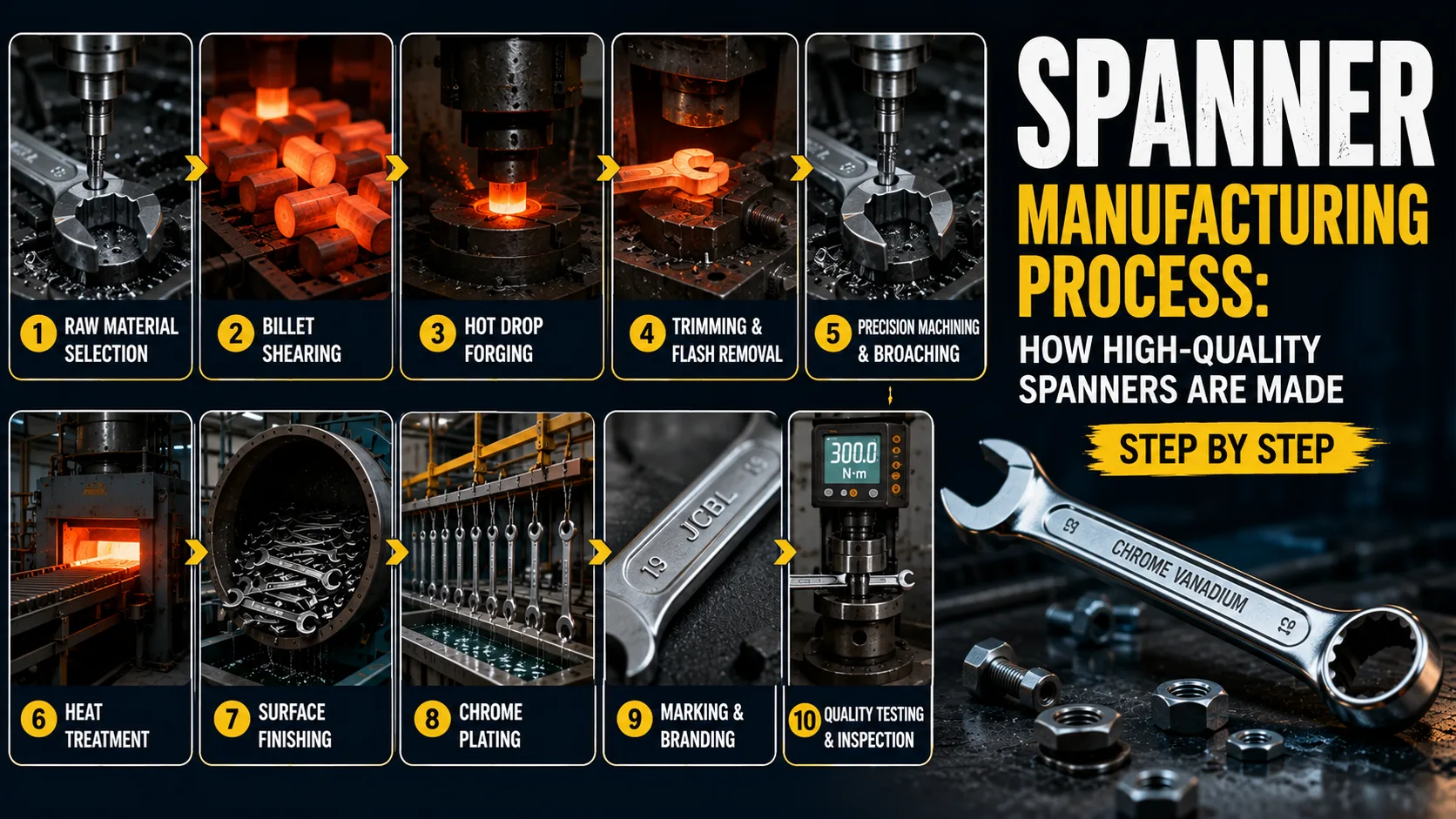
1. Review the OEM Specification
Production begins with reviewing the buyer’s approved drawing, product specification, sample, or technical requirements.
The manufacturer confirms important details such as dimensions, material, tolerances, spanner type, surface finish, markings, testing requirements, and packaging.
This step is particularly important in OEM production because the finished tool must match the agreed specification rather than simply a general spanner design.
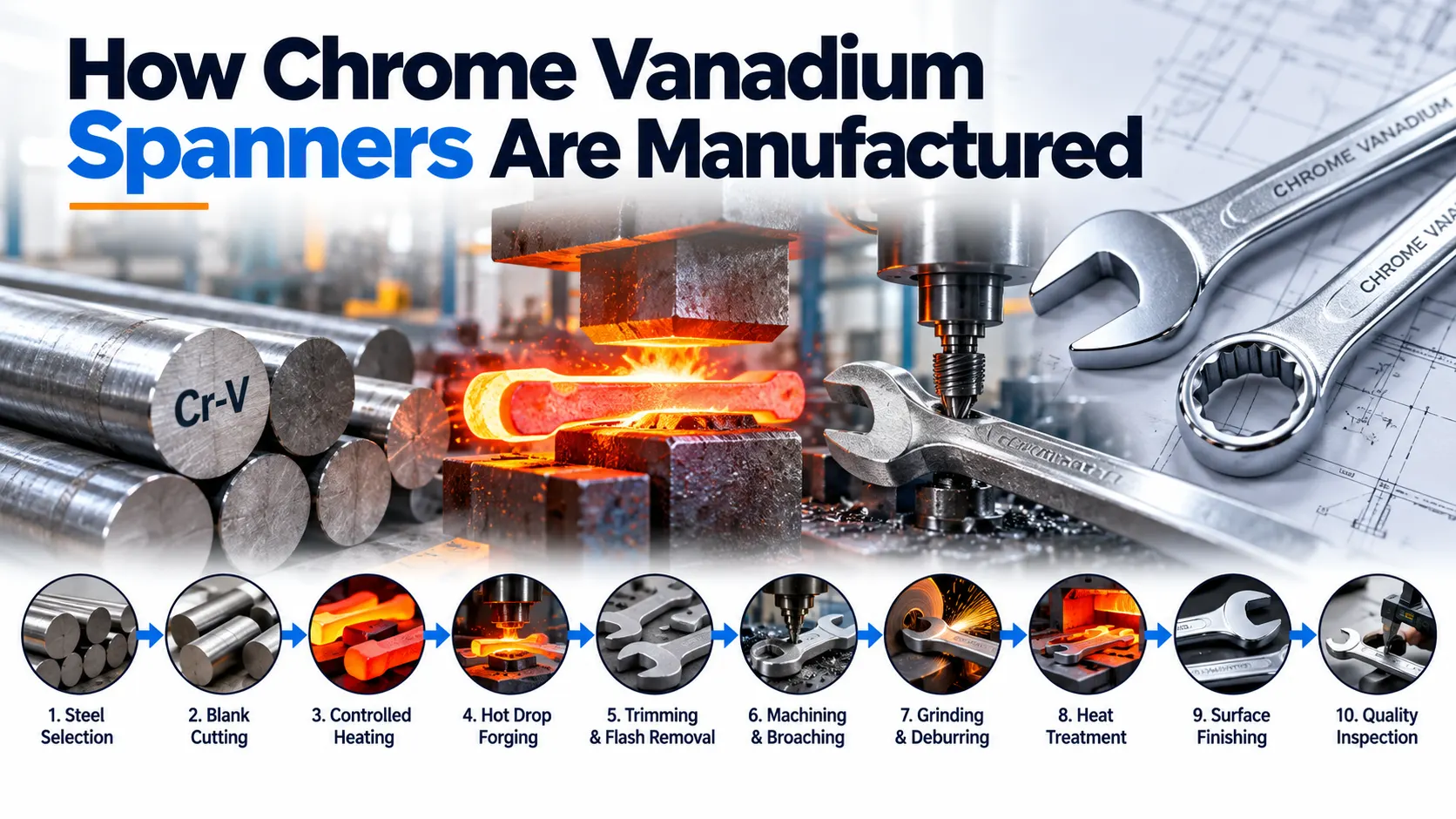
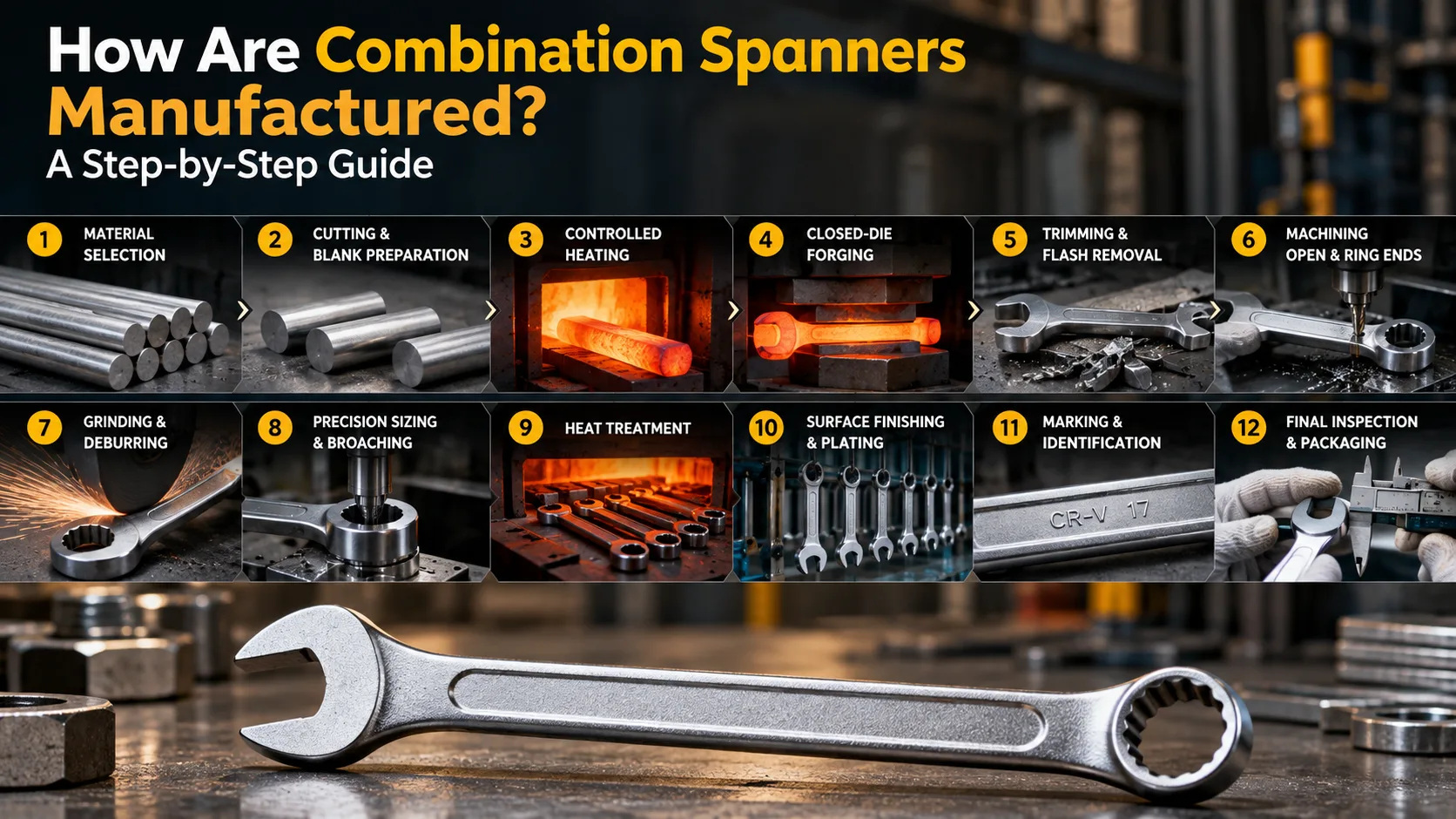
2. Select the Material
The required steel is selected according to the product specification and performance requirements. Common materials used for spanners include carbon steel and alloy steel, including chrome vanadium steel for applications where its properties are specified.
Material selection can affect the tool’s:
- Strength
- Hardness
- Toughness
- Machinability
- Heat-treatment response
The material grade should be agreed upon before production so that subsequent manufacturing and inspection processes can be controlled accordingly.
3. Cut and Prepare the Raw Material
Steel bars or other approved raw materials are cut into blanks of the required length and weight.
Accurate blank preparation helps maintain consistency during forming and reduces variation between production batches. The blank dimensions depend on the spanner design and the selected manufacturing process.
4. Forge or Form the Spanner
For many conventional forged spanners, the prepared steel blank is heated to the required temperature and formed using dies.
The forging process creates the basic geometry of the spanner, including its handle and working end. It is commonly followed by trimming and machining to achieve the final dimensions.
Forging parameters such as temperature, die condition, and forming consistency need to be controlled to maintain uniform production.
Not every spanner is manufactured by the same forming process. Specialty products may require different combinations of forming, machining, or other production methods depending on their design.
5. Trim the Forged Component
Forging can leave excess material, commonly called flash, around the component. This material is removed during trimming.
The part is then brought closer to its intended profile before proceeding to heat treatment and precision machining.
Consistent trimming is important because excessive variation at this stage can affect subsequent machining and dimensional control.
6. Apply Heat Treatment
Heat treatment develops the required combination of hardness, strength, and toughness in the spanner.
Depending on the material and specification, the process can include hardening and tempering. Process parameters such as heating temperature, holding time, and cooling conditions are controlled according to the material and required properties.
The objective is not simply to make the spanner as hard as possible. The finished tool needs an appropriate balance of hardness and toughness for its intended application.
7. Perform Precision Machining
After heat treatment, critical areas are machined to achieve the required dimensions, tolerances, and working surfaces.
Machining may be used for:
- Open-end jaws
- Ring or box ends
- Working faces
- Profiles and edges
- Other dimensionally critical surfaces
For OEM production, machining is particularly important when the buyer provides a detailed drawing or dimensional specification. The finished component must conform to the agreed requirements rather than relying only on visual similarity.
8. Apply Surface Treatment and Finish
The machined spanner undergoes the specified surface-finishing process. Depending on the product requirements, finishes can include chrome plating, satin finishing, black oxide, or other specified treatments.
Surface treatment can provide characteristics such as corrosion resistance and a defined appearance.
The appropriate finish depends on the OEM specification, target market, product design, and manufacturing requirements. There is no single surface finish that is appropriate for every OEM spanner.
9. Add OEM Branding and Markings
Once the required manufacturing and finishing operations are completed, the spanner can receive the buyer’s branding and identification markings.
Depending on the specification, markings may include:
- Company or brand name
- Logo
- Spanner size
- Product or model number
- Batch or identification code
- Required technical markings
Stamping, laser marking, and other marking methods may be used depending on the product material, surface finish, design, and required appearance.
10. Inspect and Test the Finished Spanner
Quality inspection verifies whether the finished product meets the agreed specification.
Depending on the spanner and customer requirements, inspection may cover:
- Dimensions and tolerances
- Hardness
- Surface finish
- Marking accuracy
- Visual defects
- Functional performance
- Torque or load performance where specified
The applicable tests and acceptance criteria should be established before production. Inspection records and batch traceability may also be maintained where required by the OEM agreement.
OEM Spanner Manufacturing Process at a Glance
The process can be summarized as:
OEM specification → Material selection → Raw material cutting → Forging/forming → Trimming → Heat treatment → Precision machining → Surface finishing → OEM branding → Quality inspection → Packaging
This sequence provides a clear production framework, although individual steps can vary according to spanner design, manufacturing method, and customer specification.
What Can OEM Buyers Customize?
OEM buyers can often specify different aspects of the finished spanner and its presentation.
| OEM Requirement | Possible Specification |
| Material | Approved steel grade |
| Size | Metric, SAE, or specified dimensions |
| Design | Drawing or approved product design |
| Tolerances | Defined dimensional requirements |
| Surface finish | Chrome, satin, black oxide, or specified finish |
| Branding | Logo and brand name |
| Marking | Size, model, product, or identification code |
| Packaging | Boxes, sleeves, labels, and cartons |
| Quality control | Inspection and testing requirements |
| Documentation | Quality or inspection records as agreed |
The available options depend on the manufacturer’s production and finishing capabilities.
What Standards Apply to OEM Spanners?
There is no single universal standard that applies to every OEM spanner. Applicable requirements depend on the spanner type, design, target market, and agreed product specification.
A relevant standard may define requirements related to dimensions, materials, performance, testing, or other product characteristics. OEM buyers should identify the applicable standard or technical specification before production begins.
It is also important to distinguish a product standard from a manufacturer’s quality-management certification. A product standard establishes requirements for a particular product or application, while a quality-management certification addresses the manufacturer’s management system. They are not interchangeable.
For international OEM sourcing, buyers should also confirm any market-specific regulatory, labeling, packaging, or documentation requirements before placing an order.
How to Choose an OEM Spanner Manufacturer
When sourcing OEM spanners, buyers should evaluate whether the manufacturer can consistently meet the agreed technical specifications.
Key factors include:
- Material sourcing and control
- Forging and forming capabilities
- Heat-treatment process control
- Precision machining facilities
- Surface-finishing capabilities
- Quality inspection and testing
- OEM branding and packaging
- Ability to work from technical drawings
- Production capacity and MOQ
- Quality documentation and traceability
- Experience with the intended domestic or export market
A capable OEM manufacturer should be able to take an approved specification through controlled production and deliver consistent batches according to the agreed requirements.
Conclusion
OEM spanner manufacturing is a controlled process that starts with an approved product specification and progresses through material selection, forming, heat treatment, machining, finishing, branding, inspection, and packaging. For B2B buyers, the critical consideration is whether a manufacturer can consistently reproduce the required design, dimensions, material properties, finish, and quality requirements across production batches. Clear specifications, defined inspection criteria, and controlled manufacturing processes help establish consistency for domestic and international OEM orders.
FAQs
An OEM spanner is manufactured according to a buyer’s specified requirements, which can include material, dimensions, design, finish, branding, packaging, and quality criteria.
Commonly forged OEM spanners are produced through specification review, material preparation, forging, trimming, heat treatment, machining, surface finishing, branding, inspection, and packaging.
Spanners can be made from different carbon and alloy steels. The appropriate grade depends on the product design, required mechanical properties, manufacturing process, and approved specification.
Many conventional hand spanners are forged and then machined to achieve their final dimensions and working surfaces. However, the manufacturing method varies according to the spanner design.
Yes. OEM spanners can generally be marked with a company logo, brand name, size, product code, or other agreed identification details, subject to the manufacturer’s capabilities.
Depending on the product specification, testing can include dimensional inspection, hardness testing, surface inspection, marking verification, and functional or torque testing.