Hand Tools from India: A Complete Sourcing Guide for Global Buyers & Importers
- Why Source Hand Tools from India?
- India’s Robust Hand Tool Manufacturing Ecosystem
- Types of Hand Tools Manufactured in India
- The Hand Tool Manufacturing Process
- How to Evaluate the Quality of Hand Tools Before Importing
- OEM and Private Label Customization
- How to Source Hand Tools from India
- B2B Sourcing Checklist for International Buyers
- FAQs
- Conclusion & Next Steps
India has become one of the most reliable sourcing destinations for industrial hand tools. Global buyers, distributors, and OEM partners are increasingly choosing Indian manufacturers not just for competitive pricing, but for consistent quality, flexible private-label options, and reliable export capabilities.
As global supply chains shift, international procurement managers are looking for manufacturing partners who can handle everything from custom branding to strict quality checks. Whether you want to launch a new tool brand or expand your current retail lineup, finding the right manufacturer in India can directly improve your business profitability and product reliability.
This guide provides a straightforward roadmap to help global buyers evaluate Indian tool manufacturers, understand technical standards, and build a dependable long-term supply chain.
Why Source Hand Tools from India?
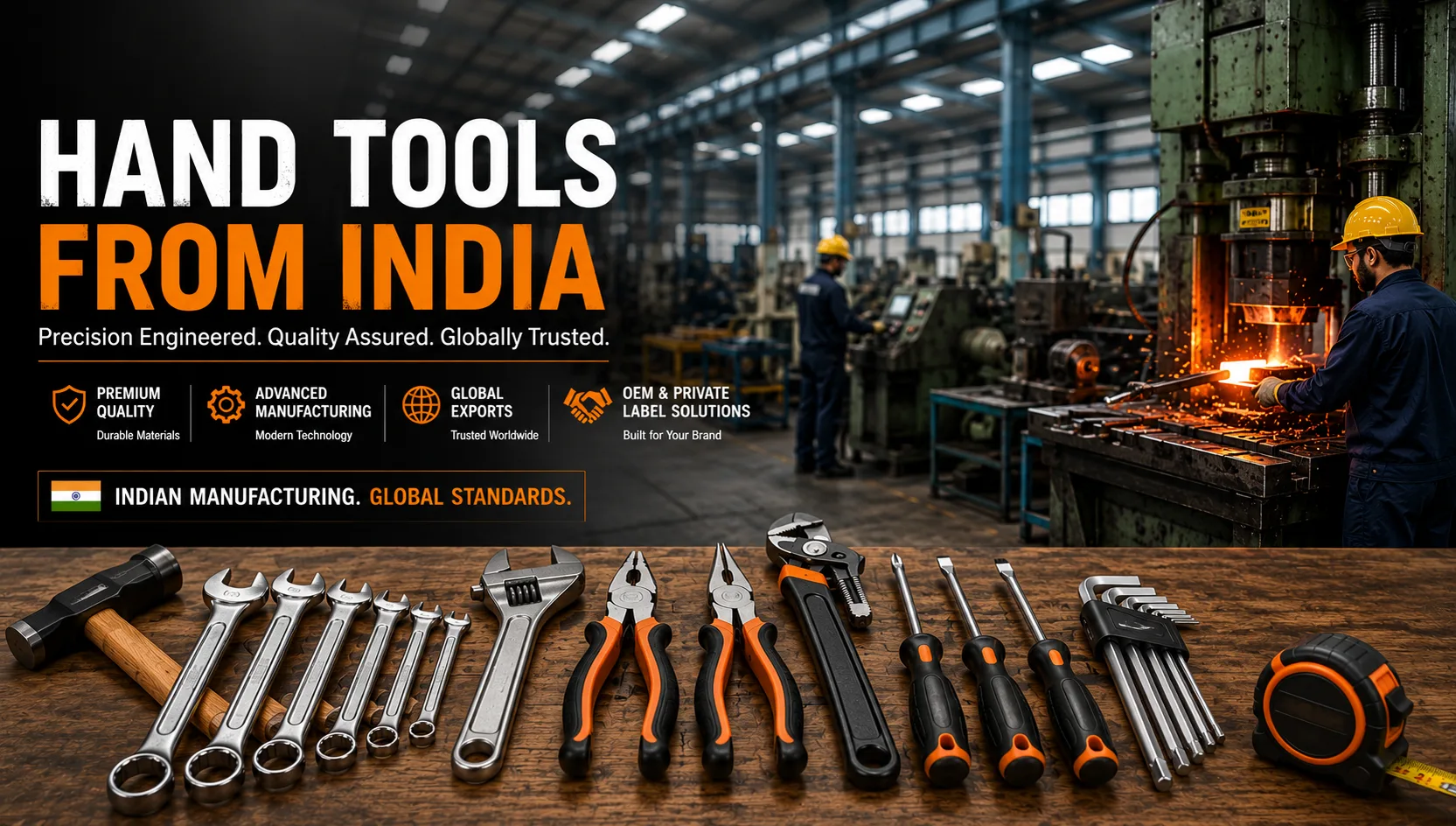
India is a preferred sourcing destination for hand tools because it combines competitive manufacturing costs, skilled engineering, international quality standards, scalable OEM capabilities, and reliable export infrastructure that ensures smooth global shipping.
For decades, the Indian hand tool industry has focused on creating products built to last. Instead of competing purely on the lowest price by compromising on material, Indian manufacturers invest in modern drop forging, precise heat treatment, and durable surface finishing. This focus on reliability helps international distributors reduce warranty claims and improve customer satisfaction.
Sourcing Landscape Comparison
Here is how India compares to other global options for industrial B2B procurement:
| Sourcing Factor | Indian Manufacturers | High-Volume Low-Cost Regions | Traditional Premium Hubs (EU/US) |
| Value for Money | High (Optimal quality at competitive costs) | High (Lowest initial price per piece) | Medium (Premium quality but high cost) |
| OEM & Private Label | Fully Available | Available (Requires very large MOQs) | Available (High setup costs) |
| Material Standards | Chrome Vanadium & Carbon Steel | Varies (Prone to batch inconsistency) | Premium Alloy Steels |
| Export Experience | Decades of global shipping experience | High | High |
| Flexibility with MOQs | Scalable & Adaptable | Rigid | Medium |
| Quality Consistency | High | Medium | High |
Why Choose a Manufacturer Instead of a Trading Company?
When expanding your supply chain into India, selecting the right type of supplier is just as critical as selecting the country itself. Working directly with an experienced, integrated manufacturer provides immense long-term advantages over sourcing via regional trading brokers.
| Procurement Factor | Working Direct with an Indian Manufacturer | Partnering with a Third-Party Trading Company |
| Pricing Efficiency | Direct factory floor pricing; no hidden broker markups. | Extra middleman margins inflate your landed cost per unit. |
| Quality Assurance (QA) | Direct access to real-time production testing and quality logs. | Limited oversight; reliant on whatever the sourcing supplier produces. |
| OEM Engineering | In-house tooling design for deep technical customization. | Extremely restrictive; cannot execute custom forging adjustments easily. |
| Technical Support | Direct consultation with plant technicians and engineers. | Delayed or inaccurate technical relay through an agent. |
| Dispute Resolution | Instant corrective action on the factory floor if batches vary. | Heavily dependent on the broker’s relationship with their sub-supplier. |
India’s Robust Hand Tool Manufacturing Ecosystem
India’s strength in hand tool manufacturing comes from its well-developed engineering ecosystem, modern production capabilities, and export-focused industrial infrastructure. Rather than being concentrated in a single city, hand tool manufacturing is supported by multiple industrial regions that contribute specialized expertise in forging, machining, heat treatment, finishing, and quality control. This diversified manufacturing network enables Indian suppliers to efficiently serve global distributors, wholesalers, retailers, and OEM partners.
Punjab: A Leading Engineering & Manufacturing Region
Punjab is recognized as one of India’s leading engineering and manufacturing regions for industrial hand tools. The state’s industrial ecosystem extends across multiple manufacturing hubs, including the Mohali region, where engineering expertise, precision manufacturing, and export-oriented operations support global B2B buyers. Together with advanced forging facilities, machining units, component suppliers, quality testing laboratories, and efficient logistics, manufacturers across Punjab are well-positioned to deliver OEM, private-label, and bulk export solutions while maintaining consistent product quality.
Beyond manufacturing capabilities, Punjab benefits from excellent road connectivity, Inland Container Depots (ICDs), and access to major Indian ports through an efficient logistics network, helping manufacturers deliver products reliably to customers across Europe, North America, the Middle East, Africa, and other international markets.
Other Manufacturing Regions
India’s hand tool industry is supported by several other industrial regions, each contributing specialized manufacturing capabilities:
- Maharashtra contributes advanced engineering, automotive tooling, and precision manufacturing capabilities.
- Tamil Nadu supports industrial production with modern manufacturing facilities and strong port connectivity.
- Rajasthan is known for producing a range of traditional and industrial hand tools through specialized manufacturing clusters.
Together, these regions strengthen India’s position as a reliable global sourcing destination for industrial hand tools by combining manufacturing expertise with efficient logistics and export infrastructure.
Types of Hand Tools Manufactured in India
Indian manufacturers produce a diverse range of industrial and professional hand tools for construction, automotive, manufacturing, electrical, and maintenance applications. Many of these products are available with OEM and private-label customization to meet international market requirements.
- Combination Spanners & Ring Spanners: Available in both metric and imperial sizes, these are primarily forged from premium Chrome Vanadium steel (Cr-V) to meet stringent international torque requirements.
- Adjustable Wrenches: Engineered with smooth jaw-movement mechanisms, high-precision structural scales, and heavy-duty handles for automotive and plumbing applications.
- Pliers: Includes combination pliers, long nose pliers, side cutting pliers, and water pump pliers featuring induction-hardened cutting edges and heavy-duty insulated sleeves.
- Hammers & Striking Tools: Includes ball peen, claw, cross peen, and sledge hammers forged with high-carbon steel and fitted with shock-absorbing fiberglass or premium wooden handles.
- Screwdrivers & Hex Keys: Manufactured in flat-head, Phillips, Torx, and Pozidriv configurations with ergonomic anti-slip grips and magnetic tips.
- Tool Kits & Sets: Custom-curated tool sets designed for automotive workshops, industrial maintenance units, household DIY collections, and specialized electrical work.
- Measuring & Utility Tools: High-accuracy spirit levels, steel measuring tapes, calipers, and utility knives built for rugged construction environments.
The Hand Tool Manufacturing Process
Understanding how your tools are made allows you to verify quality during factory audits. Reliable suppliers follow a transparent, sequential production workflow.
- Step 1 – Material Selection: Tools are constructed using high-grade structural steel bars, typically Chrome Vanadium Steel (Cr-V) for high-torque items like spanners, or Carbon Steel for heavy impact tools like hammers.
- Step 2 – Drop Forging: The heated steel is shaped using high-pressure forging dies. This process improves grain flow, increases strength, and helps produce durable hand tools suitable for demanding industrial applications.
- Step 3 – Machining & Broaching: Automated production machinery precision-cuts and profiles the exact, close-tolerance dimensions of the tool openings.
- Step 4 – Heat Treatment: Forged components go through computer-controlled induction heating and rapid cooling to lock in the ideal industrial hardness, ensuring tools do not bend or fracture under extreme load.
- Step 5 – Surface Finishing: Tools receive protective exterior coatings—such as anti-corrosive Nickel Chrome Plating, Matte Satin Finish, or chemical Black Phosphate—to prevent environmental rust and wear.
- Step 6 – Quality Inspection: Before batch sign-off, finished items undergo micro-dimensional checks, Rockwell hardness verification, visual surface audits, and stress-torque testing against target standard metrics.
- Step 7 – Packaging & Dispatch: Verified tools are treated with protective oil coats, sorted into custom retail configurations, labeled with mandatory commercial identification barcodes, and container-loaded for export shipping.
How to Evaluate the Quality of Hand Tools Before Importing
When sending a Request for Quote (RFQ) or assessing initial supplier profiles, using clear industry benchmarks ensures you get accurate pricing and high-performance products.
- Material Specifications: Always specify the raw steel chemistry. Chrome Vanadium Steel is preferred for professional, high-performance tools, while Carbon Steel is excellent for standard structural or striking tools.
- International Standards: Ensure the manufacturer complies with globally recognized dimensions and tolerances, such as German DIN standards (like DIN 3113 for combination spanners) or American ANSI regulations.
- Hardness Testing: Quality tools are tested on the Rockwell Hardness (HRC) scale. A professional spanner, for instance, requires a consistent hardness rating across the profile to ensure long-term durability and prevent jaw spreading under a heavy torque load.
OEM and Private Label Customization
A large portion of India’s top tool exporters work as contract manufacturing partners for major global brands. They provide complete private-label support to help you build your own brand identity.
Why Choose OEM Manufacturing?
OEM manufacturing allows businesses to build their own branded product line without investing in production facilities. By partnering with an experienced manufacturer, buyers can customize products, packaging, and branding while maintaining consistent quality and supply.
Benefits for Global Buyers
Partnering with an integrated manufacturer in India yields significant advantages for scaling commercial operations:
- Stronger Brand Identity: Establishes unique proprietary positioning in your domestic market, helping your brand stand out from competitors selling standard off-the-shelf products.
- Product Differentiation: Customize specific aspects of the tool design—such as specialized handle grips or custom styles—to address target market gaps.
- Better Commercial Margins: Eliminating multi-tiered importer markups lets you capture higher gross profit margins on your bulk distribution lines.
- Flexible Retail Packaging: Tailor the layout to fit seamlessly into regional hardware store constraints or modern online e-commerce shipping requirements.
- Long-Term Manufacturing Partnership: Secures consistent tool access and stable input costs even amidst volatile global supply constraints.
Customization Options Available
- Custom Branding: Custom logos can be permanently etched onto the tools using high-precision laser marking or die stamping.
- Surface Finish: Choose between a classic mirror polish, a non-slip matte satin finish, or industrial black phosphate based on your market preference.
- Retail Packaging: Suppliers can deliver retail-ready products complete with double-blister cards, custom color boxes, heavy-duty blow-molded cases, and barcode labeling.
How to Source Hand Tools from India
Importing hand tools from India becomes significantly easier when buyers follow a structured sourcing process. Rather than selecting suppliers based only on price, evaluate their manufacturing capabilities, quality systems, export experience, and long-term reliability before placing bulk orders.
- Define Requirements: Document your exact tool dimensions, target steel specs, packaging layouts, and estimated annual procurement volumes.
- Shortlist Exporters: Identify established, integrated manufacturers located within reliable engineering regions (like Punjab) who hold proven export experience.
- Evaluate Technical Specs: Review product catalogs, analyze material specifications, and request detailed B2B price quotations.
- Approve Product Samples: Request physical pre-production samples to verify weight balance, dimensional accuracy, surface finish, and real-world performance.
- Finalize Commercial Terms: Conclude negotiations regarding per-piece pricing, scalable payment structures, production lead times, and preferred Incoterms.
- Pre-Shipment Inspection: Establish clear verification parameters or deploy third-party inspection firms (such as SGS or TÜV) prior to final container loading.
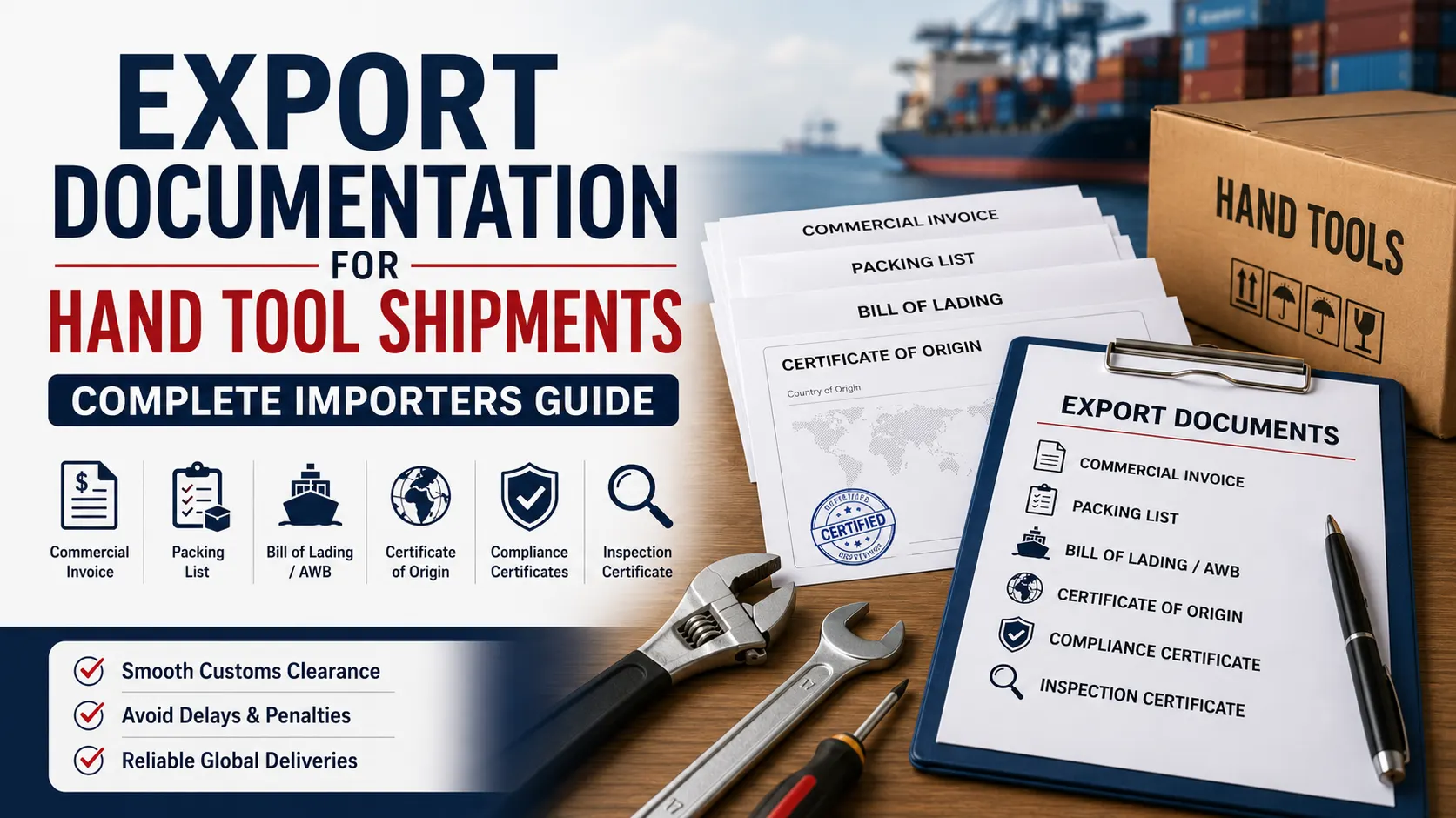
- Logistics & Dispatch: Coordinate container loading routes, verify accurate HS Code classifications, clear internal customs, and activate freight tracking lines.
B2B Sourcing Checklist for International Buyers
Pro-Tip for Importers: A common mistake is choosing a supplier based purely on the lowest price. Subtle shortcuts in heat treatment or using lower-grade steel can lead to tool failures later. Partnering with a manufacturer who manages the entire process in-house ensures consistent quality and protects your brand’s reputation.
Before signing a bulk contract or making an advance payment, use this strategic evaluation matrix to check your potential manufacturing partner:
| Evaluation Point | Why It Matters for Global Buyers |
| In-house Quality Control | Ensures consistent steel chemistry, precise HRC hardness, and batch reliability. |
| Certifications | Confirms strict structural compliance with international DIN, ANSI, and ISO protocols. |
| Integrated Manufacturing | Provides better control over production lead times by keeping forging and plating under one roof. |
| Export Experience | Means fewer logistical surprises, accurate HS Code mapping, and smooth customs handling. |
| Scalable MOQs | Matches your baseline business needs today while allowing room for future portfolio growth. |
| After-Sales Support | Guarantees faster technical dispute responses and immediate resolution of potential quality or shipment anomalies. |
Before Choosing a Supplier, Ask These Questions
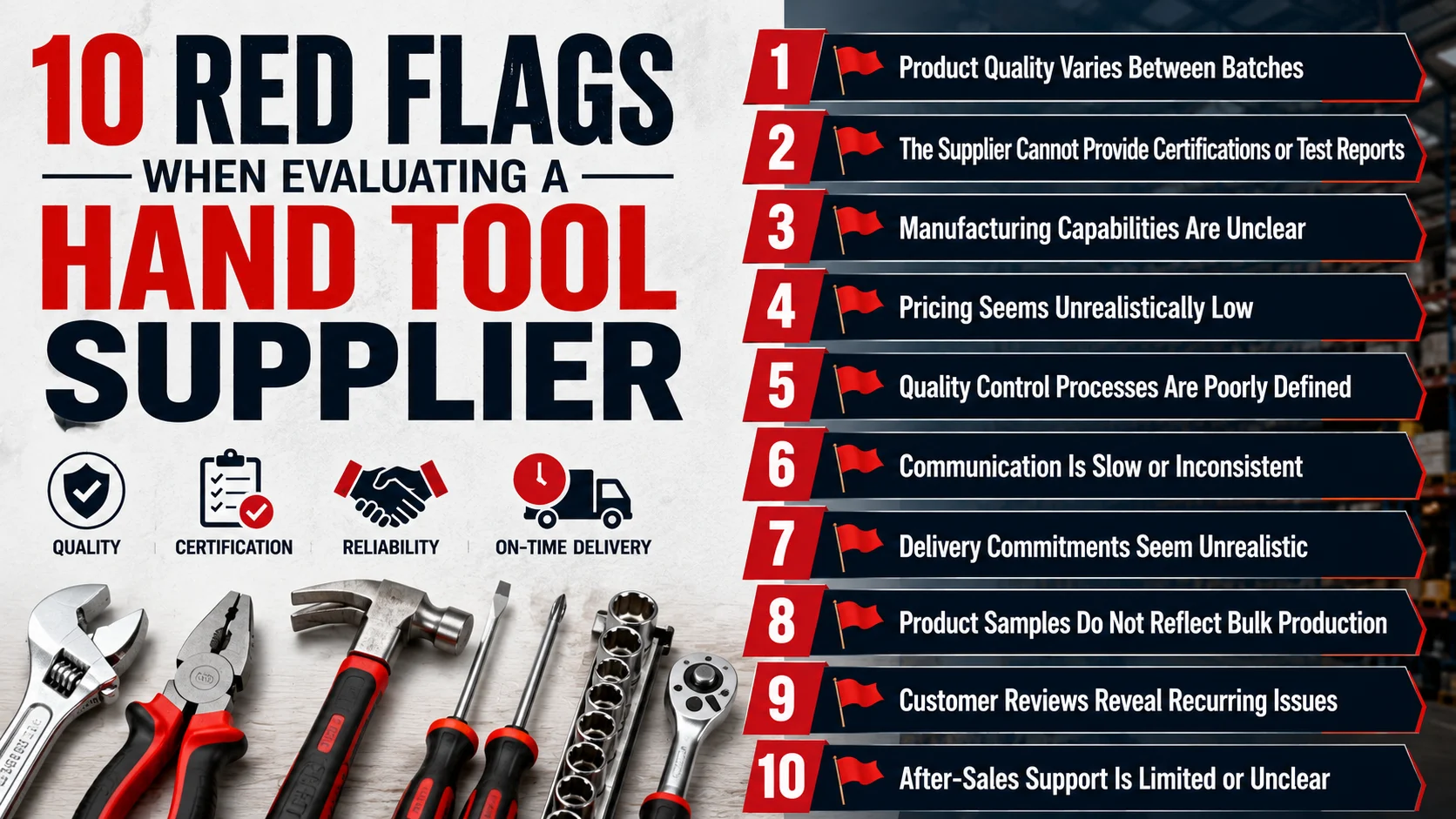
- Can you provide product test reports and material certifications for the steel used?
- Do you handle drop forging, heat treatment, and surface finishing fully in-house?
- Which international markets and global tool brands do you currently export to?
- What specific certifications (ISO, DIN, ANSI, GS) do your tools comply with?
- Can you support full OEM branding, custom laser marking, and retail-ready packaging?
- What are your standard production lead times for a full container load (FCL)?
- Can you share recent export destinations or customer references for similar products?
FAQs
As global buyers look to diversify their supply chains and reduce dependence on a single region, India has emerged as a top choice. The country offers a rare combination of well-established engineering regions, reliable material sourcing, stable export policies, and competitive pricing without sacrificing tool durability.
Punjab, including industrial regions such as Mohali, is widely recognized for its engineering ecosystem and export-oriented hand tool manufacturing. The state is supported by a network of manufacturers, suppliers, and logistics infrastructure that enables efficient production for global markets. Maharashtra, Tamil Nadu, and Rajasthan also contribute specialized manufacturing capabilities across different product categories.
Many export-oriented manufacturers produce hand tools in accordance with internationally recognized product standards such as DIN and ANSI, while operating quality management systems certified to ISO 9001 where applicable.
Yes. Most leading exporters specialize in OEM and private-label manufacturing. They offer custom laser engraving, specific surface finishes (chrome, satin, or black), and customized retail packaging to fit your brand guidelines.
Lead times typically range from 45–60 days for standard bulk orders, although production schedules may vary depending on product complexity, order quantity, customization requirements, and seasonal demand.
For long-term B2B sourcing, working directly with an experienced manufacturer generally provides better quality control, greater customization options, more competitive pricing, and direct technical support. Trading companies may be suitable for small, mixed-product sourcing, but manufacturers offer maximum transparency over the engineering lifecycle.
Check the company’s export experience, factory certifications, official business registration, customer references, and direct manufacturing capabilities. You can also request explicit client references within international markets or ask for a live digital walkthrough of their testing laboratory and forging shop floors.
Sourcing budgets are primarily driven by fluctuating raw international steel indices, chosen alloy formulations (e.g., standard Carbon vs. premium Chrome Vanadium), production order scale (volume price breaks), final surface finish requirements, and prevailing sea freight container rates from Indian exit ports to your destination.
Conclusion & Next Steps
Sourcing hand tools from India offers global buyers access to competitive manufacturing, skilled engineering expertise, OEM capabilities, and reliable export support. However, choosing the right manufacturing partner requires more than comparing prices. Evaluating production capabilities, quality management systems, technical expertise, and export experience is essential for building a dependable long-term supply chain.
As an export-oriented manufacturer based in Punjab’s engineering ecosystem, JCBL Hand Tools supports global importers, distributors, wholesalers, and OEM buyers with quality-focused manufacturing, private-label solutions, and bulk supply capabilities. Whether you’re expanding your product portfolio or developing a new tool brand, working with an experienced manufacturing partner can help ensure consistent product quality and long-term business growth.