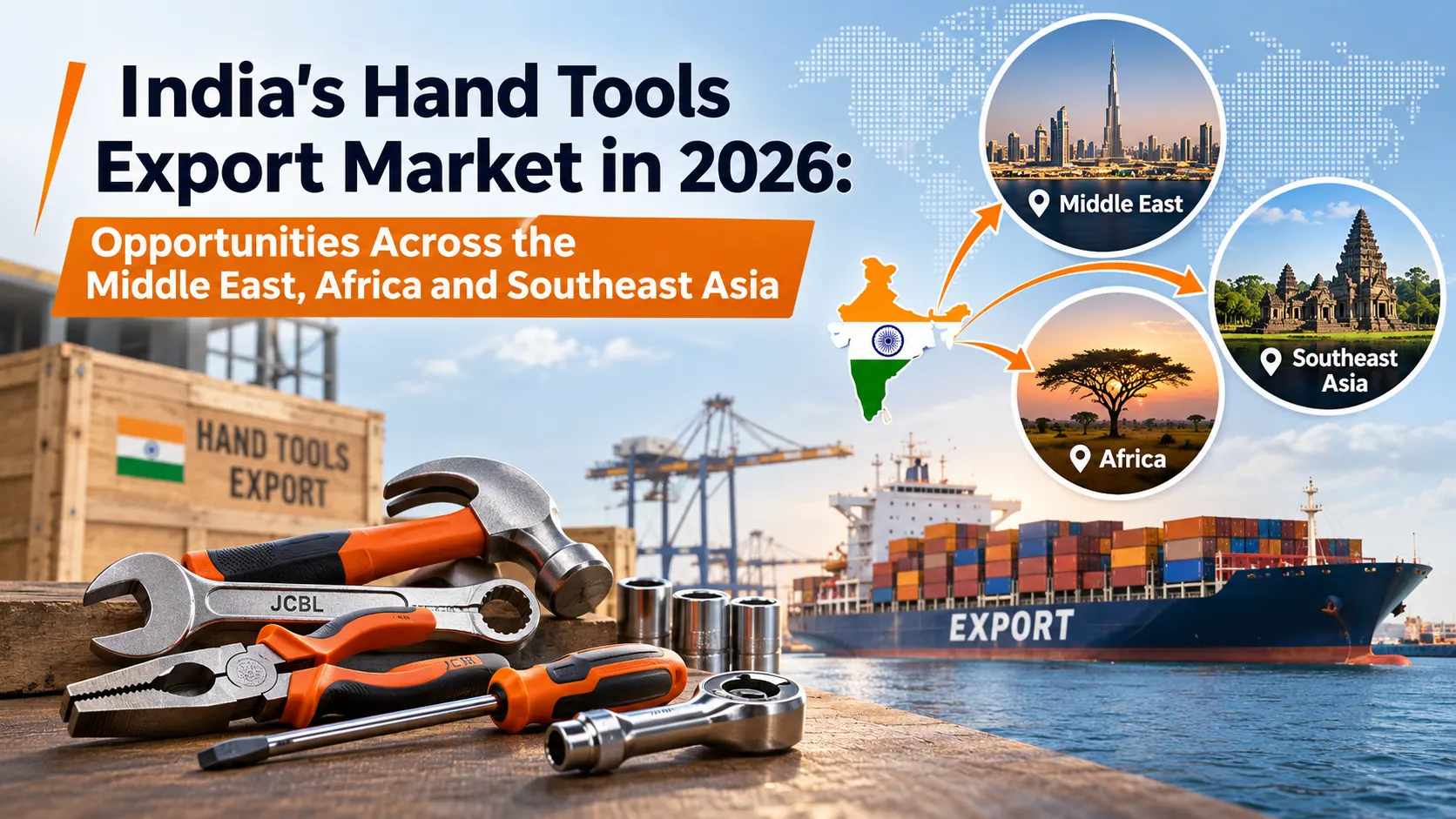
India’s Hand Tools Export Market in 2026: Opportunities Across the Middle East, Africa and Southeast Asia
- India’s Current Position in the Global Hand Tools Market
- Export Opportunities Across Three Regions
- Which Indian Hand Tools Have Export Potential?
- What International Buyers Expect from Indian Manufacturers
- How Indian Exporters Can Enter International Markets
- Challenges Facing India’s Hand Tools Exporters
- What Lies Ahead for India’s Hand Tools Export Market?
- Conclusion
- FAQs
India’s hand tools industry has an opportunity to expand its presence in international markets, particularly across the Middle East, Africa and Southeast Asia. Demand from construction, agriculture, automotive maintenance and industrial operations creates potential buyer segments for Indian manufacturers and exporters.
However, entering these markets requires more than competitive pricing. Exporters need to understand product demand, buyer specifications, quality expectations, documentation and distribution requirements in each destination.
This guide examines India’s hand tools export opportunity in 2026, the products with export potential and the practical steps manufacturers can take to reach overseas buyers.
India’s Current Position in the Global Hand Tools Market
India has an established manufacturing base, but its share of global hand tools exports remains relatively small.
According to NITI Aayog’s April 2025 report, Unlocking $25+ Billion Exports: India’s Hand & Power Tools Sector:
Estimated Indian hand tools exports
Approximate share of the global market
Estimated global hand tools market in 2025
Projected global market size by 2035
India has a stated potential to reach US$15 billion in hand tools exports by 2035, based on a target of capturing 25% of global trade.
Important distinction: The US$15 billion figure is an opportunity target, not a forecast or guaranteed outcome. The report’s wider US$25 billion-plus opportunity combines hand tools and power tools, so the two figures should not be treated as interchangeable.
India’s manufacturing ecosystem includes established clusters in Jalandhar and Ludhiana in Punjab, Mumbai and Nagpur in Maharashtra, and Nagaur in Rajasthan. These locations provide a base of manufacturers and suppliers serving domestic and overseas markets.
Export Opportunities Across Three Regions
The Middle East, Africa and Southeast Asia offer different routes to market. Exporters should assess each country separately rather than treating an entire region as one uniform market.
1. Middle East: Construction and Industrial Maintenance
Countries such as the UAE, Saudi Arabia, Oman, Qatar and Kuwait have construction, infrastructure, energy and industrial maintenance sectors that can create opportunities for hand tools suppliers.
Product categories to assess:
- Spanners, combination wrenches and socket sets
- Pipe wrenches, pliers and gripping tools
- Hammers, screwdrivers and cutting tools
- General-purpose maintenance tool kits
Importers may include hardware wholesalers, industrial distributors, construction suppliers, automotive aftermarket businesses and maintenance contractors.
For Indian exporters, the opportunity is to supply products that meet the buyer’s required material specifications, durability standards, packaging and delivery schedules. Private-label supply can also help manufacturers work with distributors developing their own tool ranges.
2. Africa: Agricultural and Infrastructure-Related Tools
African markets are diverse, with demand patterns shaped by local agriculture, construction activity, mining and industrial development. South Africa, Kenya, Nigeria, Ghana and Tanzania are possible markets to investigate, but product demand and import requirements should be checked country by country.
Agricultural hand tools offer one measurable trade indicator. World Bank WITS data based on UN Comtrade records shows that India exported approximately US$35.88 million under HS 8201 in 2024. This category covers tools such as spades, shovels, picks, hoes, rakes, axes, secateurs and other agricultural, horticultural and forestry tools. India’s exports under this code to South Africa were approximately US$757,360 in the same year.
Product categories to assess:
- Spades, shovels, hoes and picks
- Axes, rakes and agricultural cutting tools
- Hammers, pliers and screwdrivers
- General-purpose tools for repair and maintenance
Exporters should consider local usage conditions, tool durability, replacement-part availability and price sensitivity. Working with established importers and regional distributors can help manufacturers understand these requirements before committing to large orders.
3. Southeast Asia: Manufacturing and Automotive Supply Chains
Indonesia, Vietnam, Thailand, Malaysia, the Philippines and Singapore are worth evaluating for opportunities linked to manufacturing, automotive servicing, construction and industrial maintenance.
World Bank WITS data shows that India exported approximately US$18.35 million under HS 8207 to Singapore in 2024. This code covers interchangeable tools used with hand tools or machine tools, including certain drilling, cutting and machining tools. It is a relevant adjacent tooling indicator, but it does not represent hand tools alone.
Product categories to assess:
- Socket sets and spanners
- Precision screwdrivers and pliers
- Cutting and interchangeable tools
- Automotive repair and maintenance tool kits
Manufacturers targeting this region should evaluate product specifications, dimensional accuracy, material consistency and packaging requirements. Buyers serving industrial and automotive customers may also expect repeatable quality across bulk orders.
Which Indian Hand Tools Have Export Potential?
The right product mix depends on the destination market, buyer type and intended application.
| Product category | Potential buyer segments |
| Spanners and wrenches | Industrial distributors, automotive workshops |
| Pliers and screwdrivers | Hardware wholesalers, repair businesses |
| Hammers and cutting tools | Construction suppliers, maintenance contractors |
| Agricultural hand tools | Agricultural equipment dealers, rural retailers |
| Socket and tool sets | Automotive aftermarket distributors, workshops |
| Specialised hand tools | Industrial suppliers, machinery maintenance businesses |
Rather than exporting a broad catalogue without a clear market fit, manufacturers should shortlist products based on import data, competitor pricing, buyer enquiries and local application requirements.
What International Buyers Expect from Indian Manufacturers
Overseas buyers evaluate more than the unit price. Consistent quality, product performance and reliable fulfilment are essential to building long-term supply relationships.
Key requirements include:
1. Material and Manufacturing Quality
Buyers may specify steel grade, hardness, heat treatment, finish, dimensions and corrosion resistance.
2. Product Testing
Manufacturers should maintain documented inspection and testing procedures appropriate to the tool and its intended use. Read more about product testing.
3. Relevant Standards
DIN, ISO and ANSI standards or buyer-specific specifications may apply. The applicable requirement must be confirmed for each product and destination; these standards should not be presented as universally mandatory.
4. Export Documentation
Commercial invoice, packing list, shipping bill, certificate of origin where required, and other destination-specific documents must be prepared accurately. See this export documentation checklist.
5. Private-Label Capability
Some importers require customised branding, packaging, product labelling and catalogue support. Learn more about OEM and private-label capability.
6. Reliable Production and Delivery
Buyers expect manufacturers to meet agreed order quantities, lead times and repeat-order specifications.
How Indian Exporters Can Enter International Markets
A focused export strategy helps manufacturers reduce risk and identify buyers more efficiently.
- Select markets using trade data. Review country-level import values, product classifications, supplier countries, tariffs, and demand trends. Use the relevant HS code rather than broad hand tools search terms.
- Build a market-specific product range. Match products to local applications and buyer segments. For example, agricultural distributors may require a different product portfolio from automotive tool wholesalers.
- Strengthen quality control. Standardise raw material checks, dimensional inspections, hardness testing, finishing and final product inspections. Keep records that can be shared with buyers when requested.
- Develop distributor and importer relationships. Participate in relevant trade fairs, use credible B2B platforms and approach importers with product catalogues, specifications, certifications where applicable and clear production capabilities.
- Calculate the complete export cost. Include manufacturing, packaging, inland transportation, freight, insurance, customs duties, port charges and destination handling. A competitive factory price does not automatically translate into a competitive landed cost.
- Establish a dependable supply process. Confirm production capacity, minimum order quantities, lead times, packaging specifications and after-sales arrangements before accepting large orders.
Challenges Facing India’s Hand Tools Exporters
India’s export opportunity is significant, but manufacturers still face structural challenges. NITI Aayog identifies cost disadvantages, limited scale, infrastructure gaps and technical capability constraints as barriers to global competitiveness. Its report estimates a 14–17% cost disadvantage compared with China.
To compete effectively, Indian manufacturers need to improve production efficiency, invest in modern machinery, reduce defects, strengthen supply chains and maintain consistent product quality. Competing only on price can weaken margins; dependable quality and delivery are equally important.
What Lies Ahead for India’s Hand Tools Export Market?
India’s hand tools industry has a clear opportunity to increase its international presence. NITI Aayog’s target of US$15 billion in hand tools exports by 2035 highlights the scale of the ambition, but reaching it will depend on manufacturing competitiveness, technology adoption, quality consistency and access to overseas buyers.
For manufacturers and exporters, the immediate priority is practical: identify the right markets, select products that match buyer requirements, verify applicable standards and build reliable distribution relationships. These steps can help Indian suppliers move from occasional export orders towards sustainable international business.
Conclusion
India’s hand tools export market has significant growth potential across the Middle East, Africa, and Southeast Asia. Turning this opportunity into long-term success will depend on competitive manufacturing, consistent product quality, and strong overseas partnerships.
For Indian manufacturers, the next step is clear: understand buyer needs, target the right markets and build a reliable export network.
Exploring hand tools sourcing opportunities from India?
Explore the JCBL Hand Tools product range or contact the team to discuss product categories and bulk sourcing requirements.
FAQs
1. How large is India’s hand tools export market?
NITI Aayog’s April 2025 report estimated India’s hand tools exports at US$600 million, representing around 1.8% of the global market.
2. Which countries can Indian hand tools exporters target?
Exporters can evaluate the UAE, Saudi Arabia, South Africa, Kenya, Nigeria, Vietnam, Thailand, Indonesia and Malaysia. The best market depends on product-specific import demand, competition, tariffs and buyer requirements.
3. Which hand tools are commonly exported from India?
Relevant categories include spanners, wrenches, pliers, screwdrivers, hammers, cutting tools and agricultural hand tools. The export opportunity varies by product classification and destination.
4. Which certifications are required to export hand tools?
Requirements depend on the product, destination and buyer. Importers may request compliance with relevant DIN, ISO or ANSI specifications, product test reports or other quality documentation. Exporters should confirm the exact requirements before shipment.
5. How can overseas buyers find Indian hand tools manufacturers?
Buyers can identify suppliers through trade exhibitions, industry associations, verified B2B platforms and direct manufacturer enquiries. Before placing an order, they should review product specifications, quality-control processes, production capacity and sample performance.