Corrosion Resistance in Industrial Spanners: Materials, Coatings & Testing
- What Is Corrosion Resistance in Industrial Spanners?
- Why Is Corrosion Resistance Important in Industrial Spanners?
- Which Materials Are Used in Corrosion-Resistant Industrial Spanners?
- Which Coatings Improve Corrosion Resistance in Industrial Spanners?
- What Factors Affect Corrosion Resistance in Industrial Spanners?
- How Is Corrosion Resistance Tested in Industrial Spanners?
- How to Choose Corrosion-Resistant Industrial Spanners for Different Applications
- What Should B2B Buyers Check When Sourcing Industrial Spanners?
- Conclusion
- FAQs
Industrial spanners are exposed to moisture, humidity, oils and chemicals across manufacturing facilities, automotive workshops, construction sites and other industrial environments. These conditions can cause rust, coating deterioration and surface damage. Corrosion resistance in industrial spanners depends on three key factors: the base material, protective surface treatment and manufacturing quality. Understanding these factors helps industrial buyers, distributors and OEMs select tools suited to their operating conditions and quality requirements.
What Is Corrosion Resistance in Industrial Spanners?
Corrosion resistance refers to an industrial spanner’s ability to withstand chemical and environmental reactions that cause rust and surface deterioration. It depends on the steel composition, protective coating, surface condition and exposure environment. Suitable corrosion protection helps preserve the tool’s surface integrity and reduces premature deterioration during industrial use.
Why Is Corrosion Resistance Important in Industrial Spanners?
Corrosion protection is important because rust and surface deterioration can affect tool condition, maintenance requirements and long-term usability.
Key advantages include:
- Reduced rust formation: Protective finishes help limit direct exposure of the underlying metal to moisture and corrosive substances.
- Better surface durability: Appropriate coatings help protect against environmental exposure and surface deterioration.
- Lower maintenance requirements: Suitable corrosion protection reduces frequent cleaning and rust-removal needs.
- Consistent tool condition: Maintaining the surface finish helps preserve the tool during repeated industrial handling and use.
Which Materials Are Used in Corrosion-Resistant Industrial Spanners?
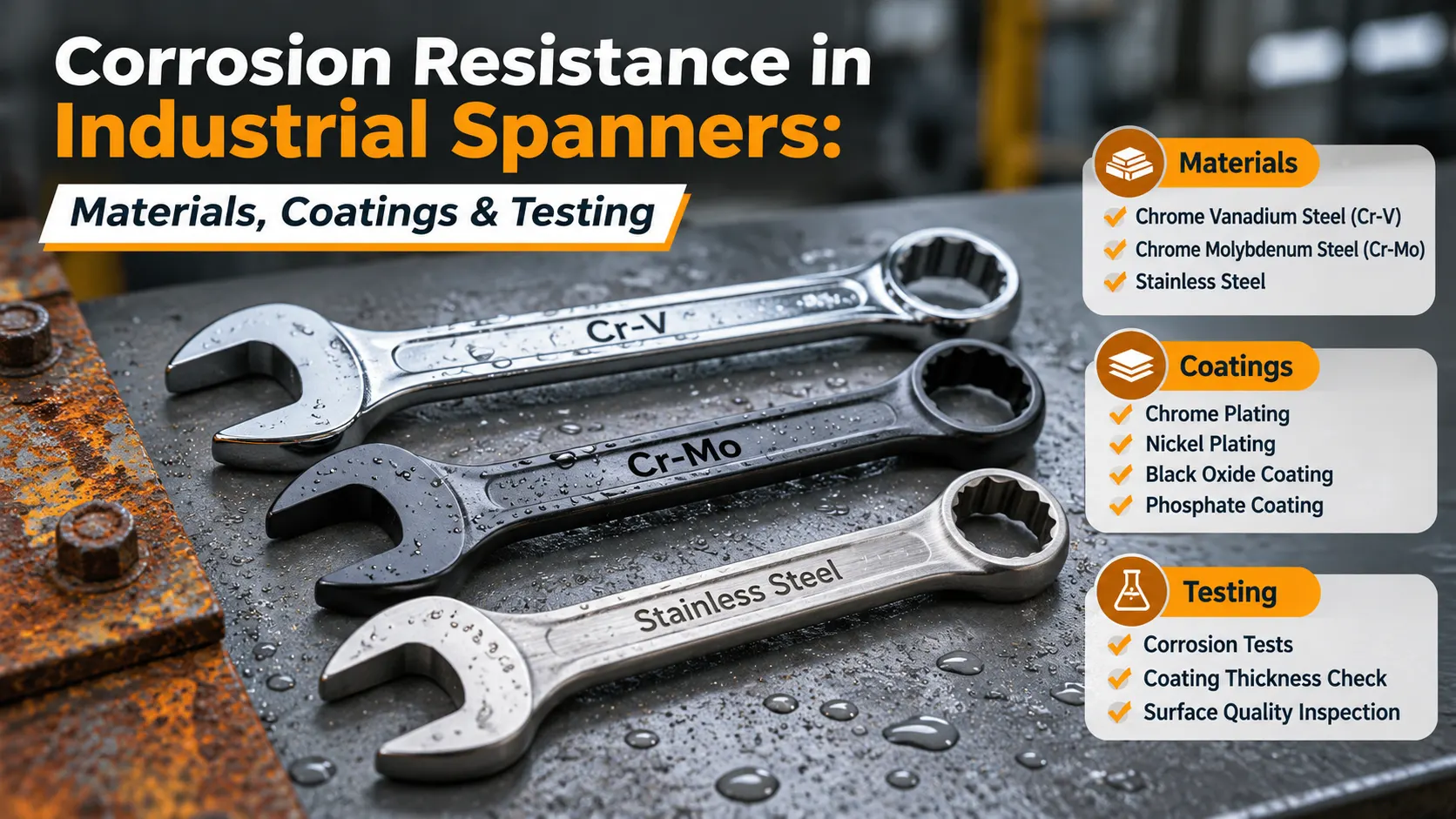
Material selection influences both mechanical performance and corrosion behaviour. Common materials include:
1. Chrome Vanadium Steel (Cr-V)
Chrome vanadium steel is widely used in industrial spanners because of its strength, hardness and wear resistance. It is suitable for tools designed to withstand repeated mechanical loads. However, conventional Cr-V steel is not rust-proof and generally requires a suitable protective finish to resist moisture and corrosion.
2. Chrome Molybdenum Steel (Cr-Mo)
Chrome molybdenum steel offers high strength and toughness, making it suitable for demanding applications requiring substantial mechanical performance. Its alloy composition supports these properties, but it does not automatically provide corrosion protection. Surface treatment remains important when the tool is exposed to moisture or corrosive environments.
3. Stainless Steel
Stainless steel contains chromium, which forms a passive oxide layer that helps protect the surface against corrosion. Its suitability depends on the stainless steel grade, environmental exposure and mechanical requirements. Buyers should verify strength and hardness specifications before selecting stainless steel spanners for demanding applications.
Which Coatings Improve Corrosion Resistance in Industrial Spanners?
Protective coatings and surface treatments help reduce the exposure of the base metal to corrosive elements. Common options include:
1. Chrome Plating
Chrome plating deposits a chromium layer onto the spanner through an electroplating process. It provides a durable, polished finish and helps protect the underlying steel against corrosion. Performance depends on coating thickness, adhesion, surface preparation and coverage.
2. Nickel Plating
Nickel plating creates a protective metallic barrier that helps limit corrosion. It can also serve as an underlayer in nickel-chromium coating systems. Uniform deposition and proper adhesion are essential for consistent coating performance.
3. Black Oxide Coating
Black oxide is a chemical conversion treatment that forms a thin magnetite layer on steel. It provides a dark finish and limited corrosion protection. Additional oil or another suitable protective treatment is generally necessary to improve moisture resistance.
4. Phosphate Coating
Phosphate coating forms a conversion layer on the metal surface through a chemical treatment process. It provides a suitable base for supplementary protective finishes, including oil and paint. Its corrosion performance depends on the process and additional protection applied.
| Surface treatment | Main function | Important consideration |
| Chrome plating | Protective metallic finish | Coverage and coating adhesion |
| Nickel plating | Corrosion barrier | Deposition uniformity |
| Black oxide | Surface conversion | Requires supplementary protection |
| Phosphate coating | Surface conversion | Usually needs additional protection |
What Factors Affect Corrosion Resistance in Industrial Spanners?
Even when two spanners use the same material and coating, their corrosion performance can differ because of manufacturing and operating conditions.
The main factors include:
- Material composition: Steel grade and alloy composition influence corrosion behaviour.
- Surface preparation: Cleaning and removing contaminants before coating improves coating adhesion.
- Coating thickness: Inadequate or inconsistent thickness can leave areas insufficiently protected.
- Coating coverage: Edges, corners and recessed surfaces need particular attention because incomplete coverage can expose the base metal.
- Coating adhesion: Poor adhesion can cause peeling or flaking during handling and use.
- Operating environment: Humidity, salt, chemicals and moisture exposure influence corrosion risk.
- Surface damage: Scratches and abrasion can break the protective layer and expose the underlying steel.
For manufacturers, controlling surface preparation, coating application and inspection is essential to maintaining consistent quality across production batches.
How Is Corrosion Resistance Tested in Industrial Spanners?
Manufacturers and quality teams use testing and inspection procedures to evaluate protective finishes.
1. Salt Spray Testing
Salt spray testing evaluates the corrosion behaviour of metallic materials and protective coatings under controlled conditions. ISO 9227:2022 specifies three methods:
- Neutral Salt Spray (NSS): Uses a neutral salt solution to assess corrosion resistance.
- Acetic Acid Salt Spray (AASS): Uses an acidified salt solution for evaluating certain coating systems.
- Copper-Accelerated Acetic Acid Salt Spray (CASS): Uses an accelerated test environment for specified metallic coating systems.
The test helps identify coating discontinuities, pores and visible corrosion. Exposure duration and acceptance criteria must be defined by the relevant product specification. Salt spray hours should not be treated as a direct prediction of actual service life.
2. Coating Thickness Measurement
Thickness measurement verifies whether the applied coating meets specified requirements. Depending on the coating and substrate, suitable measurement methods include magnetic or eddy-current techniques.
3. Visual Inspection
Visual checks help identify rust, pitting, peeling, scratches and incomplete coating coverage. Edges, corners and recessed areas deserve particular attention during inspection.
How to Choose Corrosion-Resistant Industrial Spanners for Different Applications
Industrial buyers should evaluate corrosion protection according to the actual working environment.
| Industrial application | Key selection considerations |
| Manufacturing facilities | Humidity, handling frequency and coating durability |
| Automotive workshops | Oils, cleaning agents and moisture |
| Marine operations | Salt exposure and prolonged moisture |
| Construction sites | Rain, outdoor exposure and surface abrasion |
| Chemical processing | Compatibility with specific chemicals |
For example, marine applications require careful evaluation of salt exposure, while chemical processing facilities need material and coating compatibility with the specific chemicals involved. A coating suitable for an indoor workshop may not provide adequate protection in either environment.
What Should B2B Buyers Check When Sourcing Industrial Spanners?
For industrial spanner procurement in India and international markets, buyers should evaluate technical specifications alongside manufacturing and supply capabilities.
Use this checklist:
- Base material: Verify the specified steel grade and material composition.
- Surface finish: Confirm coating type, thickness, adhesion and coverage requirements.
- Corrosion test reports: Request documented results against agreed testing criteria.
- Mechanical properties: Check hardness, torsional strength and dimensional accuracy.
- Manufacturing consistency: Evaluate production controls and batch inspection procedures.
- Quality documentation: Check material records, inspection reports and traceability.
- Bulk supply capability: Assess production capacity, customisation options and delivery requirements.
ISO 1711-1:2019 provides mechanical performance requirements for hand-operated wrenches and sockets, including hardness and torsional strength. It is relevant to mechanical quality assessment, not a corrosion-resistance certification.
For Indian distributors, OEMs and industrial procurement teams, working with manufacturers that can provide clear material specifications, coating details and verifiable quality documentation supports more informed sourcing decisions.
Conclusion
Corrosion resistance in industrial spanners depends on the right combination of steel grade, surface treatment, coating quality and application-specific testing. For industrial buyers, selecting a spanner should involve evaluating both corrosion protection and mechanical performance. Manufacturers that maintain controlled coating processes, consistent production standards and verifiable quality documentation are better positioned to meet the requirements of industrial distributors, OEMs and bulk procurement teams.
FAQs
1. Which material is best for corrosion-resistant industrial spanners?
Stainless steel generally offers better inherent corrosion resistance than conventional chrome vanadium steel. However, the best choice depends on the required strength, hardness, application and environmental exposure.
2. Does chrome plating prevent rust on industrial spanners?
Chrome plating helps protect the underlying steel against corrosion by providing a protective surface layer. However, scratches, coating defects and incomplete coverage can expose the base metal to moisture.
3. Is chrome vanadium steel rust-proof?
No. Chrome-vanadium steel provides useful mechanical properties but is not inherently rust-proof. Appropriate surface treatments are generally needed to improve its corrosion resistance.
4. What is the salt spray test for industrial spanners?
It is a controlled laboratory test used to evaluate the corrosion behaviour of metals and protective coatings. ISO 9227 specifies NSS, AASS and CASS testing procedures.
5. How many hours of salt spray testing should an industrial spanner withstand?
There is no universal requirement for all industrial spanners. The exposure duration depends on the coating system, product specification, application and agreed acceptance criteria.
6. How can buyers check the corrosion resistance of industrial spanners?
Buyers should review material specifications, coating thickness, surface coverage, corrosion test reports and manufacturing inspection records. They should also evaluate mechanical properties and application suitability.
7. How should industrial spanners be stored to prevent rust?
Store spanners in a clean, dry and ventilated area. Remove moisture and contaminants after use, avoid prolonged exposure to corrosive substances and apply a suitable protective oil when required.