How Chrome Vanadium Spanners Are Manufactured
- What Are Chrome Vanadium Spanners Made Of?
- Chrome Vanadium Spanner Manufacturing Process at a Glance
- How Are Chrome Vanadium Spanners Manufactured?
- How Are Chrome Vanadium Spanners Finished?
- How Are Chrome Vanadium Spanners Quality Tested?
- Which Standards Apply to Chrome Vanadium Spanners in India?
- Why Is Drop Forging Used for Chrome Vanadium Spanners?
- What Determines the Quality of a Chrome Vanadium Spanner?
- Conclusion
- FAQs
Chrome vanadium spanners are manufactured by cutting Cr-V steel into blanks, heating and hot drop forging the blanks, trimming excess material, machining the working ends, heat treating, grinding, surface finishing, and inspecting the finished spanners. The exact process varies by spanner design, steel grade, production equipment, and applicable specification.
For B2B buyers, the manufacturing process matters because material consistency, forging accuracy, machining tolerances, heat treatment, and final inspection all affect the quality and performance of the finished spanner.
What Are Chrome Vanadium Spanners Made Of?
Chrome vanadium spanners are made from chrome vanadium (Cr-V) alloy steel. The exact grade depends on the manufacturer and product specification. For example, 31CrV3/1.2208 is one chrome-vanadium grade used for spanner production.
Cr-V steel is suitable for forged hand tools because its composition and heat-treatment response can provide the combination of strength, hardness, and toughness required for service.
The material grade should therefore be specified and verified according to the applicable product or customer requirement rather than assuming that every chrome vanadium spanner uses the same steel grade.
Chrome Vanadium Spanner Manufacturing Process at a Glance
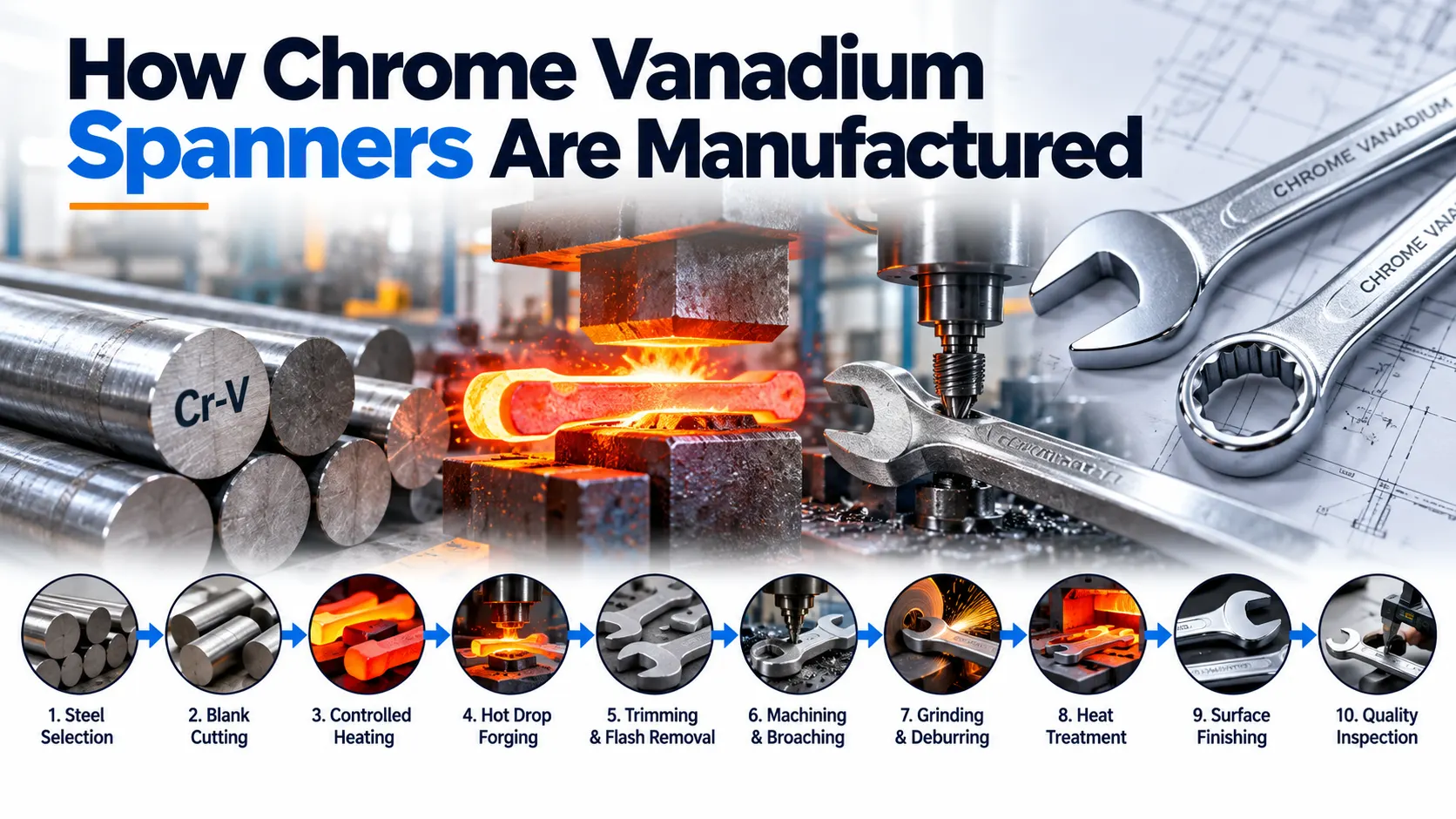
The typical manufacturing sequence is:
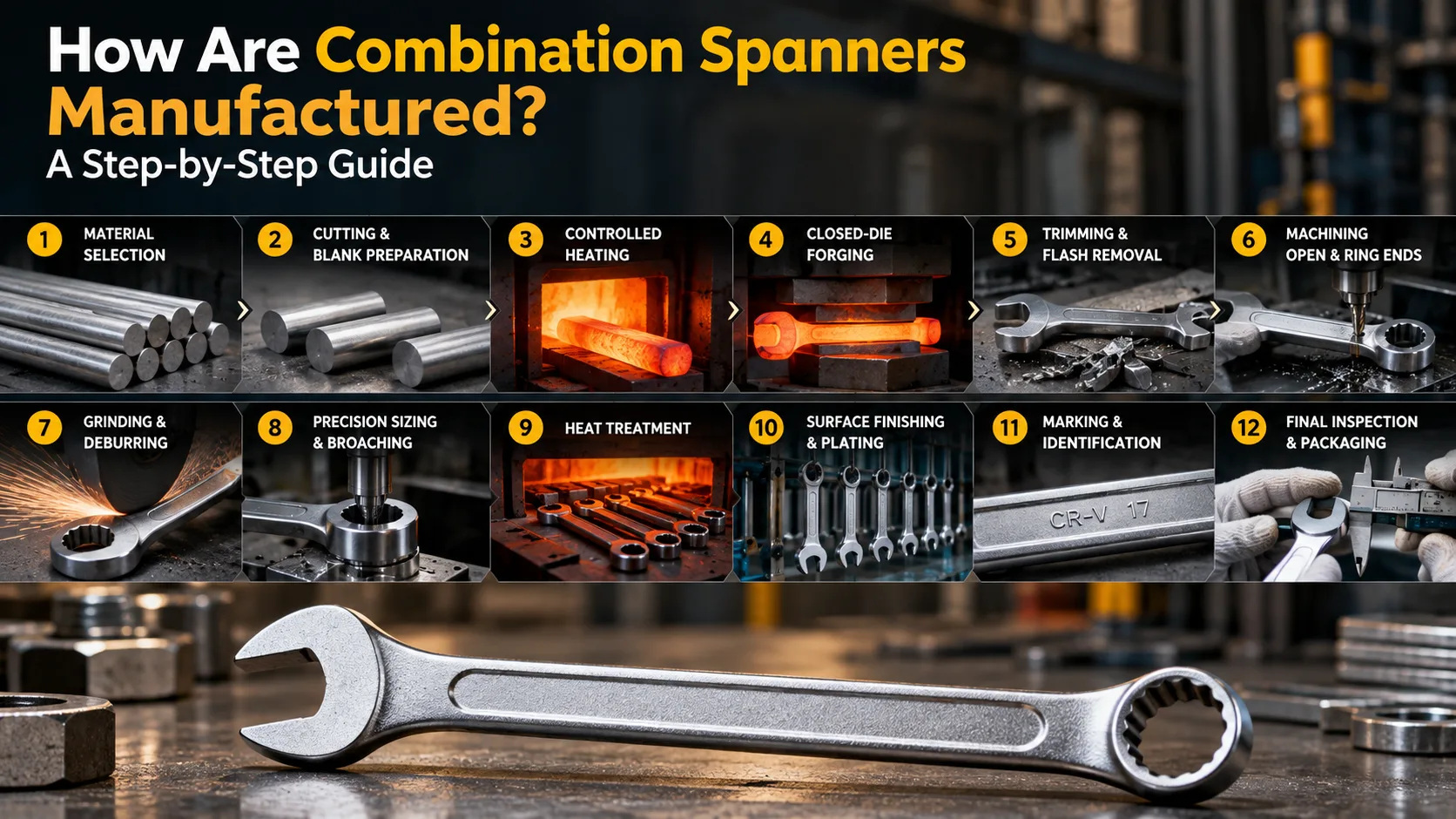
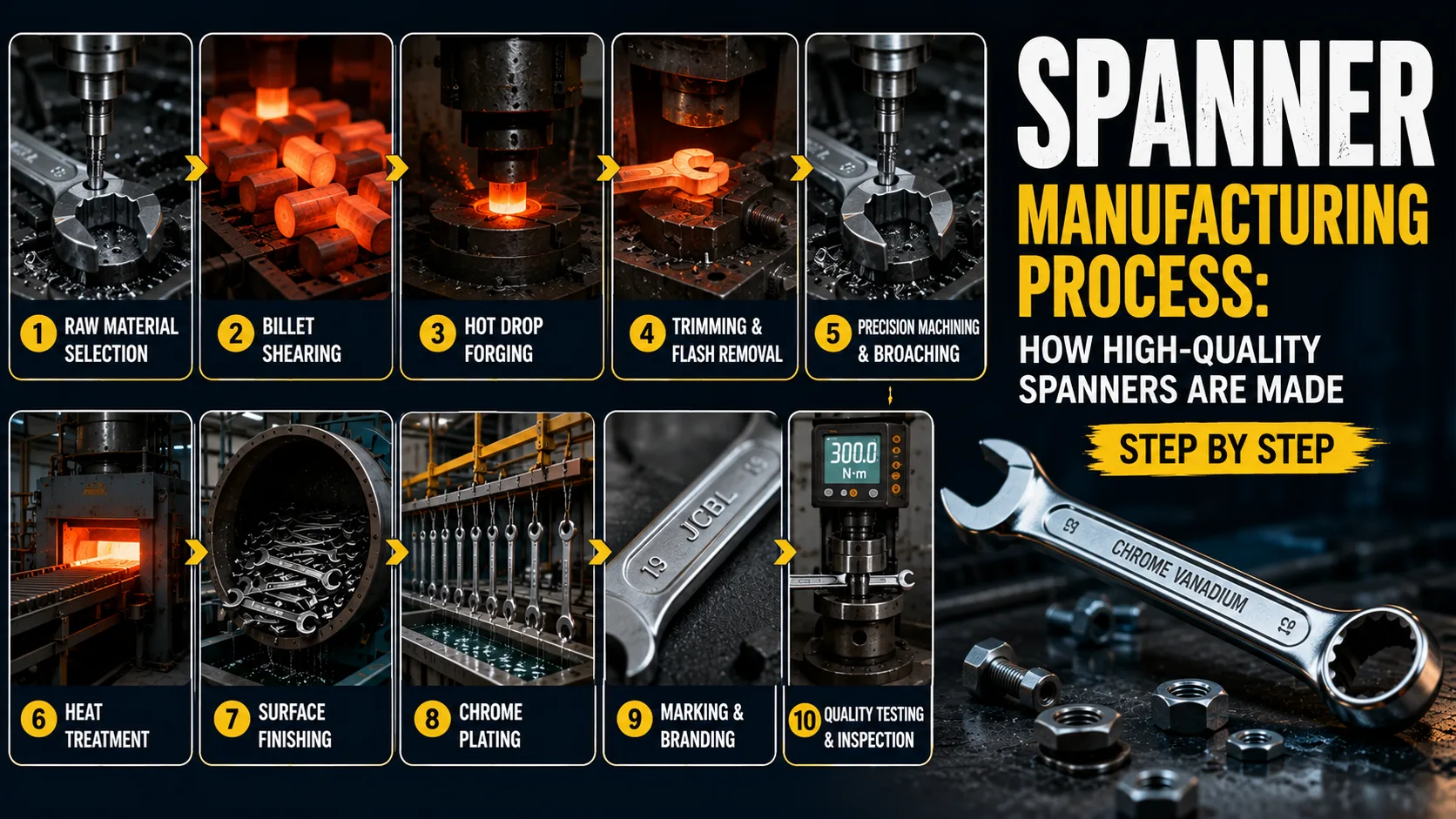
Steel selection → Blank cutting → Controlled heating → Hot drop forging → Flash trimming → Machining and broaching → Grinding and deburring → Hardening and tempering → Surface finishing → Quality inspection
In simple terms, forging creates the basic shape of the spanner, while subsequent machining produces the precise working profiles and dimensions.
How Are Chrome Vanadium Spanners Manufactured?
1. Steel Selection and Inspection
Manufacturing starts with chrome vanadium steel in suitable stock form, such as bars or billets.
Before forging, the incoming material may be checked for:
- Steel grade and chemical composition
- Dimensions
- Surface condition
- Heat or batch identification
- Material traceability
Consistent raw material is important because variations in steel composition and condition can affect forging behavior and heat-treatment results.
2. Cutting the Steel Blank
The steel stock is cut into individual blanks based on the required spanner design.
Blank dimensions and weight are selected so that sufficient material is available to fill the forging die. An incorrectly sized blank can contribute to incomplete die filling or excessive forging flash.
This makes blank preparation an important process-control stage before forging.
3. Controlled Heating
The cut blank is heated to a controlled temperature suitable for hot forging.
Heating makes the steel sufficiently plastic to flow into the die during forging. Uniform heating is important for consistent material flow and predictable forging results.
The appropriate forging temperature depends on the specific Cr-V steel grade and manufacturing process, so there is no single temperature that applies to every chrome vanadium spanner.
4. Hot Drop Forging
The heated blank is placed between shaped dies and subjected to high forging forces.
During hot drop forging, the steel flows into the die cavity and takes the basic shape of the spanner, including its handle and head.
The forging dies determine much of the component’s geometry. Die accuracy, forging temperature, material condition, and process control therefore influence dimensional consistency.
Hot forging is particularly suitable for producing large quantities of forged hand tools with repeatable shapes.
5. Trimming and Flash Removal
During forging, excess material can extend beyond the die cavity. This excess material is called flash.
A trimming operation removes the flash and brings the forged component closer to its intended dimensions.
The trimmed forging is then ready for machining and other downstream operations.
6. Machining and Broaching
Forging establishes the basic geometry, but the working ends require more precise machining.
Depending on the spanner design, operations may include:
- Punching the ring opening
- Broaching the ring profile
- Machining or broaching the open jaw
- Sizing or calibration
- Profile finishing
These operations establish the required dimensions and contact geometry at the working end.
For example, industrial spanner manufacturing processes can include hole punching and broaching of ring and jaw profiles.
The exact machining sequence depends on whether the product is an open-end, ring, combination, or another spanner type.
7. Grinding and Deburring
After machining, the spanner is ground to improve its surface condition and remove unwanted material.
Deburring removes sharp edges and burrs generated during forging and machining. Vibratory finishing or similar processes may also be used.
Grinding and deburring must be controlled so that surface defects are removed without affecting critical working dimensions.
8. Heat Treatment
Heat treatment develops the mechanical properties required for the finished spanner.
A typical hardening cycle involves:
Heating → hardening/quenching → tempering
Hardening increases the steel’s hardness and strength, while tempering adjusts the hardened structure to obtain the required balance of hardness and toughness.
The actual heat-treatment parameters depend on the Cr-V steel grade and product specification. Therefore, a single hardness value or heat-treatment temperature should not be presented as universal for all chrome vanadium spanners.
Controlled heat treatment is followed by hardness verification where required. Established spanner manufacturing processes include hardening and tempering before final surface treatment.
How Are Chrome Vanadium Spanners Finished?
After heat treatment, the spanner undergoes surface finishing according to the product specification.
Typical finishing operations include:
- Grinding
- Polishing
- Blasting
- Vibratory finishing
- Nickel plating
- Chrome plating
Surface finishing improves the appearance and surface condition of the tool and, depending on the coating system, can provide additional corrosion protection.
The selected finish depends on the manufacturer’s process and the buyer’s specification.
How Are Chrome Vanadium Spanners Quality Tested?
Quality inspection verifies that the finished spanner meets the required dimensional, mechanical, and workmanship requirements.
Typical checks can include:
| Quality Check | What It Verifies |
| Dimensional inspection | Critical sizes and tolerances |
| Hardness testing | Heat-treatment results |
| Torque testing | Ability to withstand specified torque |
| Workmanship inspection | Cracks, burrs, defects, and surface condition |
| Material verification | Correct steel grade and composition |
| Finish inspection | Surface quality and coating condition |
The applicable tests depend on the spanner type, product standard, customer drawing, and market requirements.
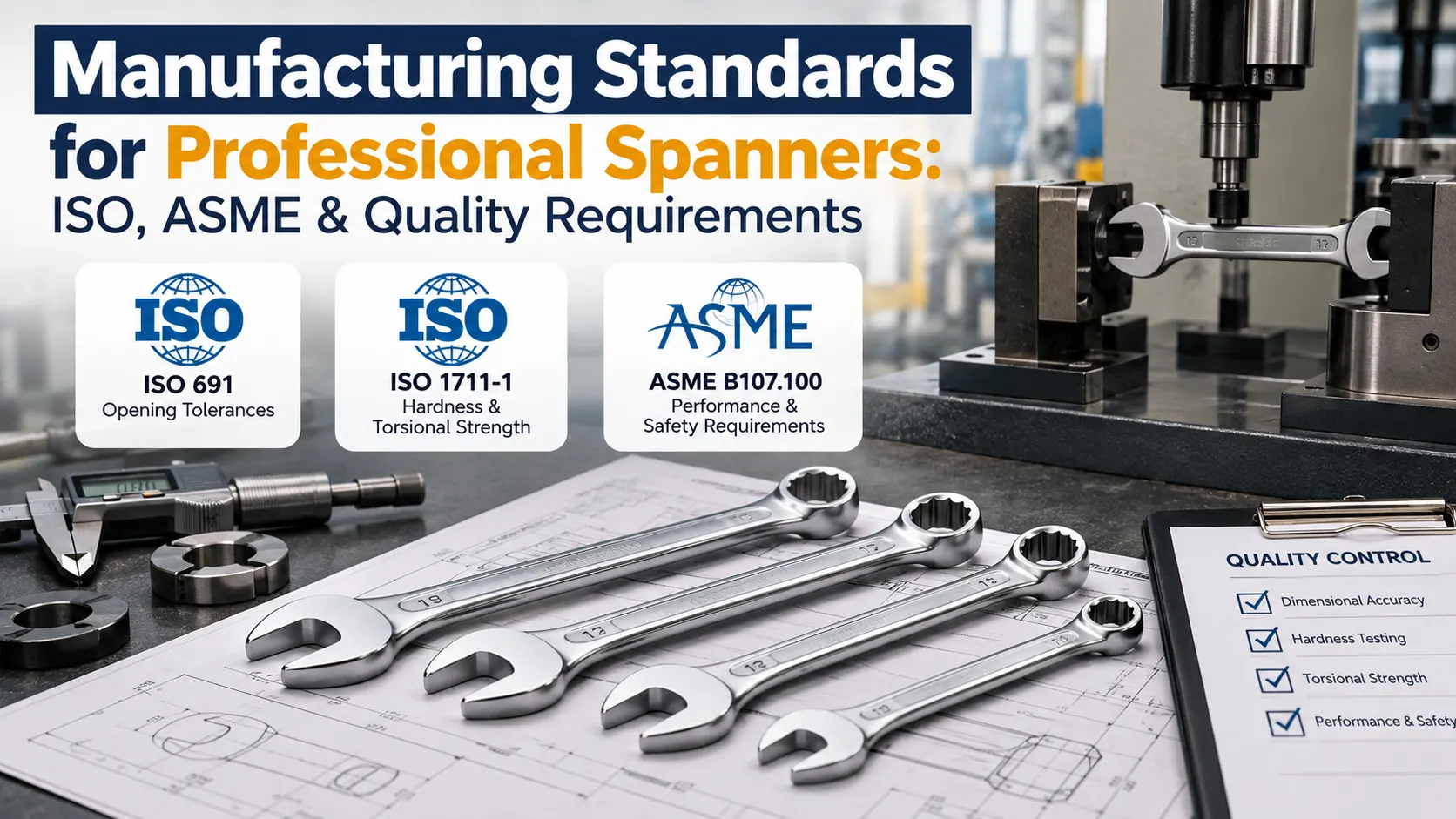
For example, IS 2028 covers forged open-jaw spanners in India and includes requirements relating to dimensions, material, hardness, workmanship, finish, and torque. IS 2029 covers forged double-ended ring wrenches.
Manufacturers and buyers should identify the relevant standard for the specific spanner type rather than applying one BIS standard to every spanner.
Which Standards Apply to Chrome Vanadium Spanners in India?
There is no single BIS standard that applies to every type of spanner.
The applicable standard depends on the product category and specification. For example:
- IS 2028: Forged open-jaw spanners
- IS 2029: Forged double-ended ring wrenches
A manufacturer or buyer should first identify the exact spanner type and then determine the applicable BIS standard, customer specification, or international requirement.
This helps define the required dimensions, material, hardness, torque performance, workmanship, finish, marking, and inspection criteria.
Why Is Drop Forging Used for Chrome Vanadium Spanners?
Drop forging is used because it efficiently forms the basic geometry of a spanner while the heated steel is sufficiently plastic to flow into the die.
For manufacturers, the process is suitable for repeatable, high-volume production of forged hand tools.
However, forging alone does not determine the quality of the finished spanner. Steel quality, die accuracy, machining, heat treatment, finishing, and inspection must all be controlled to achieve the required product specification.
What Determines the Quality of a Chrome Vanadium Spanner?
For B2B procurement, the main manufacturing factors are:
- Consistent Cr-V steel grade
- Accurate forging dies and controlled forging
- Correct working-end dimensions
- Controlled hardening and tempering
- Consistent surface finishing
- Documented dimensional, hardness, and torque inspection
A reliable chrome vanadium spanner is therefore the result of controlling the complete manufacturing process, not simply selecting a steel described as chrome vanadium.
Conclusion
Chrome vanadium spanner manufacturing is a controlled process that combines Cr-V steel selection, blank cutting, hot drop forging, precision machining, heat treatment, surface finishing, and quality inspection. For B2B buyers, evaluating these production and quality-control stages provides a more meaningful assessment of spanner consistency and performance than relying on the chrome vanadium designation alone.
FAQs
Many professional chrome vanadium spanners are manufactured using hot drop forging, although the exact process depends on the spanner design and manufacturer’s production method.
Chrome vanadium alloy steel is commonly used. The exact grade varies by manufacturer and specification; 31CrV3 is one example used in spanner manufacturing.
Heat treatment develops the required combination of hardness, strength, and toughness in the finished tool.
The forging is typically trimmed, machined or broached, ground and deburred, heat treated, surface finished, and inspected.
Depending on the specification, testing can include dimensional inspection, hardness testing, torque testing, material verification, and workmanship and finish inspection.
The applicable BIS standard depends on the spanner type. For example, IS 2028 covers forged open-jaw spanners, while IS 2029 covers forged double-ended ring wrenches.